
Walt Dickerson
Peace...

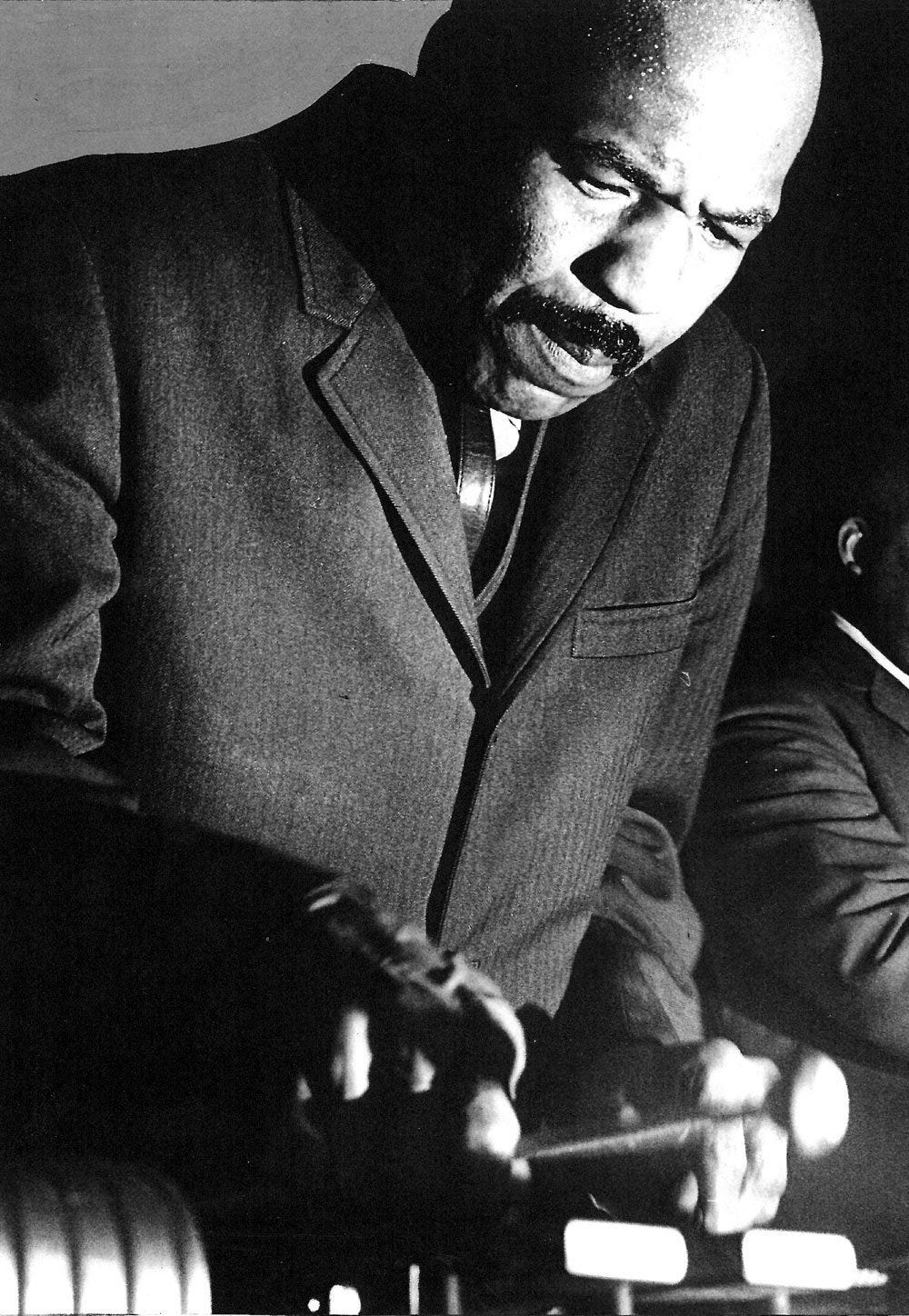
First of all, my music has always been considered spiritual and even more so as time has passed. Realizing where it comes from and giving the glory to the source allows me growth in the music sphere over and above the academics of the music.
-Walt Dickerson
Today’s journey is a companion piece to last week’s Sun Ra solo piano exploration, which you can read here:
On that journey, I also wrote about the masterpiece Visions, Walt Dickerson’s 1979 duo album with Sun Ra. Over a decade earlier, they recorded together for the first time.
In 1965, at MGM Studios in New York City, Dickerson’s vibes and Sun Ra’s keyboards were supported by bass and drums on another excellent album, Impressions of a Patch of Blue:
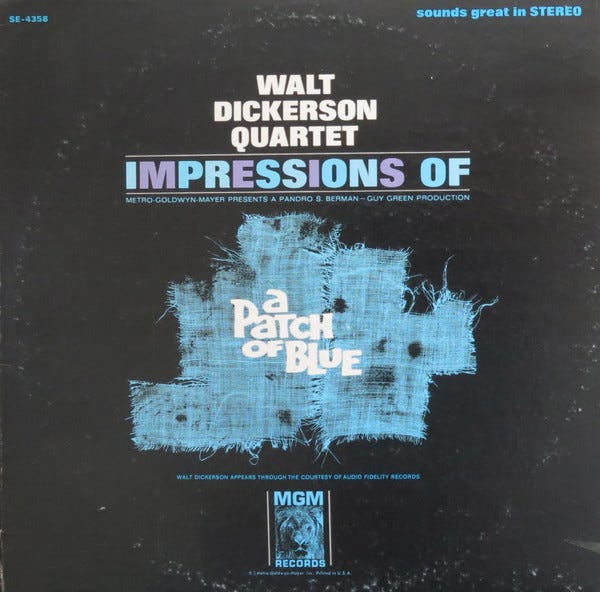
Impressions of a Patch of Blue is based on the 1965 film A Patch of Blue. It is an extraordinary film that was nominated for five Academy Awards:
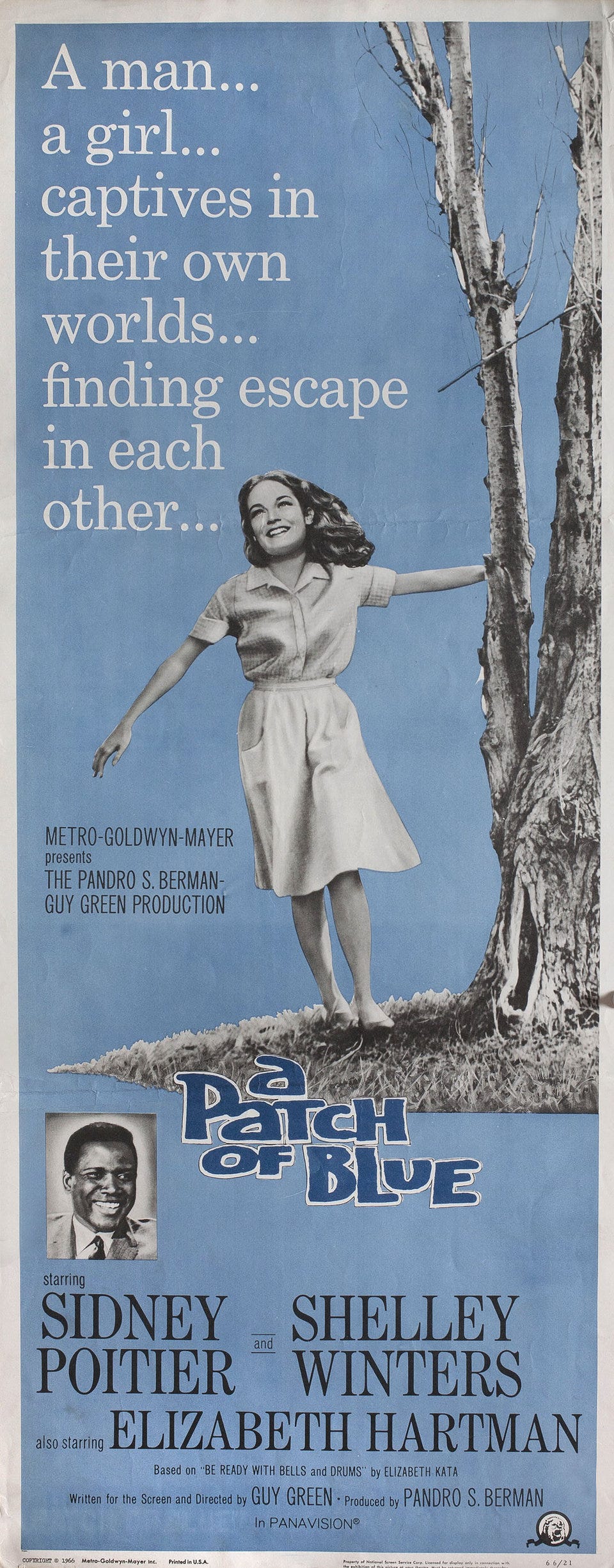
Adapted from the 1961 book Be Ready with Bells and Drums by Australian author Elizabeth Kata, the film, directed and written by Guy Green, is about the friendship between an educated black man and an illiterate, poor, blind white 18-year-old girl. Incidentally, it was produced by Pandro S. Berman, who produced six Fred Astaire and Ginger Rogers films.
Jerry Goldsmith’s Oscar-nominated score remains a classic 1960s film score and one of the composer’s pivotal works, which you can hear here.
I liked the score, in particular, for the wonderfully sparse use of the harmonica throughout, which was played by perhaps the most famous Hollywood studio harmonica player, Tommy Morgan. You can hear him stretch out just a little on the song Friends:
As you watch and listen to the film, it’s not difficult to understand why Dickerson may have decided to record his impressions of it. First, at times, Goldsmith’s score sounds as if a vibraphone is playing. It has that same ethereal sound that Dickerson captures in his recordings. Second, this is an amazing and deep film, which deals with a very important theme. It’s inspiring. From Impressions of a Patch of Blue, here is Alone in the Park - Part 2, with Sun Ra playing both harpsichord and piano:
I’m pretty sure I first heard the vibes when I was discovering my brother’s album collection, which he left behind when he joined the Navy in the spring of 1977. In a collection of rock albums, he had one jazz album: Herbie Mann’s Et Tu Flute, a double-album compilation released in 1973. I remember that this song from the album turned me onto the vibes, Autumn Leaves, with Johnny Rae on vibes:
Shortly after discovering and listening to Et Tu Flute, I bribed my older brother to take me to a nearby record store. I wanted to find some more albums like that one.
I was too young to drive, so I asked him, “You fly, I buy?” Off we went. While looking through records, I came across two albums, Dewey Redman’s Ear of the Behearer (which we’ll get to next week) and Walt Dickerson’s Peace. I bought them based on the covers alone. When I saw Peace, I thought, "Hey, this guy is playing the vibes!”
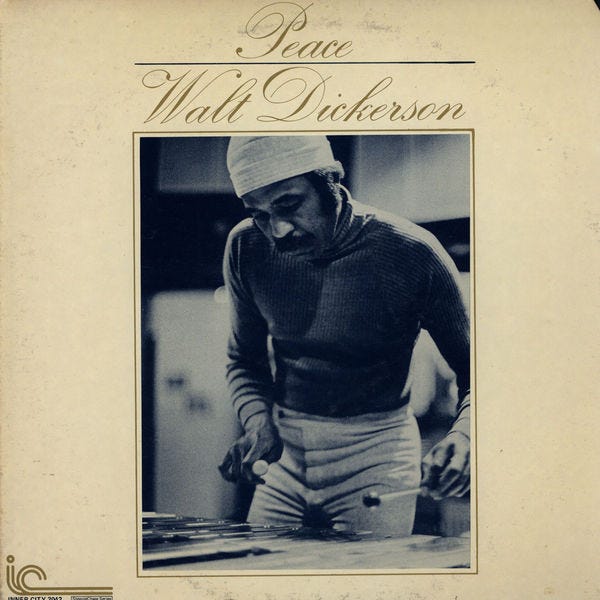
When I got home and played Peace, I was shocked and thought, “What in the world is this? This is nothing like Herbie Mann.” I put it away and never played it again, until probably 20 years later. In 1977, I was just a kid, and Peace was operating on a different level. It would take many years before I reached that level.
In 1995, Mike Johnston, bassist for the terrific Michigan group Northwoods Improvisers, conducted an excellent interview with Dickerson intended for Coda magazine. In the interview, Dickerson shares this about his music:
What this is about is in the supernatural realm. And that’s a different perspective, Mike. I’d describe it as a projection from the supernatural realm.
Peace is magical music, and I was nowhere near ready for a magic carpet ride back then
This week on that Big River called Jazz, we’ll dig in our paddles and discover the world of Walt Dickerson.
Walt Dickerson was born and grew up in Philadelphia. He spent a lot of time playing music with his childhood friend, pianist John Dennis, whom Dickerson cites, along with John Coltrane, as his biggest influence.
While growing up, he met Coltrane, and they played in the Jimmy Heath Big Band in the Philadelphia area. Around 1953, Dickerson joined the Army and served in the Seventh Army Symphony in Stuttgart, Germany. In 1955, while Dickerson was in Germany, his friend Dennis recorded an album on the Debut label. From the album, here is Variegations with Charles Mingus on bass and Max Roach on drums:
Dickerson also toured Stuttgart with his own quartet and, probably sometime in 1954, made his first recording on a radio broadcast for the Armed Forces Network. When he returned to the States, his friends, Coltrane and Philly Joe Jones, who were now in New York City, made some calls, and their recommendations opened the door for him to record for Prestige Records.
So, in early 1961, he went to New York City and, at Van Gelder Studio in Englewood Cliffs, New Jersey, recorded his first album, This Is Walt Dickerson!. The New Jazz label, a subsidiary of Prestige, released the album in 1961.
With this album, it became apparent that Dickerson was not cut from the same mold as established jazz vibraphonists Lionel Hampton and Milt Jackson. If any comparisons are worthy, perhaps Teddy Charles comes to mind. However, Dickerson was forging his own way, and that journey was only beginning.
According to Johnston:
Walt Dickerson had a very unique and singular approach on the vibraphone, an instrument rarely featured, even in jazz. He had a “plush sound” (his words) and even today remains one of the most distinguished voices on the instrument.
In an interview with Cadence magazine, Andrew Cyrille discussed the mallets Dickerson used, how he played at a quieter volume, and his concern with sound itself. Johnston asked him about this, and Dickerson gave a very enlightening answer:
Sound is so important, and it’s difficult for me discuss sound and omit execution too. The two are the same, if you understand what I’m saying. Each is an integral part of the other. My approach has always been to be physically close to the instrument, very close. This is different than the approach that is taught on the instrument. I was unable to play intricate things on the instrument with the commonly taught approach. The music that the creator sends me is not of a cosmetic nature;
This is interesting, and it supports why, after recording Jerome Kern’s Yesterdays and Cole Porter’s I Love You on his 1976 album Why Not, he quit playing standard tunes. From that point on, he pursued his own personal compositions until the final song of his final recording in February 1982 in Milan, when he recorded Gershwin’s It Ain’t Necessarily So on Life Rays for the Soul Note label. During this time, his music reflected a very personal, open, and distinct sound.
After Dickerson recorded four albums for New Jazz, the last To My Queen in September of 1962, Dickerson recorded the fantastic album Jazz Impressions of Lawrence of Arabia, released in the spring of 1963 on the Dauntless label. I think this record marked a turning point for Dickerson, having left behind standards, he focused on a more uninhibited approach to the music.
He told Johnston that it was, “An aspect of playing music that comes by way of another level in the music. These are often the kinds of things that get called magical.” For example, from the album Nefud Mirage, Part 2, has that magical feel:
By the way, the bass player on this song is the great Philadelphian, Henry Grimes, whom I wrote about here:

The other bassist on this album is Ahmed Abdul-Malik, who we’ll catch up with a little further down the river…
By the time of his next album, Walt Dickerson Plays Unity, released in 1963 on the Audio Fidelity label, Dickerson’s transition was nearly complete. As you can still hear on this track, he was not yet totally defiant of convention:
In 1965, when Dickerson and Sun Ra recorded Impressions of a Patch of Blue, the songs on the album ranged from fairly straight-ahead, like Eggs and Beacon, which sounds like it could have been written by Herbie Nichols, to the more far-out, ethereal song, High Hopes. But after Impressions of a Patch of Blue, Dickerson’s transition was completed, and he never looked back. However, for some reason, he did not record again for nearly a decade, when he recorded the seminal Peace in 1975 by SteepleChase Records.
Dickerson’s Peace is a landmark album that completely transformed the possibilities of jazz vibes. It was the first of several albums he released between 1975 and 1978 with SteepleChase, a jazz record company and label based in Copenhagen, Denmark, founded in 1972 by Nils Winther, who was a student at Copenhagen University at the time. Dickerson is joined on Peace by Lisle Atkinson on bass and Andrew Cyrille on percussion. From that album, here is Universal Peace:
When I think about my jazz journey, I do not think it was strictly by coincidence that, of all the possible albums I happened to grab at the used record store in 1977, Peace is the one I chose. That album, along with his two duet albums, Divine Gemini with Richard Davis in 1977 and Visions with Sun Ra in 1978, played an important part in shaping my jazz journey.
In fact, I find Dickerson’s work in the duo format to be some of his best. As already mentioned, Visions with Sun Ra is a masterpiece. Another masterpiece, Divine Gemini, was recorded in July 1977 at C.I. Recording Studio in New York City. You need only listen to the title track and prepare for an incredibly sensitive and intimate musical journey:
In September 1978, Dickerson recorded another amazing duo recording, Landscape With Open Door, with Danish avant-garde jazz guitarist Pierre Dørge at Sweet Silence Studios in Copenhagen, Denmark. The SteepleChase label released it in 1979. From that album, here is Dørge’s song Tribute to Master Tchicai:
As I said last week, I have always been fascinated by the duo format. The back-and-forth sharing of two individuals reflects a very human quality, like an intimate conversation. It is perhaps the purist form of direct musical communication. And for Dickerson, the important thing is not the instrument, but the person with whom he’s playing. They need to be able to play in the “other realm,” that supernatural realm.
Here’s one more for the road. In January 1980, Walt Dickerson and Sun Ra played together again at Haverford College. This time, Sun Ra was playing a Rhodes piano. Here’s Dickerson and Sun Ra playing an encore duet:
When I look back over Dickerson’s work, I think back to a quote from the liner notes for the CD reissue of Divine Gemini, where Dickerson shared:
Also my music now is in the realm of dealing with aspects of understanding and accepting spiritual life forces. It’s opened up a sphere of musical possibilities whereby my musical improvisational projections come from another dimension.
Dickerson’s music is not for prancing. This is mystical music and requires deep listening.
In February 1982, Dickerson recorded his last album, Life Rays, which was released that same year by the Italian label Soul Note. His last track was the Gershwin song It Ain't Necessarily So. After that recording, he had performed sporadically around his native Philadelphia and in Europe, mostly in solo performances. Walt Dickerson passed away on May 15, 2008. He was 80 years old.
Late in his career, Dickerson was all about positive energy. So as we leave our journey today, let’s pay homage to Walt Dickerson and take a magic carpet ride on this wonderful song, Always Positive:
Next week on that Big River called Jazz, we’ll dig our paddles into the waters of Dewey Redman.
Please hit this link to buy me a cup of coffee if you’d like to show your guide some appreciation for this and past journeys. I thank you in advance for your kindness and support.
If you like what you’ve been reading and hearing so far on our journey and would like to share this with someone you think might be interested in learning more about our great American art form, Jazz, just hit the “Share” button.
From Astaire to Sun Ra: A Jazz Journey is a reader-supported publication. If you feel so inclined, subscribe to my journey by hitting the “Subscribe now” button.
Feel free to contact me anytime to talk shop. I welcome and encourage that.
Until then, keep on walking….
He is a longtime favorite of mine as well, excellent overview.
Can't believe I never noticed this guy and his music before. Thanks so much for introducing him to me!