
Peter Brötzmann in Chicago
Blowing into the windy city...

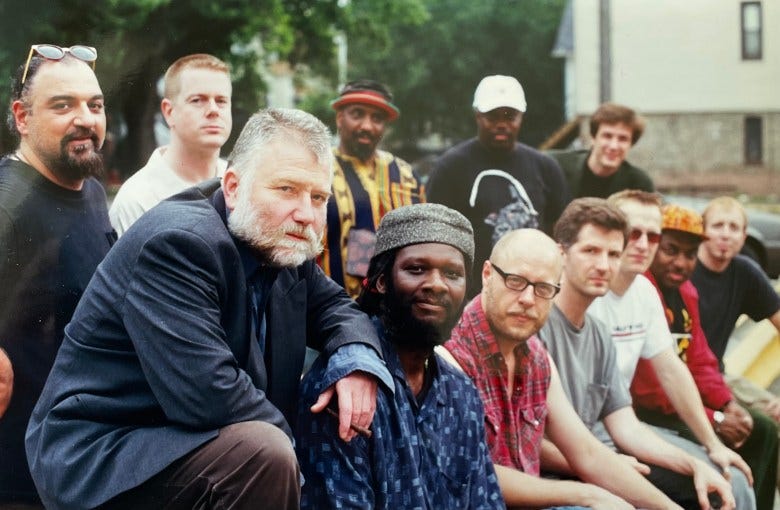
Free Jazz, I never liked that. That word. Because it always gave reasons for a lot of misunderstandings. There is not the type of freedom that many people from the very beginning thought - that you could do what you want. Of course you can’t. Because if you are on stage together, you want to build up something together.
-Peter Brötzmann
My entry into Chicago’s Free Jazz, or better, improvised music scene took place in the spring of 1993, when I met Ken Vandermark at a most unlikely place.
I had recently moved to Chicago from California and was completely in the dark about the local jazz scene. I read about a Birthday Party for Nelson Algren in downtown Chicago at a place called the Bop Shop. Now, I knew that Algren had passed away in the 1980s, so I decided to see what it was all about. Evidently, every year the Nelson Algren Committee celebrates the author’s birthday at some local Chicago establishment. That year, it was at the Bop Shop.
When I got there, I was by far the only young person. After a while, I noticed another young guy in the back. I walked up to him and struck up a conversation. His name was Ken Vandermark. He’d recently moved to Chicago from Boston and was also a Nelson Algren fan. After a few minutes, he told me that he had to go, and then I noticed him playing sax on the bandstand.
The band was Vandermark’s trio format with Kent Kessler on bass and Michael Zerang on drums. I’m not sure, but I think this was before he formed his DKV Trio with Hamid Drake on drums. Most likely from around the time he released Big Head Eddie in 1993 on the short-lived Platypus Records label. Anyway, Vandermark’s trio was the first jazz I’d heard in the city, and they were awesome. After he finished, we talked a little bit more, and he invited me to his show at a place called the Velvet Lounge. I went to the show, and that night he played alongside Chicago legend Fred Anderson. I wrote about Anderson here.
I continued to follow Vandermark’s success in Chicago, and years later, there was a lot of buzz on the north side that he had convinced the German saxophonist Peter Brötzmann to come to Chicago to form a group.
Brötzmann was a landmark figure in improvised music, who first performed in the city in the late 1980s in small-ensemble settings, duos, and trios, often with drummer Hamid Drake. I wrote a tribute to Brötzmann here:

In 1996, when Brötzmann returned to Chicago, he formed his legendary Chicago Octet and Tentet, an all-star band that performed consistently around the world for more than 15 years. I was lucky enough to be at one of their first performances at the Empty Bottle, a club on North Western Avenue, which had established itself a few years earlier as a go-to rock club.
When I saw Peter Brötzmann’s Tentet that night at the Empty Bottle, the earth shook. Although in the late 1980s and early 1990s, at the North Sea Jazz festivals, I had heard some heavy music by Willem Breuker’s Kollektief and John Zorn’s Speedfreak, which was stunning and very new to me, that night at the Empty Bottle, I was faced with music altogether different than anything I had ever heard before.
This week on that Big River called Jazz, we’ll dig in our paddles and discover the world of Peter Brötzmann’s Chicago Tentet.
Peter Brötzmann is best known as one of the preeminent figures in contemporary improvised music. He was also trained as a visual artist in his hometown of Wuppertal, Germany, in the late 1950s. His early musical career as a saxophonist and clarinetist was paralleled by his first art exhibitions in the Netherlands and Germany. He assisted South Korean visual artist Nam June Paik on Exposition of Music-Electronic Television, Paik’s first installation at Wuppertal’s Galerie Parnass in 1963, and he participated in Fluxus events throughout the mid-1960s.
I think the first time Chicago’s wonderful Corbett vs. Dempsey (CvsD) gallery displayed Brötzmann’s art was from February to December 2005 at the Eye & Ear Musician/Artist exhibition, which featured, along with Brötzmann's works, works by musician-artists Pee Wee Russell, Han Bennink, Sun Ra, Fred Lonberg-Holm, Terry Nilssen-Love, and Anthony Braxton, among many others.
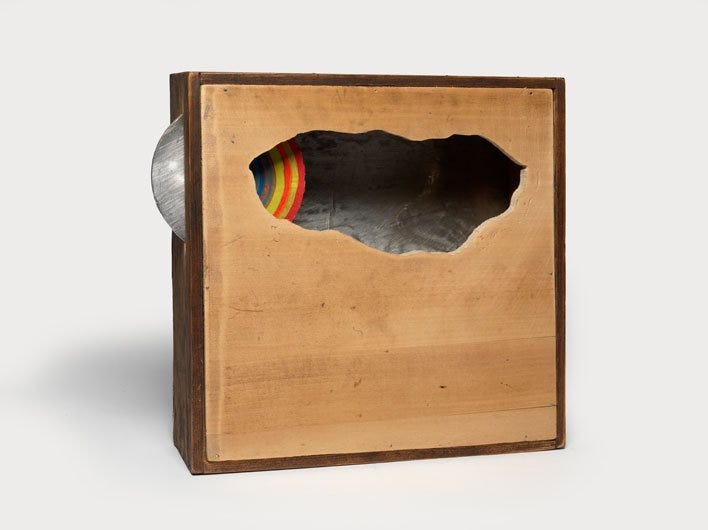
Over the years, CvsD presented many more exhibitions of Brötzmann’s art, including solo showings such as Peter Brötzmann Left / Right, on view from July to August 2013. From that exhibition, here is Brötzmann’s 2013 Untitled (cloud), a 12 1/2 x 14 x 3 3/4 inches wooden box construction with shaped wood and shaped and painted metal:
A 1995 visit by a group of European musicians from the Free Music Production (FMP) label prompted John Corbett to arrange for Brötzmann to return in 1997 to perform and record with seven of the finest improvisers working in Chicago. The results were so positive that seven months later, Brötzmann returned to work in an expanded format. Brötzmann’s visit was a critical historical event, similar to Cecil Taylor’s month-long residency in West Berlin during the summer of 1988, which was documented in the 10-CD box set Cecil Taylor – In Berlin ‘88, released by FMP in 1989.
Earlier in 1996, Vandermark and Corbett launched Chicago’s Empty Bottle Jazz & Improvised Music Series, which would run most Wednesday nights until 2005. It was cut from the same cloth as Berlin’s Total Music Meeting, which ran annually from 1968 to 2008, of which Brötzmann was an integral part. So it was fitting that he found a home in the Windy City.
Corbett recalls, “I don’t think anyone thought of it as an important series yet. For us, this was an outgrowth of all sorts of activities that we were doing in such a huge number of different places.” To document the series, CvsD recently released The Bottle Tapes: Selections from the Empty Bottle Jazz & Improvised Music Series, 1996-2005, a 6-CD box set.
The Peter Brötzmann Chicago Tentet's first recording was the 3-CD box set titled The Chicago Octet/Tentet – 1 / 2 / 3, released in 1998 by Okka Disk, an independent American jazz record company and label founded in 1994 in Chicago by Bruno Johnson.
The release features one disc by the octet and two discs by the expanded 10-piece lineup.
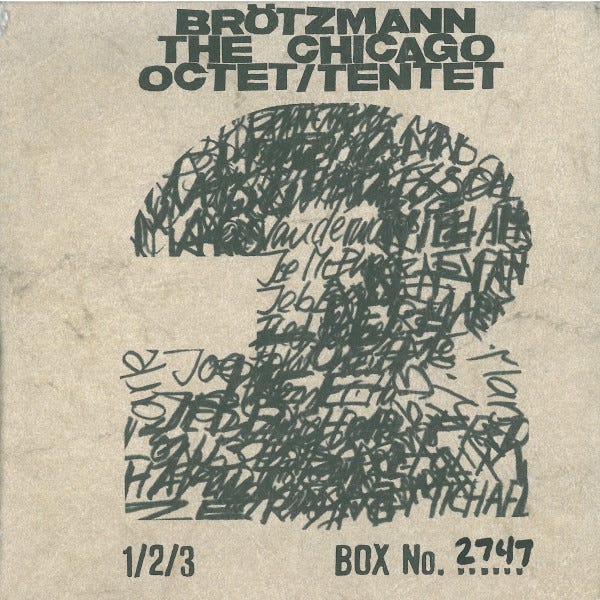
From the release, here is the tentet performing Vandermark’s composition Other Brothers, recorded live at Chicago’s AirWave studio on September 16, 1997:
Here they are the next day performing Michael Zerang’s composition Aziz, recorded live at the Empty Bottle on September 17, 1997:
Brötzmann’s Tentet went on to record many more fine albums. However, by 2012, the tentet was beginning to run its course. While in Tokyo in November 2012, Brötzmann reflected on 14 years with the Chicago Tentet:
14 years… The Chicago Tentet
That’s a long time for a 10/11 piece band. Time to say goodbye? Time to stop? For sure time to think about the future!
There are a couple of reasons why I decided to stop it, at least for the moment. The first one is the everlasting critical economic situation, actually with no expectation for better times – we Germans and Americans can’t count on support from our cultural departments.
The second, much more important, is the music. Hanging together for such a long time – with just a couple of small changes – automatically brings a lot of routine. In general nothing against, you need it sometimes to survive, but if it gets so far that one can’t exist without the other – music is over.
In 2011 with the weekends in London and Wuppertal we have reached the peak of what is possible in improvisation and communication with an immense input from all of us. For my taste it is better to stop on the peak and look around than gliding down in the mediocre fields of “nothing more to say” bands.
I love to work with larger ensembles and I won’t say, “That’s it,” but I need a bit of time to think about some changes, the financial situation is important and in a way the financial situation forms and builds sometimes the music. Who can afford to travel with a quintet nowadays, you see what I mean?
I think the next fall will answer the question about the future of a NEW tentet.
The tentet disbanded shortly after this. However, Brötzmann continued to perform and record many terrific albums; some of my favorites are his later duo albums, such as Sparrow Nights with pedal steel guitarist Heather Leigh, released in 2018 on the Austrian Trost label, and Front to Front with pianist Fred Van Hove, released in 2020 on the Belgian Dropa Disc label.
Peter Brötzmann’s last appearance in Chicago was on May 22, 2016. He performed with a quartet featuring double bassist John Edwards, drummer Steve Noble, and vibraphonist Jason Adasiewicz. It was the same group with whom he played his final concerts at London’s Cafe Oto in February 2023, just a few months before his passing on June 22, 2023, in Wuppertal, Germany.
Here’s one more for the road. Since that day we met at the Nelson Algren birthday party, Ken Vandermark has had an amazingly successful career and developed into a world-renowned avant-garde composer, improviser, saxophonist/clarinetist, curator, and writer. He continues to be a force in the Chicago music community.
In 2011 in Chicago, Vandermark, alongside a core group of improvising musicians that included Norwegian drummer Paal Nilssen-Love, Swedish saxophonist Mats Gustafsson, and German saxophonist Peter Brötzmann, started Catalytic Sound, a cooperative built from the ground up around the needs of musicians working at the forefront of free jazz, improvised music, and experimental sound. In May of 2014, he also organized Audiographic Records to chronicle specific aspects of his creative work not available through other outlets. Both endeavors are going strong today.
In October 2025, Vandermark released October Flowers for Joe McPhee, a solo record celebrating the legendary musician. The session was released by the Corbett vs. Dempsey label. For this live recording at the CvsD gallery, which McPhee attended, Vandermark composed six solo pieces, each named after a flower. This was a nod to something first expressed by Jackie McLean, who declared that rather than sending flowers to funerals, “give them their flowers while they’re here”.
From the album, here is Violets:
About the release, Vandermark wrote:
This recording has deep personal significance for me. Joe has been and remains a key source of inspiration, as a beautiful musician and as a beautiful human being. When CvsD gave me the opportunity to record compositions I first wrote to celebrate Joe at the book release of his memoir co-written with Mike Faloon, Straight Up, Without Wings: The Musical Flight of Joe McPhee in October of 2024, I thought immediately of Joe’s own solo album, Tenor, released by Hat Hut in 1977. I wanted to evoke the power of that music while making something that was my own. When Bill Meyer [who reviewed the album] states, “So hold your wreath; in its micro scale, severe attention to detail, and sublimated emotion, October Flowers for Joe McPhee is more like a masterful ikebana arrangement,” it means something.
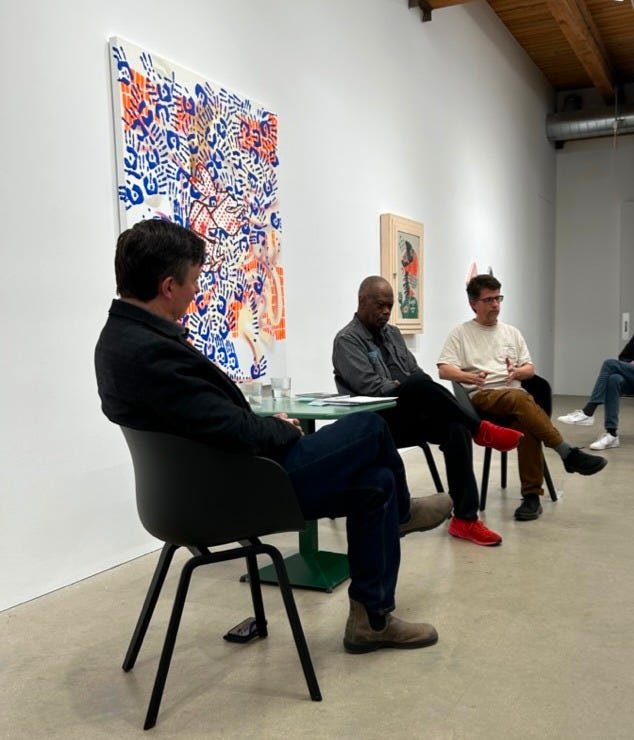
Here are some photos from the aforementioned book release event at CvsD:
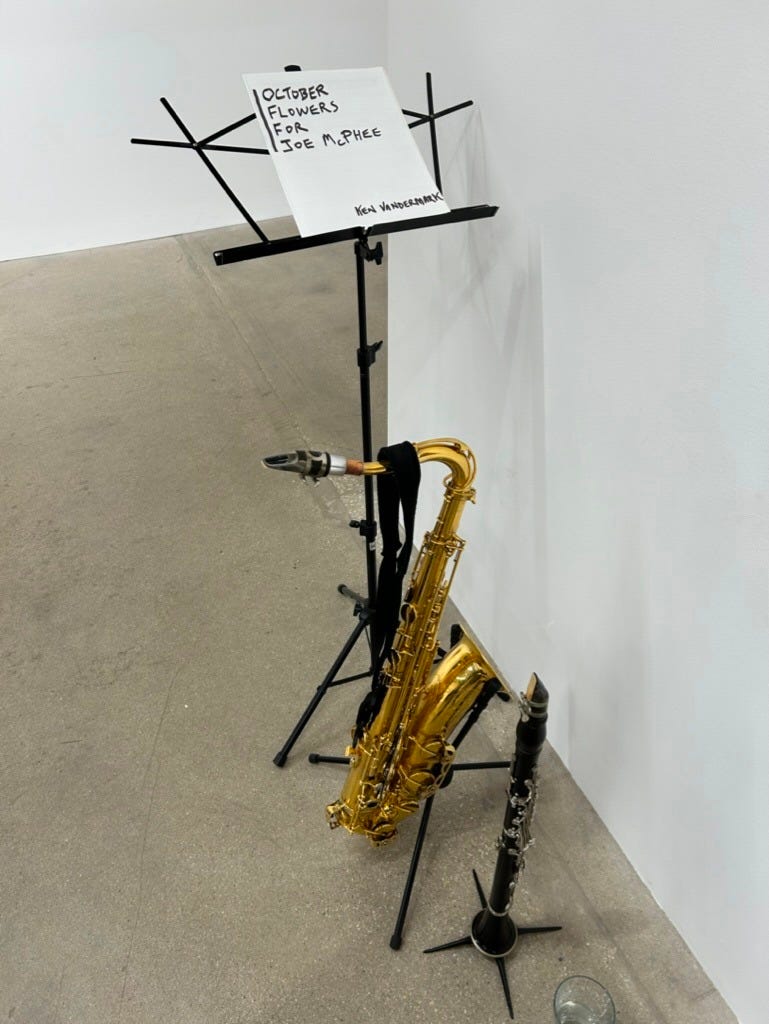
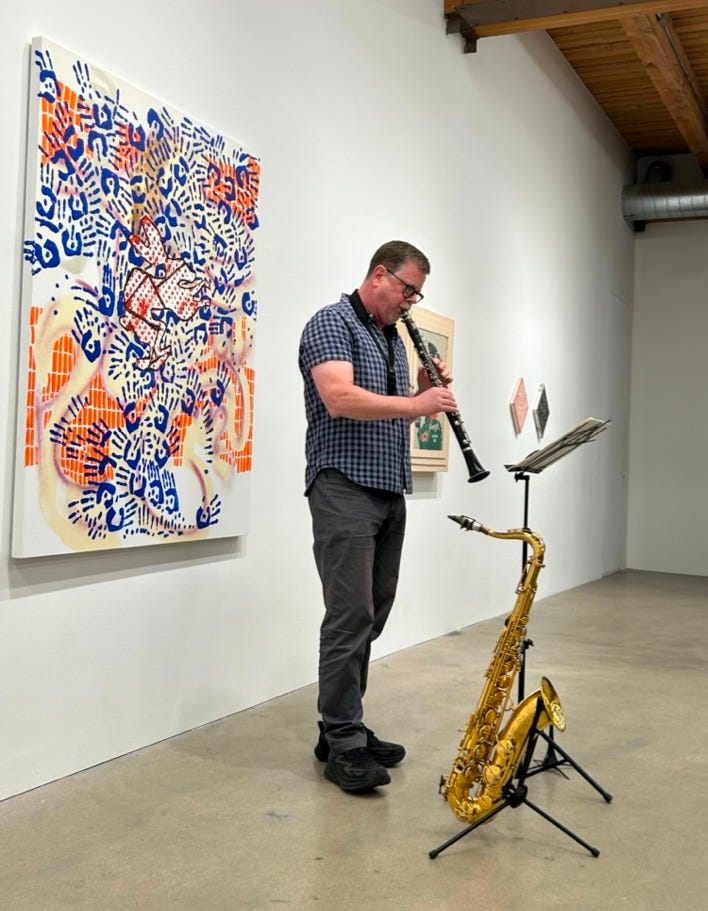
Joe McPhee recorded Tenor in September 1976 at Michael Overhage's farmhouse in Adlemsried, Switzerland. On Good-Bye Tom B (Dedicated To Klaus Baumgärtner), I think you can hear the influence Vandermark spoke about:
At the invitation of Vandermark and Corbett, Joe McPhee made his Chicago debut in February 1996 at the Empty Bottle, a show I attended. Although I really didn’t understand it at the time, looking back now, the Chicago jazz scene was on fire in the mid-1990s. It’s amazing to think back at how those two 1993 Vandermark shows, when I had just arrived in Chicago, were the start of a jazz education that lasted until I moved to Minnesota in the spring of 2000. I owe a lot to Ken Vandermark and John Corbett. Thanks, guys. You ignited a flame that still burns brightly today.
Next week on that Big River called Jazz, we’ll dig in our paddles and discover the world of the jazz kissa scene in Japan.
Please hit this link to buy me a cup of coffee if you’d like to show your guide some appreciation for this and past journeys. Know in advance that I thank you for your kindness and support.
If you like what you’ve been reading and hearing so far on our journey and would like to share this with someone you think might be interested in learning more about our great American art form, Jazz, just hit the “Share” button.
From Astaire to Sun Ra: A Jazz Journey is a reader-supported publication. If you feel so inclined, subscribe to my journey by hitting the “Subscribe now” button.
Feel free to contact me anytime to talk shop. I welcome and encourage that.
Until then, keep on paddling….
Excellent piece; I believe the first show of Brötzmann's visual art in Chicago was in spring 2003 at 1926 Gallery, called The Inexplicable Flyswatter (I attended & have the catalog). Corbett curated it of course. Saw PB many times in Chicago in the early 2000s, although only with small groups, duos, and performing solo, not the Tentet.
thank you Tyler, this is so well written and documented. As a person who arrived in Chicago in 2004 and left in 2013, I never got to hear him in that town. I did get to see him in 2019 at Vision Fest here in NY which was incredible. I was in Wuppertal with Tomeka in October of 2022, he already wasn't feeling well and couldn't meet with us, his response was very kind. Thank you again for these beautiful memories