
Dewey Redman
Ear of the behearer...

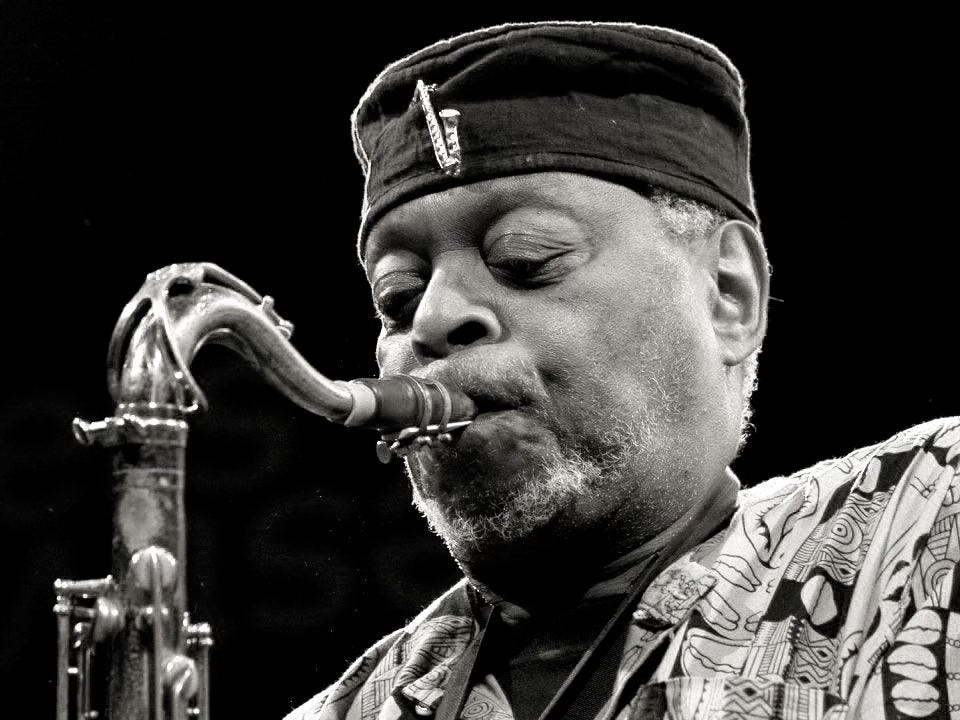
Dewey’s my hero… Dewey’s the truth.
-Joe Lovano
As I wrote about last week, in the spring of 1977, when I was 14 years old, my brother joined the Navy. He left behind his record collection. It was all rock albums; however, he did have one jazz album: Herbie Mann’s Et Tu Flute, a double-album compilation released in 1973. I loved that album—so many cool songs. I wanted to go to a used record store and find some “jazz,” since I thought it must all sound like that.
I was too young to drive, so I bribed my brother or sister to take me to the nearest used record store, where I came across two albums, Walt Dickerson’s Peace (which I wrote about last week) and Dewey Redman’s Ear of the Behearer. I bought both based on their covers alone. When I got home and played Ear of the Behearer, it sounded nothing like Et Tu Flute. I was shocked, “What is this - it can’t be jazz.” Clearly, I was not ready for that type of “jazz.” I kept the albums, though, and I still have them.
In the summer of 1981, when I was a sophomore in college, when Pat Metheny’s album As Falls Wichita, So Falls Wichita Falls came out, I became a big Metheny fan. After that, I bought all his albums when they came out, generally on cassette so that I could listen to them in the car. In 1984, Metheny created quite a controversy when he released Rejoicing, without long-time collaborator pianist Lyle Mays. Instead, Metheny decided to make an album with Ornette Coleman’s old bandmates Charlie Haden and Billy Higgins. After its release, I read that back in 1980, Metheny recorded 80/81 and used Coleman alum. I did not have that one, as it was released before I was introduced to Metheny.
So in the early summer of 1984, after I graduated from college, I went to the Tower Records in Greenwich Village and tracked down 80/81. As I looked at it, I was surprised to see Dewey Redman’s name on it. I had not thought about him since 1977, when I listened to Ear of the Behearer. Needless to say, I was anxious to find out what I’d hear this time.
I can remember it like yesterday. I played that cassette over and over while driving from Brooklyn, where I had been living, to Airborne School in Georgia. I was trying to figure out this new music I was hearing, so different from all the Pat Metheny songs I’d been hearing for years. Here’s the title track, with Dewey Redman on tenor sax:
This week on that Big River called Jazz, we’ll dig in our paddles and discover the world of Dewey Redman.
Dewey Redman was born in May 1931 in Fort Worth, Texas. He grew up kitty-corner to a juke joint. As a young boy, he would sit in the corner of the yard and listen to the music coming from that juke joint. It was one of the biggest thrills of his life. By the time he was 12, he decided he wanted to play music.
He was a year behind Ornette Coleman in their Fort Worth high school. They both played in the school concert band and became friends. After Coleman graduated in 1947, he immediately moved to Los Angeles. After Redman graduated, he briefly enrolled in the electrical engineering program at Tuskegee Institute in Alabama. However, he became disillusioned and returned home to Texas to attend Prairie View A&M near Houston, where he studied industrial arts with a minor in music. After he received a B.S. degree in 1953, he joined the army. After his discharge, he taught fifth-grade students for a few years in Bastrop, Texas, near Austin. In 1959, he earned a Master’s Degree in Education from the University of North Texas near Fort Worth. Interstingly, while he was there, he did not enroll in any music classes.
With all these degrees in hand, near the end of 1959, he moved to Los Angeles. He settled in San Francisco shortly afterward, where he drove a cab during the day and looked for music gigs at night, occasionally playing with Pharoah Sanders and Wes Montgomery. While there, Redman met Chicago musician Donald Rafael Garrett, with whom he recorded his debut album, Look for the Black Star. It was recorded in San Francisco in January 1966 and released that same year on the Dutch Fontana label.
I wrote about Donald Rafael Garrett here:
At the time, Redman was 35 years old, a late start for his first recording of any kind.
Then one night while standing in line at the San Francisco airport, Redman spotted his old friend Ornette Coleman, who had arrived in town for a week-long gig. He went over to him, and in an early 2000s interview with Michael Segell for his 2005 book The Devil’s Horn, Redman recalls Coleman saying:
Dewey, are you still playing? Come down and play with us. The next thing I know I’m in New York recording New York Is Now! with Elvin Jones and Jimmy Garrison.
He played with Coleman in San Francisco and, in 1967, moved to New York City as part of a make-or-break five-year plan. Redman goes on to add, “One of the first things I did was rent this apartment.” He found a flat in the Bedford-Stuyvesant section of Brooklyn, which he had rented for nearly 40 years. He adds, “The rent’s about the same as it was in the beginning - $240 a month. It’s one of the secrets of my survival.”
He performed with Sunny Murray before joining Coleman’s quartet, with Garrison on bass and Jones on drums, both of whom had played with John Coltrane up to the time of his death in 1967.
On April 29 and May 7, 1968, Redman recorded with the Coleman quartet on two Blue Note albums, New York Is Now!, released in 1968, and Love Call, which wasn’t released until 1971. It must have been very challenging to be the “other” saxophonist in Ornette Coleman’s quartet; however, from the opening track of New York Now!, Redman redefines the sound of the tenor saxophone. Check out his solo on The Garden of Souls at the 9:54 minute mark - this is a masterful solo:
About Redman’s playing on these songs, author John Litweiler wrote that his “phrasing and at times his tone recall the young Ornette… in his playing there are passages with a loping quality that suggests a long, tall Texan.”
Then on August 11, 1968, Redman joined Coleman, Charlie Haden, and Coleman’s son Denardo on drums for a concert at the University of California, Berkeley’s Hearst Greek Amphitheater. Interestingly, Denardo was only 12 years old, but his playing seems capable and open. The concert was released as Ornette at 12 on the Impulse! label. On the liner notes, Coleman writes about Redman, “Dewey is the freshest and deepest natural player I played with in quite some years.”
Ornette at 12 is an interesting album in that Coleman not only plays alto saxophone, but also violin and trumpet. Here’s the opening track, C.O.D., with another killer Redman solo:
For those interested, go to the 25:10-minute mark for Bells and Chimes, with Coleman on violin and nice solos by Haden and Redman.
On April 27–29, 1969, Redman recorded on Haden’s seminal Liberation Music Orchestra, released by Impulse! at the beginning of 1970. I wrote about this album here:
Later, in October of 1969, while Redman was touring in Europe, he recorded Tarik at Studio E.T.A. in Paris for the French BYG Actuel label. Tarik was only his second release as a leader. Along with Redman are the great Malachi Favors on bass and Ed Blackwell on drums. From that release, here is the title track with Redman playing the musette:
Interestingly, to gain focus for their label, BYG Actuel initiated a five-day, 24-hour concert in Europe in the fall of 1969. The concert was to be held at the Parc Saint Cloud in Paris. Billed, up to the eleventh hour, as the “First Paris Music Festival”; however, lobbyists banned the event for environmental reasons. Undeterred, BYG Actuel moved it across the Belgian border to a cold, damp, open-field location in Amougies. Here’s the concert poster billed “60 hours of music for 60 francs” (note that the Vincennes location is blacked out and the new Tournai location printed above it:
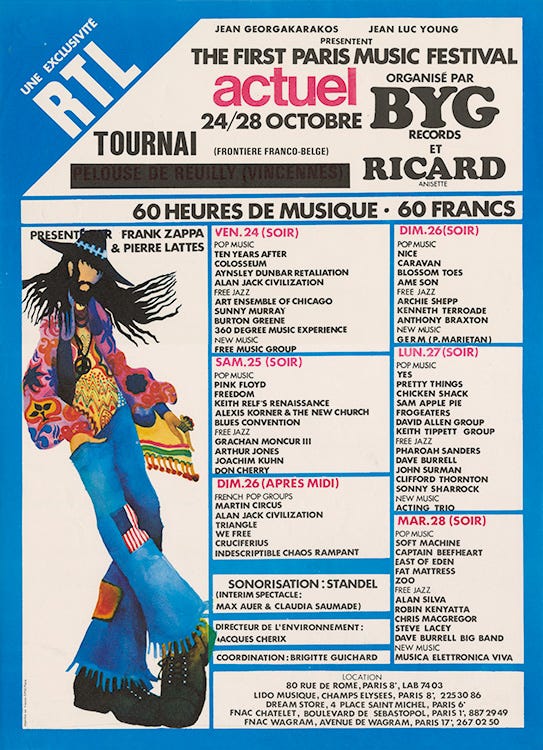
I don’t think Redman played there; however, it was an interesting event that showcased free jazz artists alongside pop artists. Note that on October 22, Ten Years After is the pop headliner, along with one of my favorite groups, Aynsley Dunbar Retaliation, and the Art Ensemble of Chicago. Pink Floyd is the pop headliner the following day. What an incredible event that must have been.
Although it was recorded live at New York University in New York City on March 22, 1969, after the above-mentioned Ornette at 12, Coleman’s Crisis was released in 1972. By that time, Redman was a member of Keith Jarrett’s band, which he joined in 1971.
Redman’s first recording with Keith Jarrett was in July 1971 on the band’s El Juicio (The Judgement). However, Atlantic didn’t release the album until 1975. It was the first in an amazing string of Jarrett albums for the Atlantic, Columbia, Impulse!, and ECM labels. The album opens with a bomb, Gypsy Moth. Redman plays alto on this tune, and you can hear the homage to Ornette Coleman. Charlie Haden is on fire on this one:
However, a few months before Redman recorded on Jarrett’s El Juicio (The Judgment), on February 9, 1971, a 6.6 earthquake centered in San Fernando struck and was felt as far away as Los Angeles. It was about to change Redman’s fate.
The earthquake literally and figuratively shook ABC’s (parent company of Impulse!) head of promotions, Larry Ray, and famous producer Bill Szymczyk, who was responsible for producing such classics as the Eagles’ Hotel California, B. B. King’s Indianola Mississippi Seeds, and Pharoah Sanders’ Thembi, to name just a few. As a result, they got out of California pronto and set up Tumbleweed Records in Denver. We’ll catch up with Tumbleweed Records a little further down the river…
Their departure opened the door for Steve Backer, who worked as a promotion man at Verve and Elektra, where he had recently worked with the Paul Butterfield Blues Band. Soon after starting, he arranged an impressive ABC-subsidized “experimental regional tour,” during which Impulse! artists like Alice Coltrane, Archie Shepp, Pharoah Sanders, John Klemmer, and Michael White played at rock clubs and college campuses. It was a big success, and Impulse! promoted Backer to General Manager. He now had full signing power, and in late 1972, signed five artists who defined the last great avant-garde wave on Impulse!: Gato Barbieri, Keith Jarrett, Marion Brown, Sam Rivers, and Dewey Redman. Redman’s work with Coleman and Haden’s Liberation Orchestra made his signing a natural progression. Also, he was already in Keith Jarrett’s band.
Redman’s first recording with his new label was on February 24, 1973, at a live show at the Village Vanguard in New York City, when Jarrett’s band recorded the album Fort Yawuh with Redman on tenor sax, Charlie Haden on bass, and Paul Motian on drums. It was released in November 1973.
Later that year, in June, Redman recorded The Ear of the Behearer, his first Impulse! album as a leader: From this album, here is Image (In Disguise):
Redman’s second and last album with Impulse! was Coincide, recorded and released in the fall of 1974. From the album, Funcitydues offers a great chance to hear Redman’s combination of voice and horn come on like the down-home Delta blues:
Unfortunately, although these releases were golden, they were also brief. At the start of 1975, in a matter of weeks, all the ABC staff were let go, and the house that Coltrane built came tumbling down. In his 2006 book, The House That Trane Built, Ashley Khan quotes Steve Backer:
By 1974, we were going through the down cycle. They were cutting their losses. Pharoah Sanders was the best-paid artist at Impulse at the time - his contract was not renewed. The pressure to equal the success of Creed Taylor at CTI put a different spin on my being able to move forward at the pace that I wanted to.
By the end of 1974, Backer had left ABC for a leading jazz role at Arista Records, a new division of Columbia Pictures, which left Redman without a contract.
However, Redman continued to record with Keith Jarrett’s band. A particular favorite of mine from this period is The Survivors’ Suite, the April 1976 quartet session with Jarrett, Redman, Haden, and Motian recorded at Tonstudio Bauer in Ludwigsburg, West Germany, and released in 1977 on ECM. It was voted Jazz Album of the Year by Melody Maker in 1978:
The Survivors’ Suite is a stone-cold classic, with Jarrett also playing lovely bass recorder and soprano saxophone. This is a timeless album that, I feel, deserves wider recognition.
In October 1978, Redman recorded an album with the Galaxy label, a division of Fantasy Records, which was released in 1979 as Musics. The album was produced by Ed Michel, who had produced his albums as a leader at Impulse!. For this quartet session, he included pianist Fred Simmons. It was the first time he’d led a recording session with a pianist since his first album in San Francisco over a decade earlier.
After that, in the 1980s and 1990s, he worked with Coleman’s old bandmates Don Cherry, Charlie Haden, and Ed Blackwell. They toured the States and Europe, calling themselves Old and New Dreams. He also worked with Haden’s reformed Liberation Music Orchestra and recorded with Paul Motion. He continued to tour and record with his own groups into the 2000s.
Sticking with a theme I’ve presented over the past few weeks that emphasizes my interest in duo recordings, Redman recorded some strong duo sessions later in his career. For example, in September 1989, at the A & R Recording Studio in New York City, he recorded As One with the great pianist Geri Allen on Living on the Edge, released in 1991 on the Italian Black Saint label:
I wrote about Geri Allen here. At the time of the recording, Allen was coming off her strong trio release, Twylight, with Jaribu Shahid on bass and Tani Tabbal on drums, both from Detroit’s Griot Galaxy with Faruq Z. Bey. I wrote about them here.
Then, at Avatar Recording Studio, New York, New York, in August 1998, Redman recorded the terrific Momentum Space with Cecil Taylor and Elvin Jones, released by the Verve label in 2000. Grammy Award winner John Snyder produced the album. In his must-read book In the Brewing Luminous: The Life & Music of Cecil Taylor, Phil Freeman wrote:
Although the cover credits all three musicians equally, Momentum Space was in fact Dewey Redman’s album, with Taylor as sideman. Snyder had gotten a grant from the Creative Music Institute to make an album with an under-recorded jazz musician of his choosing. “And I thought, well, shit, who is that? And then I thought, Dewey.”
From the album, here is an excellent duet with Redman and Jones called Spoonin’:
Momentum Space was Dewey Redman’s last recording as a leader, and might be one of his best.
Recorded as Radio Guantanamo: Guantanamo Blues Project Vol. 1 for the Blue Note label in Santiago de Cuba and Guantánamo de Cuba, in December 2003 and September 2005, Redman recorded with Canadian musician Jane Bunnett. He had previously recorded on Bunnett’s 1988 debut album In Dew Time. From Radio Guantanamo: Guantanamo Blues Project Vol. 1, here is You Have Changed My Life with Redman on tenor and killer solos by Bunnett on flute and Howard Johnson on tuba:
I love this tune. It even has some nice harmonica in there by Jumpin’ Johnny Sansone. Whenever I play it, I smile because it reminds me of how Dewey Redman changed my life back in 1977, though I didn’t know it at the time.
In a 1980 Coda magazine article, Roger Robbins wrote about the impact of Dewey Redman:
Redman has been quite influential on younger musicians in “Jazz” simply for the fact that he’s one of the last of the authentic journeying “Jazzmen.” One could hardly say that they know the tenor saxophone today without really going through him. New wave artists as diverse as David Murray and Ricky Ford have absorbed him and have spoken of the beauty in how he plays.
Dewey Redman passed away in Brooklyn, New York, on September 2, 2006. He was 75 years old. Although he has passed to the Western Lands, he continues to change lives.
Here’s one more for the road. As I mentioned earlier, when I heard Metheny’s 80/81 for the first time in 1984, it definitely challenged my ears. As time went on, I realized that, like Dewey Redman, Metheny was also highly influenced by Ornette Coleman. It would be a few more years before I listened to my first Ornette Coleman album, but Metheny had put him on my radar.
So when Song X came out in 1985 with Metheny playing alongside his hero Coleman, even though I had never listened to a free jazz album before or even knew about “free Jazz,” I was somewhat ready for it. Anyway, I was amazed by songs such as Mob Job:
When I came back from serving in Europe at the end of the 1980s, and my jazz journey was opening up to free jazz, I went straight to Ornette Coleman’s music, and in some strange twist of fate, I rediscovered Dewey Redman. Only this time, I could hear him.
And that is how it goes on that Big River called Jazz…
Next week on that Big River called Jazz, we’ll dig our paddles into the waters of another Texan, Blind Lemon Jefferson.
Please hit this link to buy me a cup of coffee if you’d like to show your guide some appreciation for this and past journeys. I thank you in advance for your kindness and support.
If you like what you’ve been reading and hearing so far on our journey and would like to share this with someone you think might be interested in learning more about our great American art form, Jazz, just hit the “Share” button.
From Astaire to Sun Ra: A Jazz Journey is a reader-supported publication. If you feel so inclined, subscribe to my journey by hitting the “Subscribe now” button.
Feel free to contact me anytime to talk shop. I welcome and encourage that.
Until then, keep on walking….
thankyou for such an indepth article about Dewey...so great to read things l didn,t know..and never read so much info on him..long overdue...wanted to let you know besides IN DEW TIME..and GUANTANMO BLUES...Dewey was on mybrecording SPIRITUALS AND DEDICATIONS....along side pianist Stanley Cowell...a special recording..thankyou again for your work.
Thanks for sharing. Amazing story.