
Charles Tyler
Use discretion - play only after midnight and...

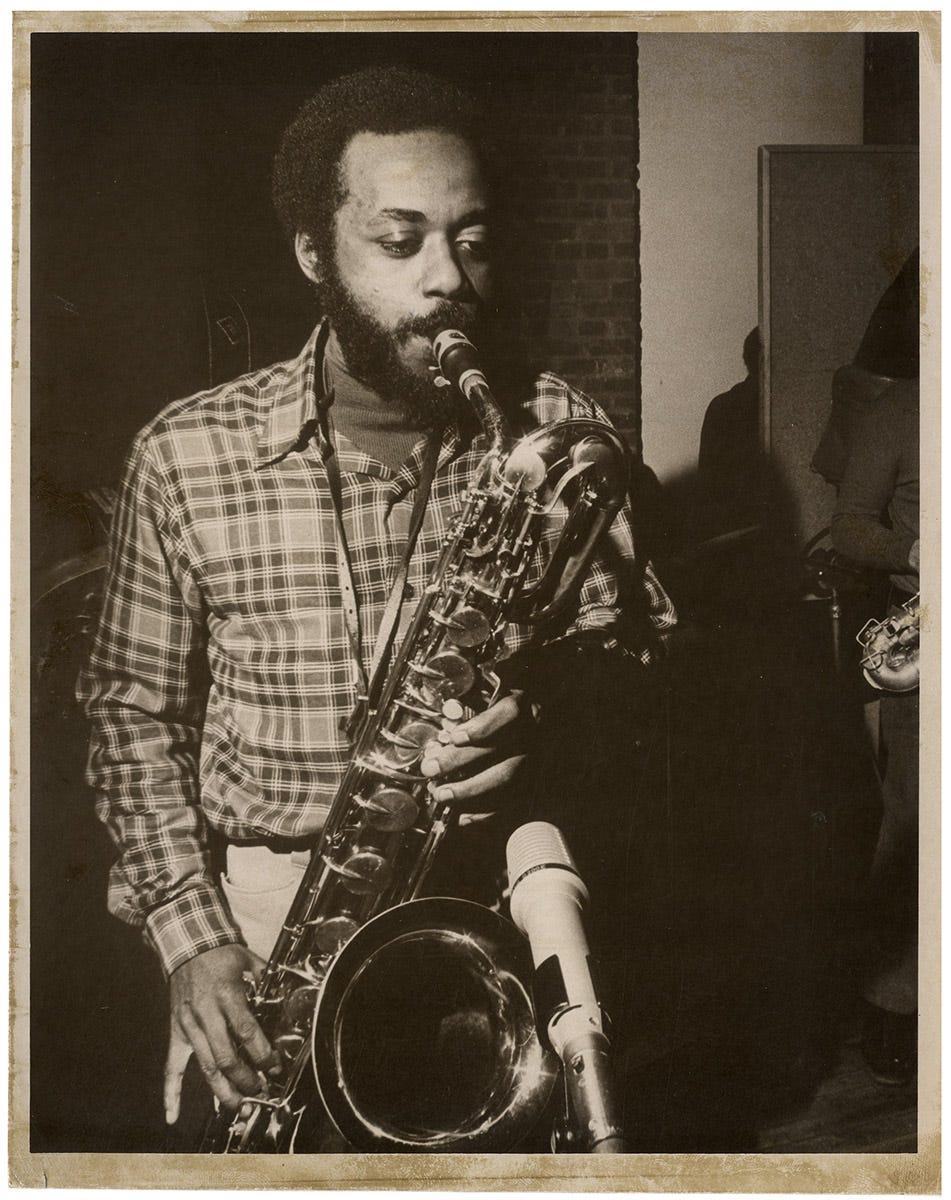
This, then, is the challenge that faces the listener. To truly understand free jazz, particularly as it exists now, it is necessary to disassociate oneself from over thirty years of rhetoric. It’s a difficult endeavor, because the truth is that the origin of the music, and more importantly the reason it began to exist as it did, is mysterious.
-Phil Freeman
I was down in Cincinnati for business years ago. I was staying at the Radisson Hotel on the south side of the Ohio River. I had some free time and wanted to go to a used record store in town. Word on the street was that Mole’s Record Exchange was the best one, so I called a cab to check it out.
Solid store with modest prices; unfortunately, after nearly 50 years, Mole’s Record Exchange closed in June 2023. I bought this really cheap cut-out for a buck:
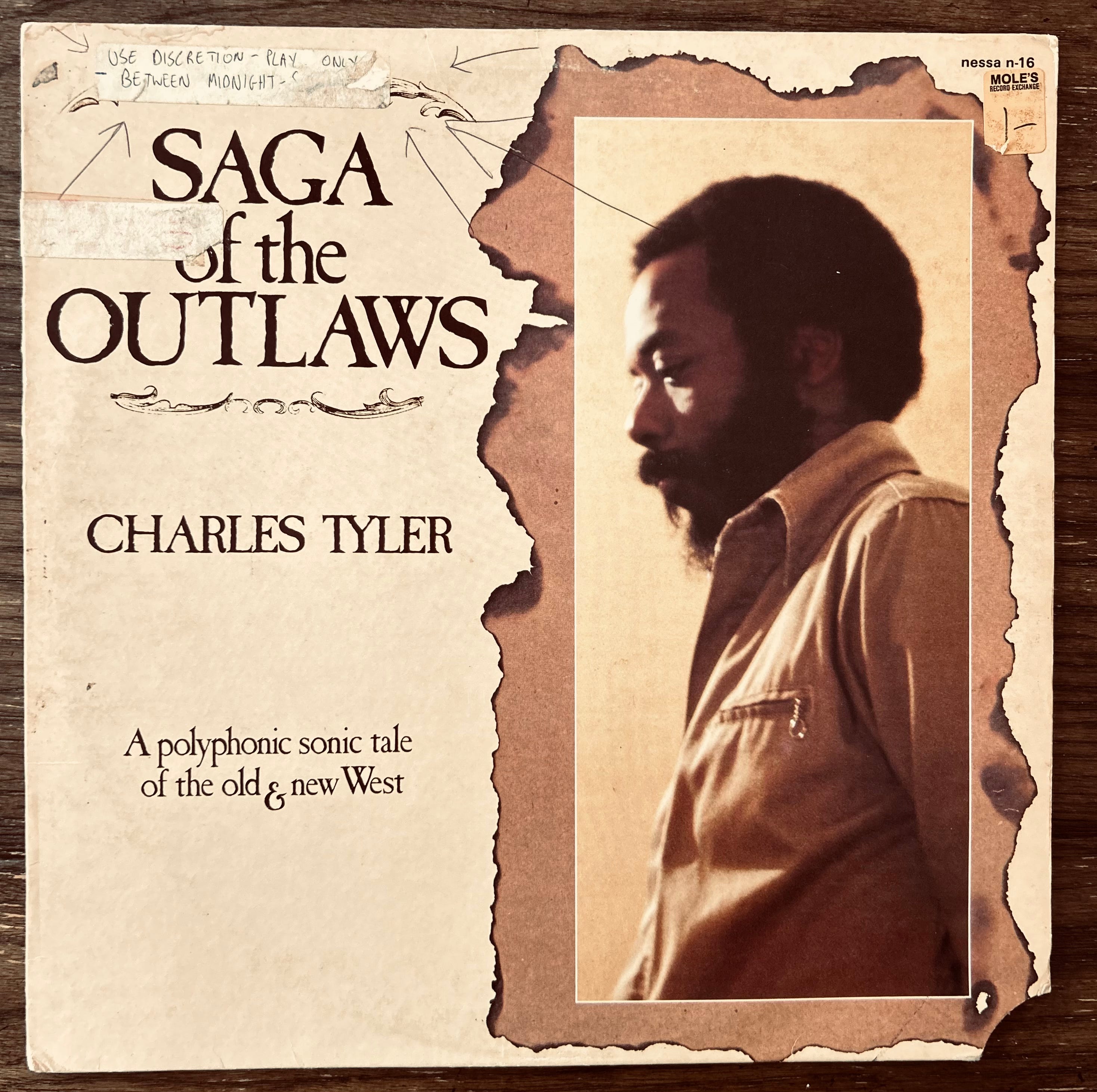
The cover is in rough shape, but the record was pristine. Notice what it says in the upper left corner:
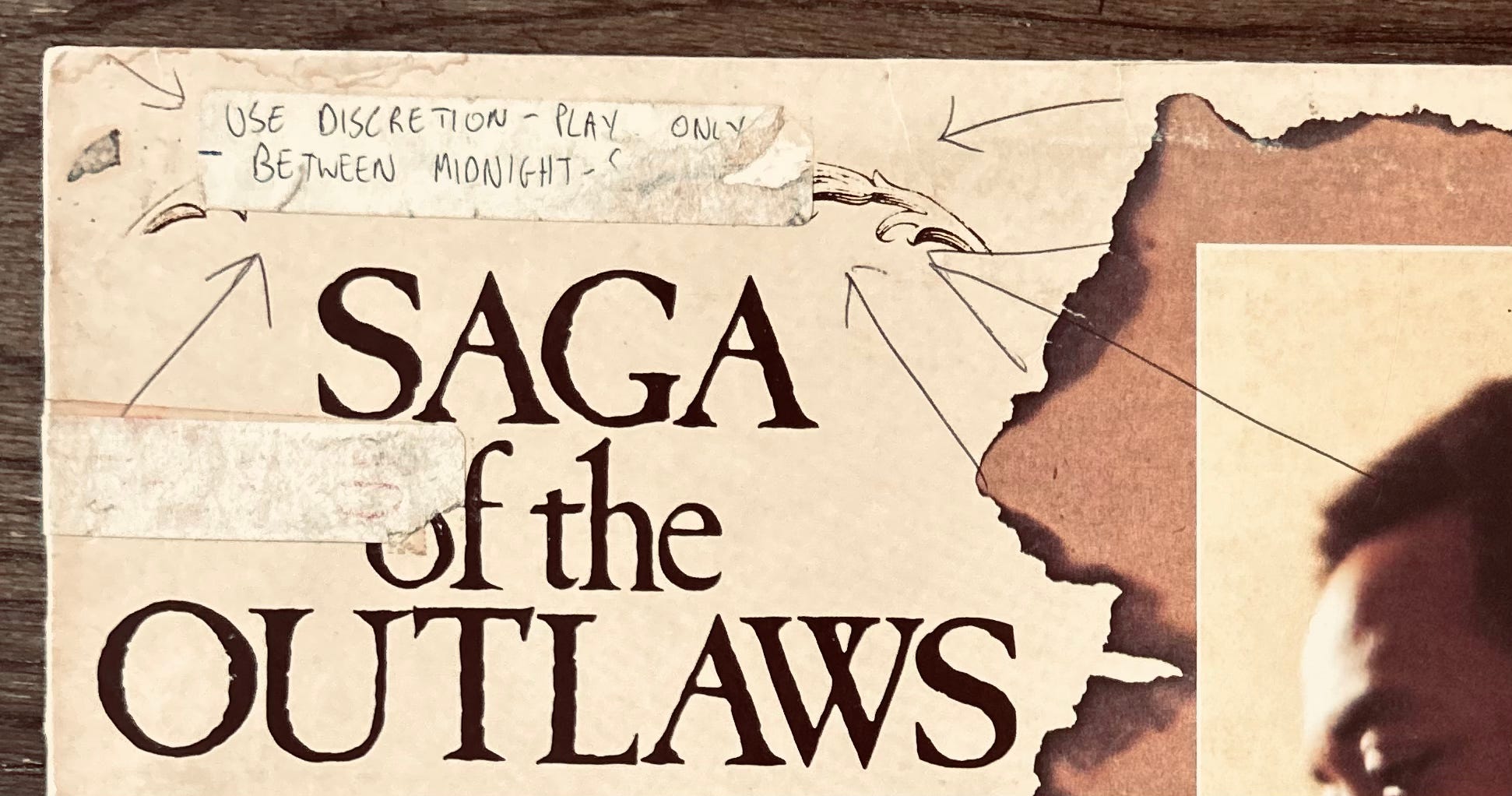
“USE Discretion - PLAY ONLY BETWEEN MIDNIGHT - ??” The ripped tape obscures the ending time for playing, but I suspect it says 6:00 am.
Classic. Trying to confine Charles Tyler's epic Saga of the Outlaws to the witching hours, so only the DJs, cab drivers, and folks working third shift can hear it. Makes me wonder how anyone can gain exposure to the music this way? And it’s exposure that is exactly what is needed.
In John Corbett’s 1994 book Extended Play: Sounding off From John Cage to Dr. Funkenstein, Chicago musician Hal Russell comments on the accessibility of free jazz:
The first time I heard Monk, I hated it. The same is true about Duke, I couldn’t stand it. This is the same, it just takes a certain amount of concentration and listening, and you will like free jazz.
Similarly, in a 1992 Coda magazine interview with Mike Johnston, the great record producer Chuck Nessa elaborates on his coming to terms with some of the first “free jazz” he heard after moving to Chicago:
The first concert I went to was a Roscoe Mitchell Sextet, the same band that I recorded on the Sound record… I honestly had no idea what they were doing. At the time, I was still trying to come to terms with some of the early ESP records like Albert Ayler’s Spiritual Unity. Contane’s Ascension was new then, too, the beginning of Screetch Music. I was twenty-two years old then, and I’d been listening to jazz since I was seventeen… and all this stuff was happening… I was trying to figure out how the music worked or whether it was bullshit or not… I thought that it was beyond my knowledge, but that when I would get there, I would enjoy it. One thing I sensed early on was that they seemed to put some sort of structure on top of free techniques. But I didn’t feel the music and understand how it functioned at that point.
The idea that it just takes time listening to free jazz in order to like it, as put forth above by both Russell and Nessa, has merit. It is also something I know to be true from personal experience.
Dewey Redman’s The Ear of the Behearer and Walt Dickerson’s Peace were strangely the first two jazz albums I bought back in the late 1970s when I was in high school. I was looking for jazz records at a used record store and saw them. At that time, I was just getting into what the radio DJ called “smooth jazz.” I thought ALL jazz was smooth jazz. They looked interesting, so I bought them. The first few times I played them, I couldn’t stand them; my ears were nowhere near ready for that music. As it turned out, I’ve kept them all these years, and now I love them.
It’s the same story for me with the music of Charles Tyler. The first time I heard Saga of the Outlaws, I wasn’t crazy about it. But I wasn’t really listening to the music. As time went on, and I became more patient with the music, my ears allowed its creativity to find a way to my heart.
This week on that Big River called Jazz, we dig our paddles into the world of Charles Tyler.
Charles Tyler was born in Cadiz, Kentucky, and grew up in Indianapolis, Indiana. When he was 7 years old, he started playing clarinet. Then, in his early teens, he switched to alto saxophone. He spent his summers in Chicago, New York, and Cleveland, taking in each city’s music scene.
When he was 14 years old, he met Albert Ayler in Cleveland. Tyler recalls:
I was walking down the street during one of my summers in Cleveland, carrying my alto. This guy about 19 years old with a patch of red skin on part of his chin stopped me and introduced himself and told me that he played saxophone too and started talking about music. That was that.
In 1957, he joined the army and played in the band, where he was assigned the baritone sax. After he was discharged, he gigged around Indianapolis with blues bands before moving to Cleveland, where he ran into Ayler again. He recalls:
Then, when I moved to Cleveland, I came across this saxophonist with white hair growing out of half of his beard. I figured that that was where the patch of red skin was. That’s how I recognized him and how our relationship started.
Tyler and Ayler started playing together and eventually began commuting to New York.
By 1965, Ayler had recorded his groundbreaking records in both Copenhagen and New York City. As work came more frequently, Ayler added Tyler as the third horn in the band, which is documented on Bells and Spirits Rejoice, both released on the ESP label. In 1966, Tyler recorded Charles Tyler Ensemble, his debut album as a leader for the ESP label.
Later in 1966, Tyler moved back to Indiana to study with composer, cellist, and educator David Baker at Indiana University, who had arranged for him a scholarship. While at Indiana University, Tyler visited New York City to record his second ESP album, Eastern Man Alone, which included Baker on cello and Brent McKesson and Kent Brinkley on bass.
Tyler remained at Indiana University for two years. In 1968, he transferred to the University of California, Berkeley, where he studied and taught. He formed a quartet and gigged around the Bay Area.
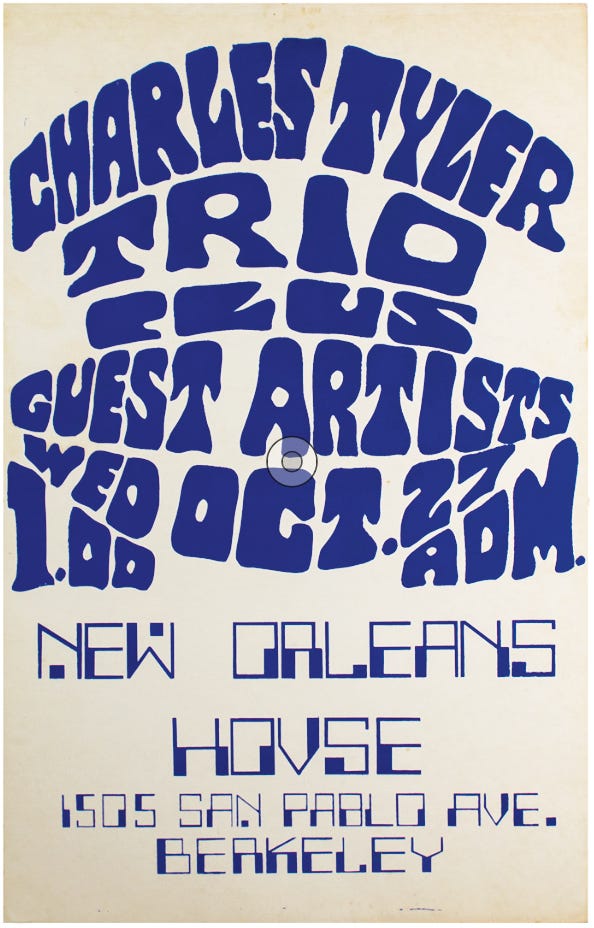
Here is a cool poster for a 1971 performance by the Charles Tyler Trio at New Orleans House, a small club in Berkeley started in 1966 that became a place for lesser-known jazz and rock bands until it closed in 1975:
Hot Tuna recorded their first album at New Orleans House, as you can see written in the bottom left corner of the album cover:
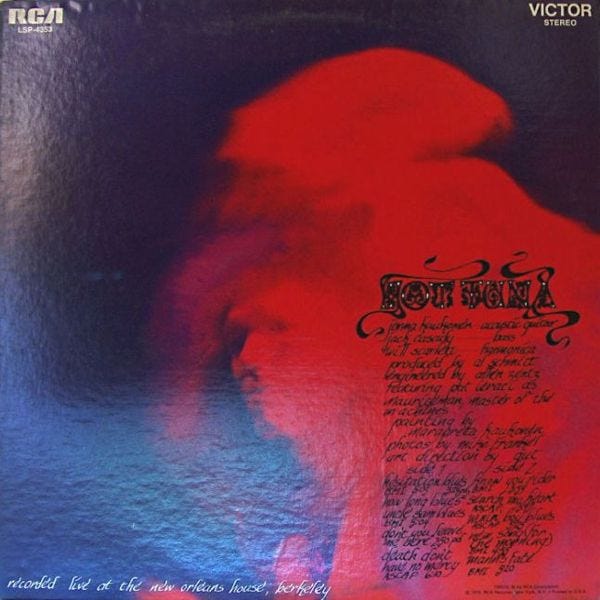
This was one of the albums in my brother’s record collection that knocked me out the first time I played it back in the mid-1970s. This is one of the albums he had that inspired me to start playing harmonica. The song New Song (For The Morning) from the album remains a personal favorite after all those years:
In 1973, after four years in California, he returned to New York for postgraduate studies at Columbia University, where he also freelanced and collaborated with Cecil Taylor, Dewey Redman, and Billy Bang.
Despite his talents, Charles Tyler never became a major name; however, he did produce rewarding albums for his independent AK-BA Records label, which, besides his own records, produced two by New York poet Barry Wallenstein and the seminal Arthur Doyle Plus 4’s Alabama Feeling.
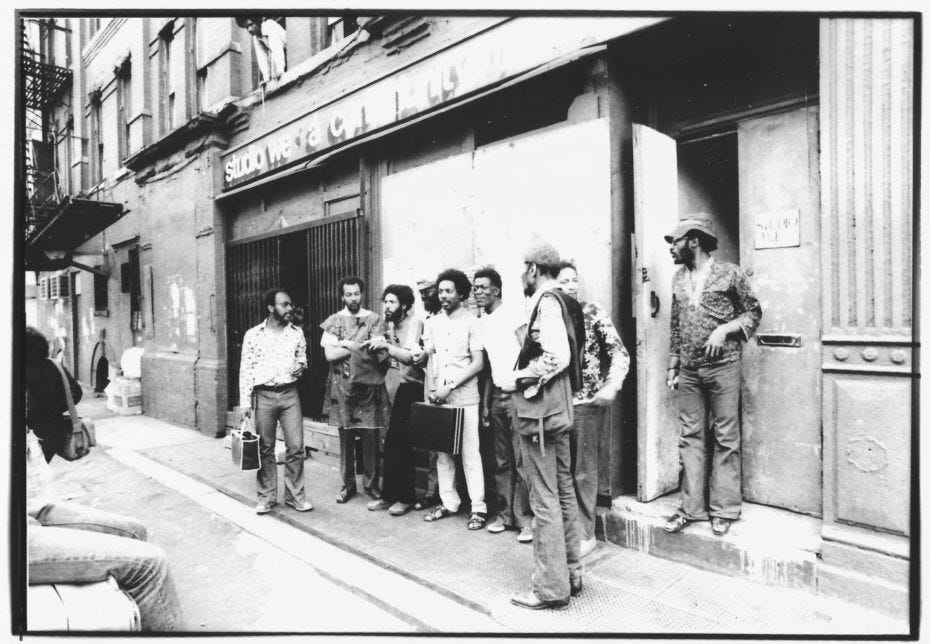
AK-BA Records’ first session was his Voyage From Jericho, recorded in July 1974 at Studio We in New York City, and released in 1975. Studio We, run by trumpeter James DuBois and bassist Juma Sultan, was located at 193 Eldridge Street in the Lower East Side and was one of the earliest jazz lofts. Here’s a picture outside Studio We - looks like Tyler on far left, with Milford Graves and then Frank Lowe to his left, and maybe Sam Rivers on far right? Can anyone else fill in the blanks?
Along with Tyler, trumpeter Earl Cross, alto saxophonist Arthur Blythe, Sun Ra veteran Ronnie Boykins, and percussionist Steve Reid appear on the album. From Voyage From Jericho, here’s Children’s Music March, with Tyler on baritone sax:
As this album demonstrates, Tyler returned to New York City a different man. His earlier work on the ESP label, I feel, reflects too much of his Ayler influence. On this album, however, Tyler finally emerges from the shadow of his mentor. In particular, his baritone work provides no better example, where he seems at ease playing in the lower register with both hard bop vigor and freedom.
In 1975, Tyler brought a quartet consisting of Boykins and Reid, along with guitarist Mel Smith, on an extensive tour of Scandinavia, which resulted in his second AK-BA release, a live recording from the Umea Jazz Festival in Sweden.
The story behind Charles Tyler’s fifth album under his own name, Saga of the Outlaws, grew out of the cultural phenomenon known as “Loft Jazz,” which came into existence in downtown Manhattan’s abandoned industrial spaces. It was here that drummer Rashied Ali founded Survival Records at his converted 77 Greene Street apartment called Ali’s Alley. Composer and musician Sam Rivers also transformed his loft on Bond Street into Studio Rivbea.
At the beginning of 1976, Michael Cuscuna and Alan Douglas arranged a festival to document this vibrant New York loft scene. I wrote about Douglas here:

These festival sessions resulted in a five-volume set, Wildflowers, released on the Dougals label in 1976. Tyler’s contribution to the festival was his 36-minute Saga of the Outlaws, recorded live at Studio Rivbea. Tyler’s band again included Cross, Boykins, and Reid; however, this time with the important addition of a second bassist, Monk’s legendary bass player, John Ore. According to Tyler:
I wrote this piece specifically for the occasion, and I was especially inspired by the ability to finally use two basses. That gave me the opportunity to write for four different melodies and set things up as almost two trio horns, bass, and drums, except they shared one drummer.
Unfortunately, Tyler’s 36-minute Saga of the Outlaws didn’t really lend itself to excerpting and editing for release on a Wilflowers record. According to Cuscuna:
Charles’ piece Saga of the Outlaws was magnificent. But I knew then that it would be impossible to excerpt a section without losing the vitality and construction of the piece. A musical triumph: but within the parameters of the project, a total disaster.
After three tedious months listening, mixing, editing, and programming, I was satisfied with the resultant five Wildflowers albums, but obsessed with finding an outlet for some of the magnificent unissued material that was returned to the artists.
Luckily, this is where Chuck Nessa stepped in to shepherd its release properly on his Nessa Records label. In Nessa's words, this is how it went down:
Near the end of May 1978 I received a call from Charles Tyler. This was unexpected; we’d not met and as far as I knew we didn’t have any mutual acquaintances. He asked if I was interested in hearing some tapes of his recent music. A package arrived about a week later and I began listening. A rough mix of Saga of the Outlaws was amongst the tapes received and it really impressed me. It was far beyond my expectation and we quickly agreed to terms for a release of the music.
Our first meeting was in late July when Charles came to Roscoe Mitchell’s recording session for The Maze. A couple of weeks later he drove out to Rudy Van Gelder’s studio to check out Roscoe’s L-R-G date.
I invited him to Chicago for a mixing session of the eight track master. Charles stayed at our apartment for a couple days and Ann took the opportunity to shoot a few rolls of pictures, some of which are included in this booklet. We went to a George Lewis/Douglas Ewart concert at the Lutheran School in Hyde Park. The cover shot was made in a staircase of the auditorium.
We were not satisfied with the Chicago mix so on September 18 Charles and I ventured to RVG’s studio to try again. Rudy found a solution we liked and the record was issued promptly
You can find Nessa’s Saga of the Outlaws here.
In my mind, as good as Saga of the Outlaws is, Charles Tyler hits full stride artistically with his solo album Sixty Minute Man, recorded in May 1979 on Verna Gillis’ radio show Soundscape on WBAI FM in New York City. It was released on the Adelphi Records label in 1980. The highlight for me again is his baritone playing. Go to the 20-minute mark to hear the album’s second side, featuring two baritone numbers. The first A Tale Of Bari Red, named for his baritone sax:
USE Discretion! This is definitely music that should be played only between noon and moon!
In March 1981, Tyler joined Billy Bang on the album Live At Green Space (question: is this a club in NYC?), released on the Anima Productions label. Along with Sixty Minute Man, this is my favorite Tyler album - and not just because of Tyler’s harmonica playing, which the album opens up with on the cool first track, Alabama Africa.
Here’s the full album - at the very least, go to the 18:32 minute mark for the sweet violin and baritone duet, Viobar, followed by Tyler’s Legend Of The Lawmen, sounding like it came from a Coen brothers Western soundtrack, great stuff and reminiscent of the Saga of the Outlaws:
Once again, this should be played only between noon and moon!
Interestingly, in 1982, Tyler and Nessa would cross paths again for another great and underrated album, Generation. Nessa tells how that session came together:
Four years later [after the Saga of the Outlaws was released] Charles informed me he would be coming to Chicago for some festival related gigs with Sun Ra, Billy Bang and Dennis Charles. I invited him to stay on a few days for a Hal Russell NRG project and he was happy to do so.
After a couple of days of rehearsal, on September 9, 1982, they recorded the session, and Tyler returned to New York.
Generation was originally released in the UK in 1982 on Donald Clarke’s Chief label. Clarke was born in Kenosha, Wisconsin, but had been living in England since 1973. Clarke also wrote an amazing biography of Billie Holiday and the Penguin Encyclopedia of Popular Music. He licensed four of Nessa’s titles for the English market. Nessa later issued Generation on his label in 2014. You can find it here.
By the way, we’ll catch up with Hal Russell a little further down the river…
Here’s one more for the road. Tyler moved to Stockholm in 1982, following a European tour with Sun Ra and the Arkestra. In 1985, he settled in Paris, where Steve Lacy had lived for the past 15 years. Lars-Olof Gustavsson and Keith Knox, founders of Swedish Silkheart Records, arranged for Lacy and Tyler to record one of their earliest releases, “One Fell Swoop.” The album was recorded at the Institut de Recherche et Coordination Acoustique/Musique (IRCAM) in Paris in June 1986.
From the album, playing a copper baritone, a new experimental horn from Buffet Crampon, here is Tyler’s composition, The Adventures of :
The album cover features a painting by black American Bob Thompson, The Hairdresser. Thompson was remarkable and prolific in his eight-year career, producing more than 1,000 works before his untimely death in Rome in 1966. His work is worth further exploration.
Charles Tyler never returned to the U.S. He recorded a couple of albums on the French Bleu Regard label in Paris shortly before he died. One of his last was Mid Western Drifter, recorded at Studio Aid, Pernes-les-Fontaines, France, on March 30 and 31, 1992, just three months before he rode off into the sunset - Tyler passed away on June 27, 1992. He was 51 years old.
I think that title, Mid Western Drifter, says a lot about how Charles Tyler felt about his life. He was like Clint Eastwood’s character Manco in the film A Few Dollars More. That’s Manco a.k.a. the “Man with No Name.”
In the “Print Run” section of the December issue of The Wire magazine, Dave Mandl previews the upcoming book Now Jazz Now: 100 essential Free Jazz & Improvisation Recordings 1960-80. The book’s afterword made me think about Charles Tyler’s legacy. It’s a “sardonic poem” by Joe McPhee that plays on the ambiguity of the words free jazz:
Who started the rumour that jazz was free/Motherfucker/Musicians been paying for that shit since day one… Over 60 years is a long motherfuckin’ time y’all/Time for some new shit/FUCK FREE JAZZ.
According to Mandl, in the final words of the book, McPhee “chides the jazz world to finally let go of that bit of the past.” I’m with Joe McPhee on this one. I dislike categories, so let’s not assign a label to the music, or better yet, let’s not determine that we “play with discretion” only during prescribed late-night hours. Yeah, how about we start there?
Music is wiser than the people who label it. How can we apply language to describe the revolutionary possibilities of sound? Let the music speak for itself. Allow folks to just hear it and listen to it and feel its strength - it will become whatever they want it to be.
In his book, New York is Now!, Phil Freeman perhaps put it best:
My only hope is that [my book] will be informative and entertaining, and that reading it will entice those with open ears to pay attention to a form of music they may have never noticed before. A form of music which, if given enough attention, could change lives forever. I know it’s changed my life, and continues to do so every time I attend a performance or listen to a CD. The music is here. You only have to listen to it for yourself.
I often wonder what “free jazz” means. What exactly is this music, and what does it have to do with freedom? I can say that the music presents boundless creative expression, and I feel liberation in the sounds I hear. So, I guess that is a kind of freedom.
But, in the end, like the music of Charles Tyler, free jazz is more about feeling than about words - let’s leave it at that…
Please hit this link to buy me a cup of coffee if you’d like to show your guide some appreciation for this and past journeys. Know in advance that I thank you for your kindness and support.
If you like what you’ve been reading and hearing so far on our journey and would like to share this with someone you think might be interested in learning more about our great American art form, Jazz, just hit the “Share” button.
From Astaire to Sun Ra: A Jazz Journey is a reader-supported publication. To subscribe, please hit the “Subscribe now” button.
Feel free to contact me at any time to talk shop. I welcome and encourage that.
Until then, keep on walking….
I consider myself lucky in that about 3 seconds into the first free jazz I ever heard, I realized I had found what I hadn't been looking for. The multitude of coworkers who asked me to keep my office door closed simply had poor musical taste. In his later years my Dad was fond of saying " Nothing good happens after midnight." Boy was he wrong. Merry Christmas & Happy New Year from Oklahoma.
Wow, the 'USE Discretion' part realy stood out to me, and your insight that exposure is exactly what's needed for the music to thrive is spot on.