
Micky Raphael
And never asked to leave...

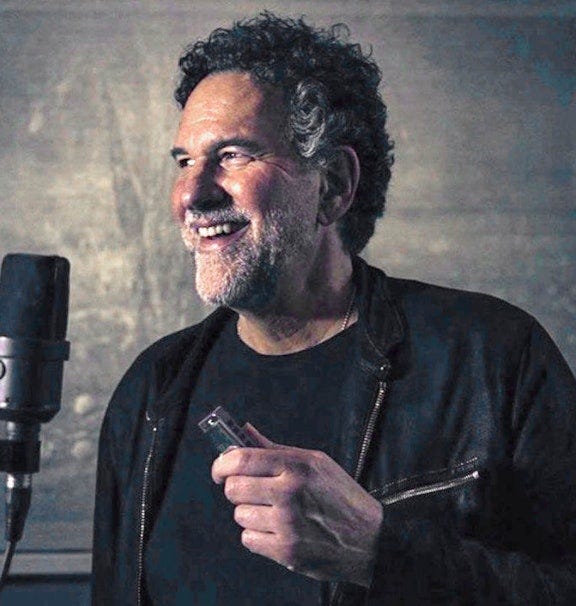
Sometimes fate just steps in, and you have to step back and let it come down.
Two weeks ago, my wife and I were in Houston for the Houston Livestock Show and Rodeo, the world’s biggest rodeo. It’s been going strong since 1932.
We invited a few guests to the concert after the rodeo, which that night was Chris Stapleton. I noticed a harmonica player on the stage to the far left of Stapleton. It didn’t take long for me to realize, by the sound of his harmonica, that it was the legendary Micky Raphael, one of my harmonica heroes. I had no idea he played or toured with Stapleton. That was the first time I’d ever seen him play. The first time I heard him play was nearly 50 years before that.
I was in high school and listening to the car radio, and in the middle of Willie Nelson’s cover of Hoagy Carmichael’s song Georgia On My Mind, out of nowhere, about halfway into the song, and with no hint that it was coming, a harmonica struck and BANG. It struck me, and I was hooked.
Back in the days when you couldn’t just look things up, after I heard the song, it took me a while to get my hands on the album to find out who was playing the harmonica. Finally, I tracked it down, and it was Micky Raphael. From then on, I kept my eyes and ears open for him.
That song won Willie Nelson the 1979 Grammy Award for Best Male Country Vocal Performance. It was released on Nelson’s 1978 album Stardust, which consists entirely of his favorite American pop standards from his childhood. Nelson asked Booker T. Jones, who was his neighbor in Malibu at the time, to arrange a version of Moonlight in Vermont. Impressed with Jones’s work, Nelson asked him to produce the entire album. After a string of successful country albums, Columbia Records executives believed the album would be a total failure; however, Stardust went on to be a huge hit, and few artists have treated the American Songbook so affectionately.
When it came out, Georgia On My Mind played on the radio a lot. I had been messing around with the harmonica for a couple of years and carried one around in my pocket, waiting for it to come on. When it did, I’d play along with Micky Raphael. I should say, I’d try to play along. I’ve been trying ever since…
This week on that Big River called Jazz, we’ll dig in our paddles and discover the world of Micky Raphael.
Micky Raphael was born on November 7, 1951, in Dallas, Texas. He grew up in the Preston Hollow neighborhood. The tuba was his first instrument in the middle school band, which he joined to avoid gym class; he always got picked last. He tried to learn to play guitar, but never could figure it out.
A friend of his dad gave him his first harmonica and said, “When you learn to play Oh Susanna, you can have it.” He did, and he got his first harmonica - a Hohner Marine Band. He just carried it around with him, and when he was alone, pulled it out and played it, kind of an escape.
He graduated from Hillcrest High School in 1969. While in school, Raphael met Smokey Montgomery of the Light Crust Doughboys and Levee Singers fame, who, with fellow Levee Singer Ed Bernet, built the famed Sumet-Bernet Studios in Dallas in 1962. That same year at the studio, Montgomery produced and played piano on Bruce Channel's hit Hey! Baby, which earned a gold record. Incidentally, the song’s distinctive harmonica riff is played by Grammy-winning blues musician Delbert McClinton, who influenced John Lennon. Later, Lennon would ask McClinton for tips on playing harmonica when they toured together in the UK. Anyway, Raphael hung around after school at Montgomery’s studio, and when someone doing demos needed a harmonica player, Raphael would jump in and play along for $5 a song.
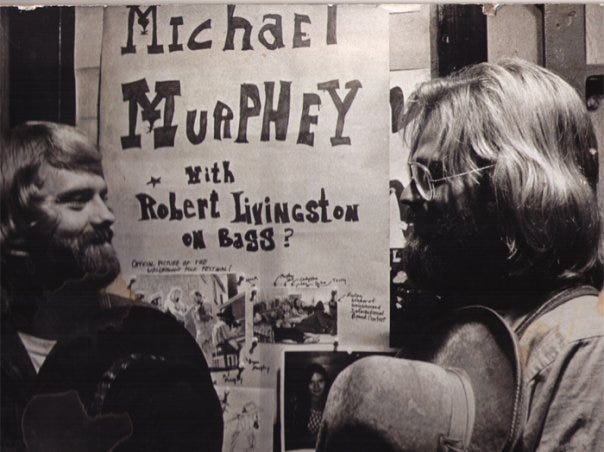
Early on, Raphael’s introduction to the harmonica came through the British Invasion bands, such as the Rolling Stones, Duster Bennett, and John Mayall. As a teenager, he gravitated toward the Dallas folk music scene and hung out at a little folk club called the Rubaiyat. During the 1960s and early 1970s, many great Texas folk musicians on the circuit played there. Here’s a 1970 photo of Michael Murphey and Bob Livingstone at the club:
One night, he heard harmonica great Don Brooks play, and it blew him away. Brooks went on to play with Waylon Jennings and became one of Raphael’s earliest and most important inspirations. In a 2022 interview, he shared:
He was the first real harmonica player that I ever saw. I heard him play, and that’s when I decided to focus on harmonica… He taught me the basics of everything I know in 10 minutes, sitting on a step outside the Rubaiyat. I’d say about 80% of my style comes from him.
Here’s Brooks playing on the Roger Miller song Lock, Stock and Teardrops from Jennings’ Hangin’ On, released in 1968 on RCA Victor.
In a 2011 interview with Scott Preston, Raphael explains meeting his mentor:
I went to this little coffeehouse one night and saw him playing, and it just impressed me so much. He had moved to New York and was kind of a legend around Dallas. He sat me down one night after a show and showed me this little lick that went all the way up and down the harmonica, just a little pattern. Right away, I just jumped about twenty steps from the little I already knew about the harp.
Brooks had an amazing career, culminating with his playing on Ken Burns' 1990 documentary series The Civil War. Brooks tragically died of leukemia on October 25, 2000, in Manhattan. He was 53 years old.
Don Brooks and Charlie McCoy, a little before him, paved the way for playing harmonica in country music, and Raphael followed that path.
He joined the band of progressive country singer B.W. Stevenson, originally known as Buckwheat Stevenson, and played on Stephenson’s 1972 debut album, recorded at RCA’s Mid-America Recording Center in Chicago:
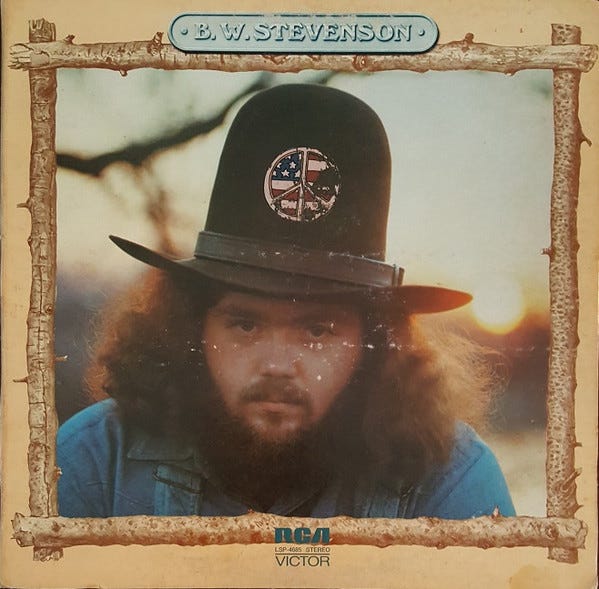
Love the hat! A few years after Raphael left Stevenson to work with Willie Nelson, Stevenson wrote and recorded the hit song My Maria, which played a lot on the radio when I was a kid:
Another song, Shambala, was on that album, and it played a lot on the radio. The guitar on the album was played by the great Larry Carlton, who was a steady studio musician at the time. I wrote about him here:

Stevenson died in 1988, but My Maria was posthumously re-popularized in 1996 when it was covered by the country duo Brooks & Dunn and reached #1 on the American and Canadian country charts.
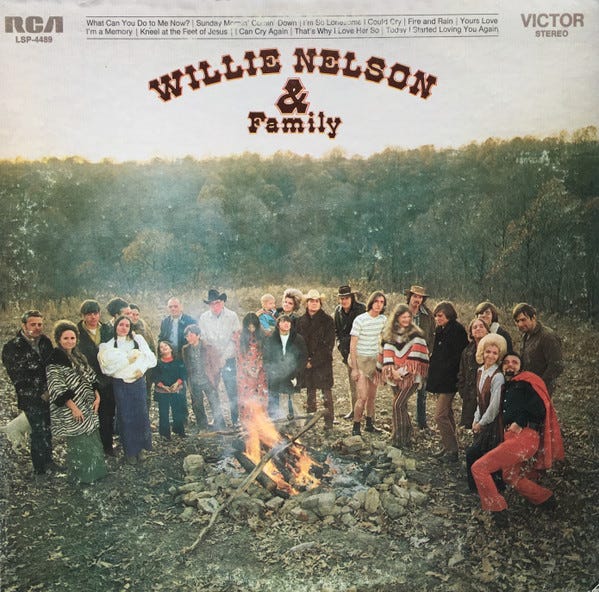
Willie Nelson was on Raphael’s radar only because Nelson and Stevenson were both signed to RCA, so Raphael was allowed to grab free records from the RCA office in Dallas. The album he grabbed was Nelson’s 1971 Willie Nelson & Family:
But it was a friend of a friend that brought him into contact with Nelson for the first time, at a “pickin’ party” in the fall of 1972 with passionate country fan Darrell Royal, the then-coach of the University of Texas football team.
In an August 2018 interview with Douglas McPherson in Country Music Magazine, Raphael explains how he first came to play with Willie Nelson:
I wasn’t ever officially hired... I just wasn’t asked to leave! I was introduced to Willie in 1973 by Darrell Royal, the coach of the University of Texas football team. He was a friend of Willie’s and a big music aficionado. He’d seen me play in Texas and got word to me: “Come by and bring your harmonica. I want you to meet some friends of mine.” He had a little picking party after one of the ball games. Willie was there, and Charley Pride. They’d pass the guitar around and sing. I was sitting in and playing a little and Willie said: “If you ever hear we’re playing in Texas, come and sit in with us.” I’d show up for a few gigs and Willie asked Paul English, his drummer: “What are we paying Mickey?” Paul said: “We’re not paying him anything.” Willie said: “Double his salary!”
He started to play weekend gigs around Dallas until Nelson asked him to play with them on their pivotal New York City debut at the legendary nightclub Max's Kansas City from May 16–21, 1973. This performance, along with subsequent gigs there, helped establish Nelson within the New York City scene.
Micky Raphael’s first album with Willie Nelson was the 1975 Red Headed Stranger, his first album with Columbia Records. It is arguably one of the greatest country albums of all time. Raphael doesn’t play on the album until this song Can I Sleep in Your Arms, halfway through Side 2, and, in typical fashion, he doesn’t make his appearance until four minutes into the song, and like a cobra strikes a stealthy blow, or maybe more like a sunburst, but with the sting of a cobra:
Interestingly, after sitting out for most of the album, he plays on the last four songs. About the album, Raphael recalls:
He came in with a couple of torn sheets of paper with the words on it. We all set up in the studio and we were hearing the songs for the first time. He would play ‘em once, maybe twice - I don’t think we played anything more than twice - and we would listen and play along with him. That’s why that record is so sparse, because we were hearing it for the first time.
The best way to appreciate Micky Raphael is to just listen to him play. Here are a couple of my favorites.
Surprisingly, for all the records he has played on, Raphael has released just two solo records: Hand to Mouth, an album of original tunes released in 1987, and Red River Valley, an album of Cowboy-related songs, such as the title track and tunes like Shenandoah and Streets of Laredo, released in 1999. From Hand To Mouth, here is The Search:
Here’s a video release of Rodney Crowell’s It Ain’t Over Yet, a song from his 2017 album Close Ties, featuring John Paul White and Rosanne Cash. In a song that I think typifies the grace and beauty of his playing, Raphael makes his grand and mellow entrance, late in the song, as usual, at the 4:25 minute mark:
You can’t imagine how many times I’ve listened to him on this song.
It's like I'm sitting at a bus stop
Waiting for a train
Exactly how I got here is hard to explain
My heart's in the right place
What's left of it, I guess
My heart ain't the problem
It's my mind that's a total mess
Raphael taught me a lot about playing the harmonica from this song. He hangs around listening, then hits the song hard, and gets out of the way. When I play harmonica, all I really ever try to do is sound like him in this song. It’s the sound of freedom.
Naturally, you can’t write about Mickey Raphael without including a clip of him playing with Willie Nelson. This is Willie, on tour with The Highwaymen in 1990, singing a song Steve Goodman wrote in 1971, City of New Orleans:
It just doesn’t get any better than that!
Ever since I heard that song as a kid, I have always wanted to ride that train, and I kinda did once.
After I finished my canoe trip down the Mississippi River, I stayed overnight in New Orleans and the next morning, caught the City of New Orleans train at the Union Passenger Terminal downtown. I was bound for St.Paul through Chicago. Unfortunately, there was a train derailment up north, so when we got to Jackson, Mississippi, we had to get off. They turned the train around, we got back on, and headed back down to New Orleans. I ended up staying another night in New Orleans. In the morning, I took a Greyhound bus to Carbondale, Illinois, where I caught a different train to Chicago. And so it goes…
Here’s one more for the road. In 2023, recorded at NightBird Recording Studios in Los Angeles, Raphael was a guest on Norah Jones Is Playing Along, where they played an impromptu version of Willie Nelson’s Night Life.
You can hear Raphael’s “less is more” philosophy in that performance. He has always maintained that the hardest thing for a supporting musician to learn is when not to play. He never solos over the singer, and he’s always looking to enhance the song, not own it. I’ve always tried to follow that rule.
In the interview with Jones, she asked him if there was ever a ritual he followed before he’d play a show, and after some time thinking he finally shared that he listens to The Butterfield Blues Band’s The Resurrection Of The Pigboy Crabshaw to psych himself up. My kind of man!
From that album, here’s Driftin’ and Driftin’, with Elvin Bishop on guitar, David Sanborn on alto saxophone, and Phillip Wilson on drums:
I wrote about Butterfield here:

Paul Butterfield was one of Micky Raphael’s mentors for many years and a great friend. He was also Raphael’s favorite harp player.
He was a guest on the final track on Raphael’s Hand to Mouth:
Micky Raphael never officially got asked to join Willie Nelson’s band; he was just never asked to leave, and has been going strong with him since 1973. Sometimes it’s not about the search. Sometimes fate smiles on you, and you never look back.
Next week on that Big River called Jazz, we’ll dig our paddles into the waters of Sun Ra’s piano solos.
Please hit this link to buy me a cup of coffee if you’d like to show your guide some appreciation for this and past journeys. Know in advance that I thank you for your kindness and support.
If you like what you’ve been reading and hearing so far on our journey and would like to share this with someone you think might be interested in learning more about our great American art form, Jazz, just hit the “Share” button.
From Astaire to Sun Ra: A Jazz Journey is a reader-supported publication. If you feel so inclined, subscribe to my journey by hitting the “Subscribe now” button.
Feel free to contact me anytime to talk shop. I welcome and encourage that.
Until then, keep on walking….
I've never heard, but I 🩷country
Haven't heard that B.W. Stevenson song for a long, long time.
Thanks for that.