
Hal Russell
The NRG Ensemble...

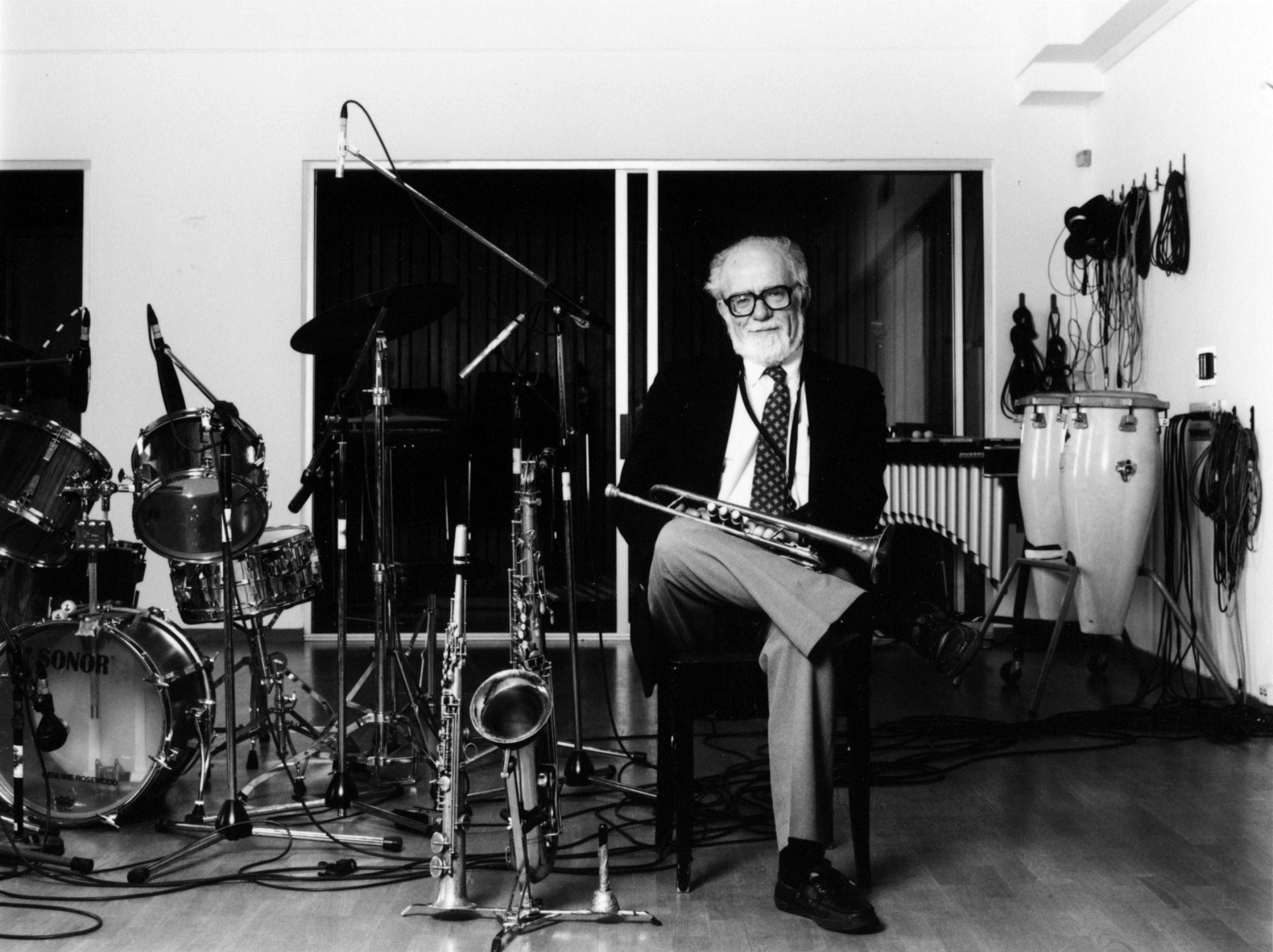
I suspect if you knew Hal’s music, you knew the man. There was no artifice, no posturing, no gamesmanship. Whatever his personal life was like, when he was performing, his exuberance exploded out into the audience, often carrying the rest of the band along with him, though he was typically twenty-some years older than each of them.
-Art Lange
I wish I knew the exact year I moved from California to Chicago. It was probably 1992 or 1993. The Chicago Stadium closed in September 1994, and I had been in Chicago a couple of years before that. So I’m thinking it was the spring of 1992. That was the second time in my life I’d moved from California to the Midwest.
The first time was when I was a child. We were living in Sacramento, where my dad worked at Aerojet General. Once the Vietnam War broke out, and funds for his government contract were transferred to the war effort, he found a job at Minnesota Mining and Manufacturing, more commonly known as 3M.
My mom and dad, three brothers and a sister, two cats, a dog, and I packed into our wood-panelled Ford station wagon and drove halfway across the country. It was the middle of winter, and we had no winter clothes. I wrote a little about that adventure here:
After the service, I settled in the Bay Area of San Francisco until Abbott Labs bought the company I worked for, and I got transferred to Chicago. Once again, I drove halfway across the country.
I grew up mostly in Minnesota, so it was an easy move, and I had that midwestern sensibility going for me. I would move to Minnesota in the spring of 2000, so I had a great run. I ended up loving Chicago.
The early 1990s were a great time to live in the Windy City. The Jazz Record Mart was still open, and I spent a lot of time and money on jazz records there. At that time, the free jazz scene was thriving, and I spent even more time and money learning about free jazz in all the great venues like the Velvet Lounge, Empty Bottle, Bop Shop, and the Elbow Room. I had the chance to hear so many great musicians back then, like Fred Anderson, Joe McPhee, Hamid Drake, Ken Vandermark, Mars Williams, all the Art Ensemble of Chicago and AACM cats, as well as European artists like Peter Brötzmann, Mats Gustafsson, and Fred Lonberg-Holm, who were spending a lot of time there. The list is endless. However, one artist I did not get a chance to hear was Hall Russell, who passed away in September 1992, a few months after I arrived in Chicago.
As I think back on that time, I really had no context at all for Hal Russell. Unlike all the great artists I was lucky enough to see and hear playing around town, I knew very little about him. It took me some time to understand where he fit into the long tradition of Chicago-area jazz and in the wider context of international jazz. For many years, he remained an enigma to me.
This week on that Big River called Jazz, we’ll dig in our paddles and discover the world of Hal Russell.
Harold Luttenbacher was born in Detroit but grew up in Chicago. When he was four, he started to play drums. By the timehe was in high school, he was leading a jazz quartet. He majored in trumpet in college and led a big band. In the summers, he toured with Woody Herman, Boyd Raeburn, and Claude Thornhill. He spent most of the 1950s playing in a supporting role for jazz greats such as Billie Holiday, Benny Goodman, Duke Ellington, and John Coltrane; however, drug addiction took much of that decade away.
I’m not sure when he changed his name to Russell, but in 1959, in search of more freedom in jazz, he joined the Joe Daley Trio. He played drums, with Daley on tenor, and Russell Thorne on bass. In 1963, they played at the Newport Jazz Festival, and RCA Records later released The Joe Daley Trio At Newport ’63. From that album, here is Ballad:
This is a terrific and very underrated post-bop album, and one of the first public displays of Ornette Coleman’s influence. This album helped spread the word. However, Russell and the band’s bassist, Thorne, who played a 5-string acoustic bass, which was unheard of at the time, eventually turned against the less adventurous Daley, and the band broke up.
Russell hit the road for Florida, but only stayed briefly. In the late 1970s, he returned to Chicago and made a decent living playing shows for dinner theater. Then he started recruiting and mentoring some younger, more forward-looking musicians about half his age to help realize his dreams and formed the NRG Ensemble.
One of his earliest ensembles included Steve Hunt on vibes and drums, Brian Sandstrom on trumpet, Curt Bley on bass, and Chuck Burdelik on reeds, who replaced the departed Mars Williams while he was on tour with The Waitresses. I wrote about them here:
Patty Donahue & Mars Williams

Here’s a Christmas Eve special edition, on that Big River called Jazz…
The NRG Ensemble tore up Chicago, but Russell didn’t record his first album as a leader until March 5, 1979, as Hal Russell’s Chemical Feast. It was recorded at Elixir Gallery in Chicago; however, it was unfortunately only released posthumously in 2001 as Elixir by Atavistic Records on John Corbett’s Unheard Music Series.
Russell’s first actual release was recorded in Chicago on May 11, 1981, and released that same year for Nessa Records:
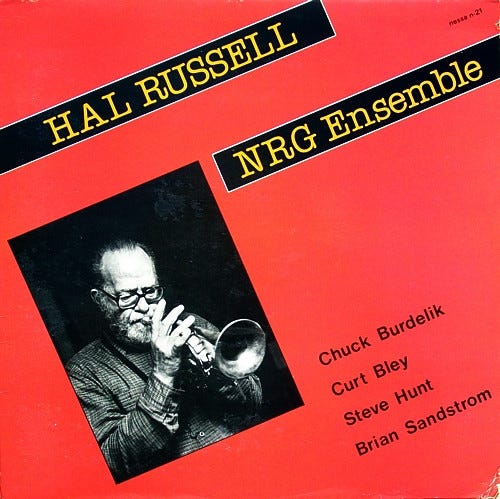
According to Chuck Nessa:
In the Fall of 1981 Mars was back in town (after touring with The Waitresses) and Hal mentioned they were jamming in his attic with great results. I suggested a recording session and they agreed. Hal, Mars and I went into Mike Rasfeld’s Acme Studio and we rolled tape (4 reels) of pure improvisations. Mars and Michael Lytle eventually edited the material down to seven pieces of lp length. By the time the project was finishing, Mars was a member of the Psychedelic Furs and was in England working on a release with that band. Mars took advantage of the situation and finished the masters with engineer/producer Howard Gray at Manor Studios. This record was issued to nasty reviews and fewer sales than the NRG record.
In 2012, Nessa re-released the album with some additional tracks. All of these players were wonderfully inventive musicians with excellent technique.
Nessa also produced Russell’s next album, Eftsoons, an explosive duo release with Mars Williams, recorded on August 21, 1981, at Acme Studios in Chicago and released in 1984. Both of these releases are excellent and can be found here.
After the release of that first NRG Ensemble album, Nessa was discussing a new project with Russell, and he mentioned that he had several charts with baritone parts that Williams used to play. Nessa knew Charles Tyler would be in town for the Chicago Jazz Festival and suggested to Russell that Tyler could play the baritone parts. While Russell was unfamiliar with Tyler’s work, Nessa knew he loved Albert Ayler and made that connection, so Russell agreed. Then Nessa contacted Tyler, who agreed to stay on after the festival for a couple of days of rehearsal and recording. The result was Generation, recorded on September 9, 1982:
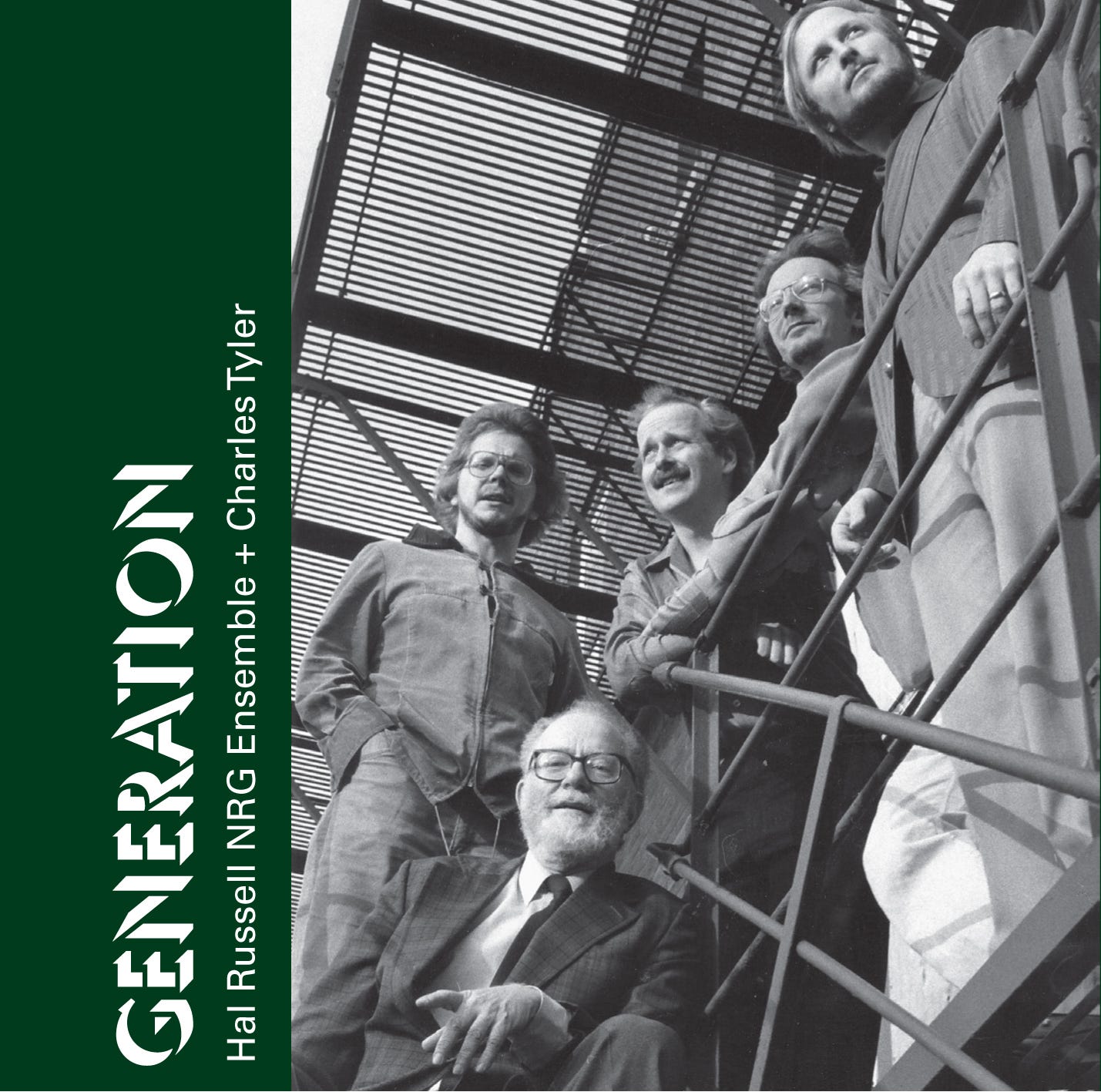
You can buy this CD here.
In his 1984 book The Feedom Principle, Chicago critic John Litweiler wrote this about the energy of Russell’s group at that time:
(Donald) Garrett’s intensity is matched by Hal Russell’s NRG Ensemble, a quintet of prolific multu-instrumentalists who explode into delirious infernos of energy, ignited by drumming of either Russell or Steve (Hunt) or sometimes both.
That’s high praise. It was Donald Garrett who helped pave the way for the AACM in Chicago, before he moved to San Francisco. I wrote about him here:

Nessa was in Chicago at the time to hear these “delirious infernos of energy” and held the band in very high regard, which is why he recorded them. And thankfully for us, he did, so we now have these important documents.
Russell and the NRG Ensemble’s music was consistently excellent by the 1980s, but it continued to develop and extend into multimedia events. For example, in May 1987, the NRG Ensemble performed four shows at Chicago Filmmakers, featuring the group onstage in front of a movie screen during a screening. The first, an off-the-wall suite, The Surreal Sound of Music, was based on The Sound of Music, while Julie Andrews, Christopher Plummer, and the rest were shown on a screen behind them. The others were: Fred, a tribute to Fred Astaire with onstage dancers; Time Is All You’ve Got: The Artie Shaw Story, a film documentary about bandleader Artie Shaw; and The Freedom Principle, based on Litweiler’s book of the same name.
In 1991, Russell recorded his first album with the ECM label, The Finnish/Swiss Tour. It was recorded in November 1990 at the Tampere Jazz Happening and the Internationales Jazz Festival Zürich. From the album, here is Dance of the Spider People:
Here’s another great one, For MC:
During the early 1990s, Russell’s NRG Ensemble finally began to enjoy a degree of international recognition, which he had fought a lifetime to achieve.
In 1993, Russell’s semi-autobiographical album The Hal Russell Story was released on the ECM label. I love this album, and it has that same sense of humor I find so enduring in the Willem Breuker Kollektief recordings.
In a Chicago Tribune article with Howard Reich in 1992, NRG instrumentalist Brian Sandstrom shared this about Russell’s last tour of Germany, with a recording stopover in Switzerland:
Finally, things were really starting to happen for Hal, and it was about time. Hal was in a good mood for that tour, because we were fine-tuning his big piece, The Hal Russell Story. Because of it, Hal was thinking all about his life, trying to get it down in sound.
It really hadn`t come together yet. When we kept at it in Germany, it finally began to work. And when we went to record it, we really got it, and Hal was quite happy about that.”
The Hal Russell Story was recorded in July 1992 at Hardstudios in Winterthur, Switzerland. Here is the last song on the record, Oh Well:
Oh Well was written by Peter Green, another innovative and underrated musician, who I wrote about here:

In a strange twist of fate, Oh Well would be the last song on Russell’s last record. Just after completing The Hal Russell Story, five weeks later, on September 5, 1992, Russell died unexpectedly of a heart attack. He was 66 years old.
Here’s one more for the road. Unfortunately, as I said, I never did see Hal Russell perform live. After he passed away, the ensemble recruited Ken Vandermark and recorded three more albums under the leadership of Mars Williams, the last Bejazzo Gets a Facelift, released by Atavistic in 1998. Here’s the title track:
They lifted the NRG Ensemble torch and kept Hal Russell’s spirit alive.
Just like New Orleans “funerals with music” were followed by a celebration of life, the Hal Russell Memorial Concert, shortly after his death, was subtitled “A Joyous Noise on Hal-o-ween,” undoubtedly because musical joy was what Hal Russell was all about. Even more, a coterie of Russell fans in Chicago continues to hold an annual “Hal the Weenie” Halloween tribute to Hal Russell. The name comes from one of Russell’s songs.
And so it goes…
Next week on that Big River called Jazz, we’ll dig our paddles into the waters of David Bromberg.
Please hit this link to buy me a cup of coffee if you’d like to show your guide some appreciation for this and past journeys. I thank you in advance for your kindness and support.
If you like what you’ve been reading and hearing so far on our journey and would like to share this with someone you think might be interested in learning more about our great American art form, Jazz, just hit the “Share” button.
From Astaire to Sun Ra: A Jazz Journey is a reader-supported publication. If you feel so inclined, subscribe to my journey by hitting the “Subscribe now” button.
Feel free to contact me at any time to talk shop. I welcome and encourage that.
Until then, keep on walking….
As someone who was trying to keep a handle on that Chicago scene from across the Atlantic I really enjoyed this remiscence. The ECM releases were a lot more available here than those on the local labels. A great band led by a fascinating musician
That Daley album, is it one of those pretend live albums recorded in a studio, a remote suggests so but you know how reliable those remote memories are...