
The Lighthouse All-Stars
Chances are it swings...

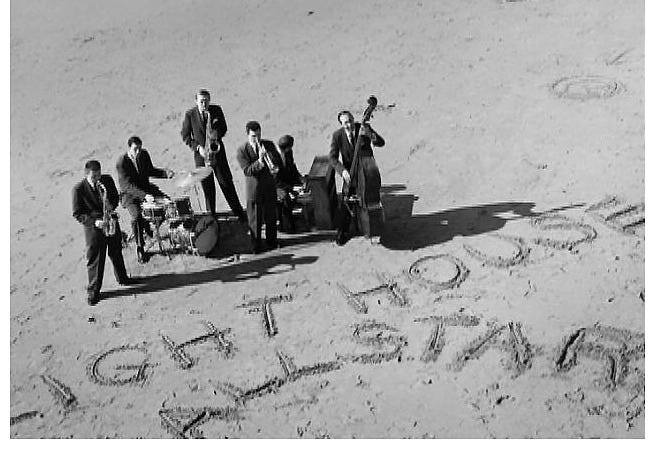
When you have great jazz improvisationalists working together, it’s like the aperitif of life. There’s nothing more elegant and beautiful.
-Howard Rumsey
One of the first West Coast jazz albums I heard was Shorty Rogers’ 1959 Chances Are It Swings, which I bought at the Papa Jazz Record Shoppe in Columbia, South Carolina, where I was sent while on army reserve duty. I bought it based on the cover alone:
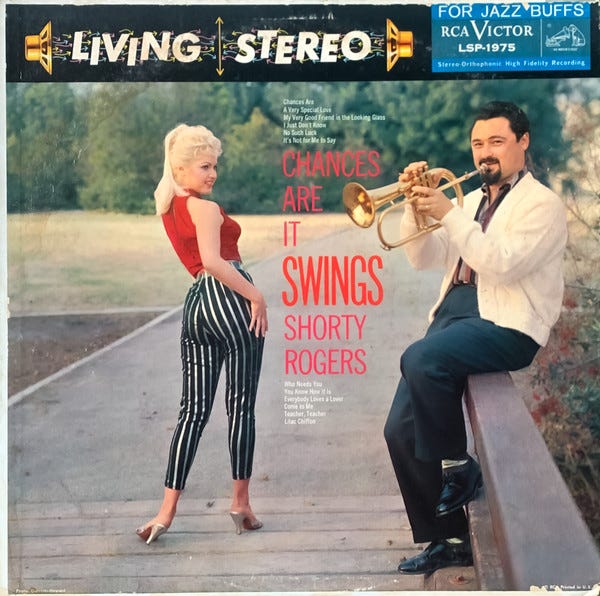
I thought the names of the first two tracks were clever: Chances Are and No Such Luck. Well, for me, I was in luck. It did swing. At that time, I was just starting on my jazz journey.
When I was in college in New York and spending time at the jazz clubs in Greenwich Village, I was still more a blues guy than a jazz guy. However, once I began my first active duty assignment in the Netherlands, I started reading The Wire magazine and learning about that Big River called Jazz. The Wire opened up a whole new world for me in music. One article in particular that I remember reading that interested me was a review of the Mosaic Records release of The Complete Pacific Jazz And Capitol Recordings Of The Original Gerry Mulligan Quartet And Tentette With Chet Baker. I ordered it, and a month or so later, it came in the mail. That box set was the beginning of my love affair with West Coast jazz.
After I left active duty, I was still in the reserves at Fort Ord and living in the Monterey Bay area. That’s when I began searching for jazz records in all the used record stores up and down the San Francisco Bay Area from Pacific Grove to Mill Valley. Whenever and wherever I travelled, I’d search out the used record stores. That’s how I found Chances Are It Swings in Columbia. And some 35 years after I bought it, I still hold this album in high regard. When I pull it out and hold the cover in my hands and listen to the music, that feeling I got when I heard it the first time comes back. It’s like that first kiss -it just stays with you.
The second album I heard was the EP Modern Sounds by Shorty Rogers and his Giants, which I picked up at the infamous Big Al’s Record Barn in San Jose:
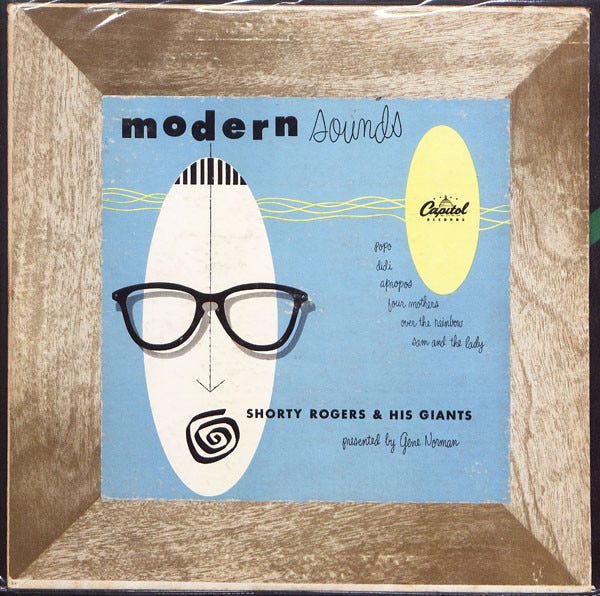
Modern Sounds was recorded for Capitol Records in Hollywood on October 8, 1951, but was not immediately released. His giants included Art Pepper and Jimmy Giuffre on saxes, John Graas on French horn, Gene England on tuba, Hampton Hawes on piano, Don Bagley on bass, and Shelly Manne on drums.
Shorty Rogers got his start shortly after he left the service in 1945 on the East Coast with Woody Herman’s First Herd. He made a name for himself writing charts for Herman’s band-within-a-band, the Woodchoppers. Rogers traveled to California with the band in the summer of 1946; however, in the fall, when the band returned to New York, Shorty and his wife, Michele, Red Norvo’s sister, stayed behind. After another short stay with Herman’s Second Herd, in December of 1948, Shorty left to join Stan Kenton’s Innovations in Modern Music orchestra, one of the most popular bands in America.
Interestingly, Kenton’s orchestra wasn’t a hard-swinging band. Kenton wasn’t all that interested in swinging and left that up to the Herman and Basie bands. However, Rogers set out to prove that Kenton’s band could swing, if it wanted to. Soon after joining the band, he wrote swinging compositions like Jolly Rogers and Art Pepper, precursors to Rogers’ work after leaving Kenton’s band. Here’s Rogers’ Art Pepper:
Kenton’s first Innovations tour ran until June 1950, when Kenton took a six-month rest. When he announced the second Innovations tour for early 1951, Rogers stayed behind; he’d had enough of the road.
Rogers then worked in Hollywood, doing the usual gigging and one-night stands until independent record producer Gene Roland approached him about a record date. Rogers agreed, and on October 8, 1951, recorded Modern Sounds. After this session, in December 1951, Rogers received a call from Howard Rumsey, a bass player and charter member of Kenton’s first band.
Howard Rumsey was born on November 7, 1917, in the desert community of Brawley, California, north of Mexicali. While attending Los Angeles City College, he took up the bass and started his professional career with Vido Musso’s band, where he met the young pianist Stan Kenton. When Kenton wanted him to play in his band at the Rendezvous Ballroom in Balboa Beach, the great jazzman asked permission from Rumsey’s mother, who at the time ran a chicken pie shop in San Diego. She agreed, and he spent two years on the road with Kenton before leaving the band in 1943. He then worked with Charlie Barnet, but quit when the band went on the road.
During the post-war years, Rumsey led a band at a place named the Lighthouse, a small club located on Pier Avenue in Hermosa Beach. Early members of his first group included many of LA’s Central Avenue musicians like Hampton Hawes, Teddy Edwards, Sonny Criss, and Wardell Gray.
Over the next couple of years, Rumsey created a working band, which he called the Lighthouse All-Stars, and turned the Lighthouse into a beacon for the LA jazz scene.
This week on that Big River called Jazz, we’ll dig in our paddles and discover the early years of the Lighthouse All-Stars.
The Lighthouse was built in 1934 as a restaurant named Verpilates. In 1940, the business changed hands, and under new ownership, it was turned into a Polynesian-style club named the Lighthouse, primarily serving merchant seamen. In 1948, the club was sold to John Levine.
In early 1949, Rumsey was searching for a place to play and came across the Lighthouse, which he felt would be an ideal place for live music. In a 1979 interview with Leonard Feather, Rumsey recalled his initial conversation with Levine:
I asked him, “How about putting on a Sunday jam session?”
He said, “Kid, are you gonna try to tell me what to do with this place?”
I talked some more. Finally, he said, “OK, let’s try it out.”
The next Sunday I put together a fine combo, opened the front doors - there was no PA system, but we kept the music loud enough to roar out into the streets - and within an hour Levine had more people in the room than he’d seen in a month. That was Sunday afternoon, 29 May 1949.
By 1951, Rumsey had settled into a permanent group, and the Lighthouse All-Stars were born.
The Lighthouse All-Stars’ first recording was a Jimmy Giuffre and Shorty Rogers tune called Big Boy, which took up both sides of a 78 RPM. It was recorded in early 1952 for Skylark Records.
Skylark Records was started by Indiana native Robert Scherman, who began his career in the record business as a producer for Cincinnati, Ohio’s King Records and Federal Records. He then moved west and was the president of California’s short-lived Atlas Records. On March 1, 1951, he launched the Skylark label with ten 78 RPM singles, which included sides by Vivien Garry.
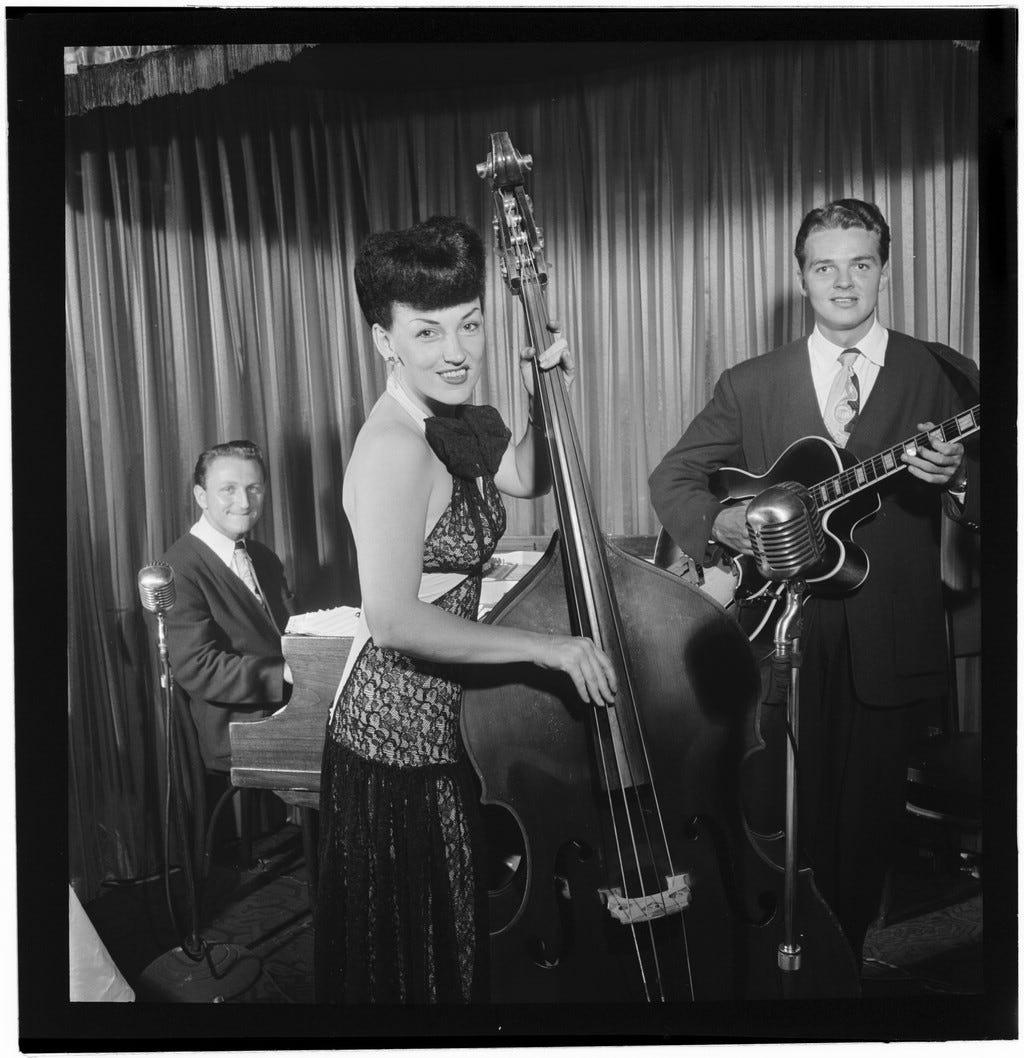
According to James Harrod, Vivien Garry’s career was intertwined with the emerging guitar career of Arv Garrison. They met in Monroe, Michigan, a lakeside town twenty miles north of Toledo, at The Silver Moon, a nightclub where Garrison was performing with a Toledo band led by Bud Ziegler. However, the Bud Ziegler Trio dissolved in 1942 when Ziegler was drafted after America entered WWII. Garry learned to play bass and continued her musical career with Garrison as the Vivien Garry Trio. Here they are:
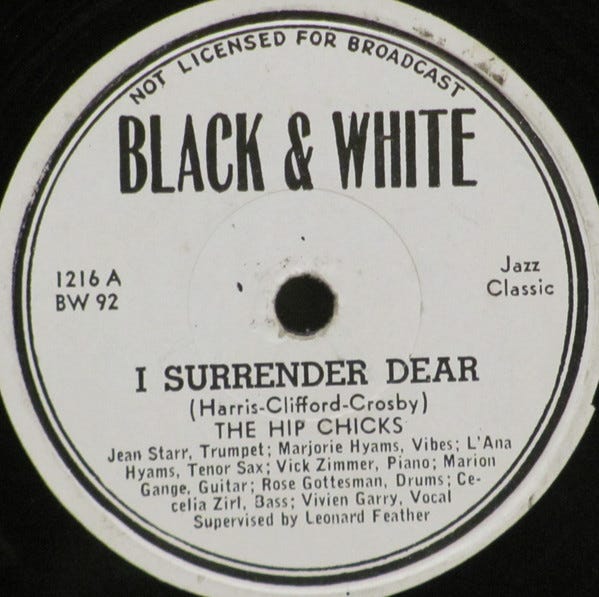
Leonard Feather heard the trio in 1945 during their lengthy engagement at Kelly’s Stable in New York City. He wrote a complimentary review in his regular column in Esquire magazine, and in March of 1945, Feather invited Garry to sing I Surrender Dear on a session for Black & White records with an all-female group, The Hip Chicks, which claimed to be the first all-female jam session in recording history:
Here she is on Armed Forces Radio Service’s Jubilee in October 1946 singing I’m in the Mood For Love with some fine obligato by Benny Carter:
Garry later formed an all-female quintet. Here she is keeping time for the Vivien Garry Quintet performing A Woman’s Place is in the Groove, released by RCA Victor in 1946 - they were more than just a novelty act:
Following her New York successes, around 1948, Garry relocated to Los Angeles and immersed herself in a growing West Coast jazz scene. Through her earlier association in New York with trombonist Dick Taylor, she recorded with Scherman’s Skylark label.
During this time, Garry met and married Lighthouse All-Star Jimmy Giuffre and arranged for the Lighthouse All-Stars to record Big Boy on Skylark, which became an instant hit in the LA area.
Big Boy was a parody of Coleman Hawkins’ The Big Head, which Hawkins performed at Jazz at the Philharmonic. Big Boy was extremely popular with the beach crowd, who gathered at the Lighthouse for the Sunday marathon jam session that lasted until early Monday morning. Here is Rumsey on the genesis of Big Boy:
Here’s Part I of Sylark Records’ Big Boy, recorded in early 1952 at Capitol Melrose Studios in LA. The group members are listed on the label:
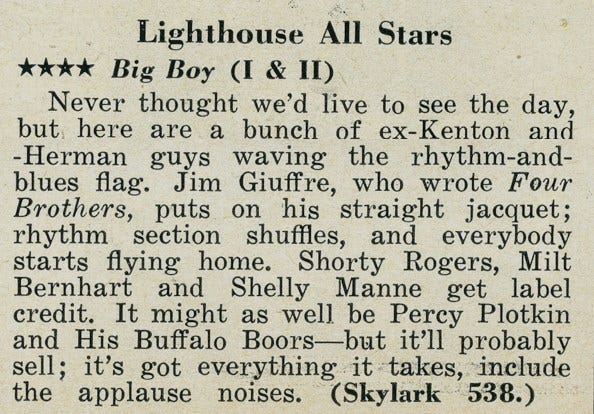
Here’s a review of the record in the July 30, 1952 issue of Down Beat magazine:
Donald Dean, a Lighthouse All-Stars fan who made dozens of private recordings when he lived next to the Lighthouse in the early 1950s, recorded this interesting live recording of Big Boy on March 15, 1953, with Jimmy Giuffre, Bob Cooper, tenor saxes; Milt Bernhart, trombone; Shorty Rogers, trumpet; Frank Patchen, piano; Shelly Manne, drums; and Howard Rumsey, bass:
At about the same time in 1952 as Skylark’s Big Boy release, Capitol Records finally released Shorty Rogers’ Modern Sounds. Based on the strength of Modern Sounds, in the spring of 1953, the Giants returned to the studio to record two albums for the RCA label: Shorty Rogers and His Giants and the seminal Cool and Crazy.
The success of the Lighthouse All-Stars’ initial Skylark releases, no doubt, was responsible for Rumsey and his partner John Levine’s decision to establish in 1952 the Lighthouse Record Company, which released 78 and 45 RPM singles as well as a 12” LP release, Lighthouse C301, Sunday Jazz A La Lighthouse Vol. 1, their final release under the Lighthouse Record Company logo.
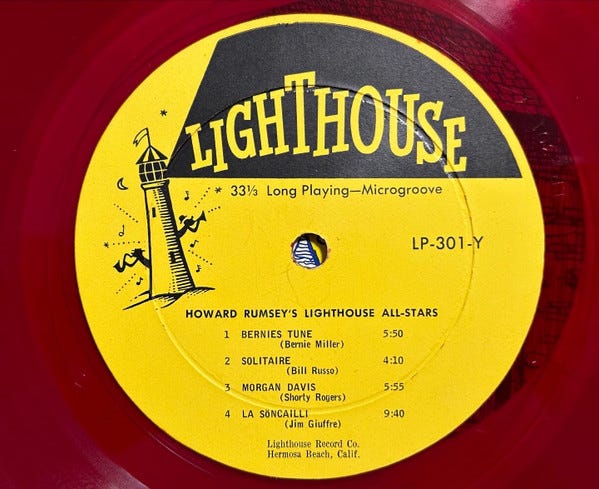
Shortly after Lighthouse Records released Sunday Jazz A La Lighthouse Vol. 1, Lester Koenig also released it on his newly founded Contemporary Records label, which he started in 1952 to concentrate on issuing contemporary classical music. However, Rumsey persuaded Koenig to release his first All-Stars recordings as an album, and from then on, Koenig focused his label on modern jazz.
Here is Rumsey’s Lighthouse Records album Sunday Jazz A La Lighthouse Vol. 1, released in 1953 as the first Contemporary Records album, essentially the same label issued now under the Contemporary Records’ “Lighthouse Series”:
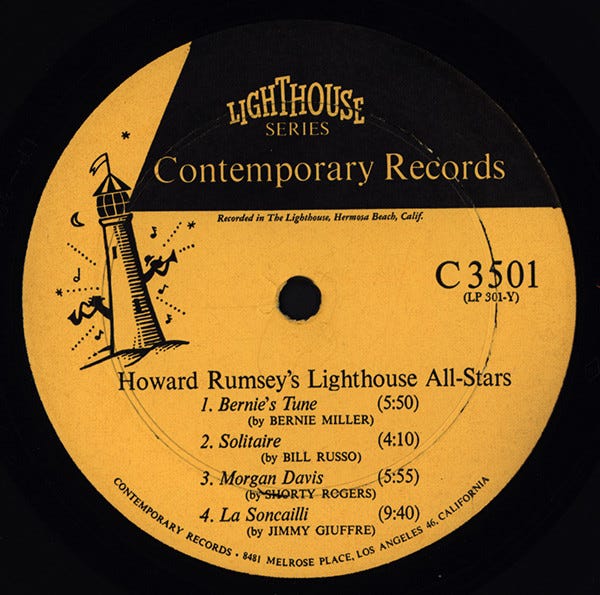
With his Skylark, Lighthouse, and Contemporary releases, along with the releases of Shorty Rogers and His Giants, Rumsey’s Lighthouse All-Stars launched West Coast jazz from their beachhead in Hermosa Beach and went on to record many more fine albums on Koenig’s Contemporary label.
Here’s one more for the road. After Rogers, Giuffre, and Manne left together in 1953 for a job at the legendary The Haig, located at 638 South Kenmore Avenue near Wilshire Blvd in downtown LA, Rumsey had to recreate his band one more time. This third edition of the All-Stars featured Bud Shank, Bob Cooper, Rolf Ericson, and Max Roach. On September 13, 1953, this group recorded a historic session featuring guest artists Chet Baker and Miles Davis, along with pianists Russ Freeman and Lorraine Geller.
In 1985, Contemporary Records released two albums from that live performance. The album with Davis was called At Last!, and with Baker was called Witch Doctor.
From Witch Doctor, here is Chet Baker together with the Lighthouse All-Stars on Bernie Miller’s tune Loaded - that’s the same Bernie Miller who composed Bernie’s Tune made popular by the Gerry Mulligan Quartet:
The Lighthouse was, as Stan Levey said, “The place to go.” It was the home of modern jazz on the West Coast, providing a steady place for many Los Angeles musicians, both young and old, to come together and jam. Their success performing with the Lighthouse All-Stars landed many of them their own recording contracts with Contemporary Records.
Throughout the 1960s, working with a core of LA’s best musicians, Rumsey continued to put on his jam sessions each week until his partner John Levine passed away in 1971. Then Rumsey opened Concerts By The Sea, a 200-seat venue in nearby Redondo Beach, where he continued to perform until he retired in 1985. What an amazing run.
When you talk about the great bassists in the history of jazz, Howard Rumsey’s name rarely, if ever, comes up. He chose a simple life, playing the music he loved with his friends in a small club just off the beach. What could be better than that?
Just last weekend, I was in Hermosa Beach on a Sunday morning. As we walked up from the beach on Pier Avenue, the doors and windows of the Lighthouse were open, and the band was playing jazz. It was wonderful - the aperitif of life. It made me glad to think that Howard Rumsey’s legacy is still alive. What a tremendous tribute it was!
Next week on that Big River called Jazz, we’ll dig our paddles into the waters of Nudie Cohn.
Please hit this link to buy me a cup of coffee, if you’d like to show your guide some appreciation for this and past journeys. Know in advance that I thank you for your kindness and support.
If you like what you’ve been reading and hearing so far on our journey and would like to share this with someone you think might be interested in learning more about our great American art form, Jazz, just hit the “Share” button.
From Astaire to Sun Ra: A Jazz Journey is a reader-supported publication. If you feel so inclined, subscribe to my journey by hitting the “Subscribe now” button.
Feel free to contact me at any time to talk shop. I welcome and encourage that.
Until then, keep on walking….
Thanks for the comments. I have been searching for a copy of her memoir, but have not had much luck. She does seem like an amazing and strong person. Do you still have the cassettes?
Great history & music-did not know about Vivian Garry but have the Allstars & associated musicians for some time;Chet, Shorty Roger’s, et. al - currently taking a deep dive into Bud Shank. I dream sometimes about making the scene at The Lighthouse or at The Haig - you know all these years & I never read Ted Gioia’s ‘West Coast Jazz’ but I have it on my TBR shelf now.