
The Basement Tapes
Lost time is not found again...

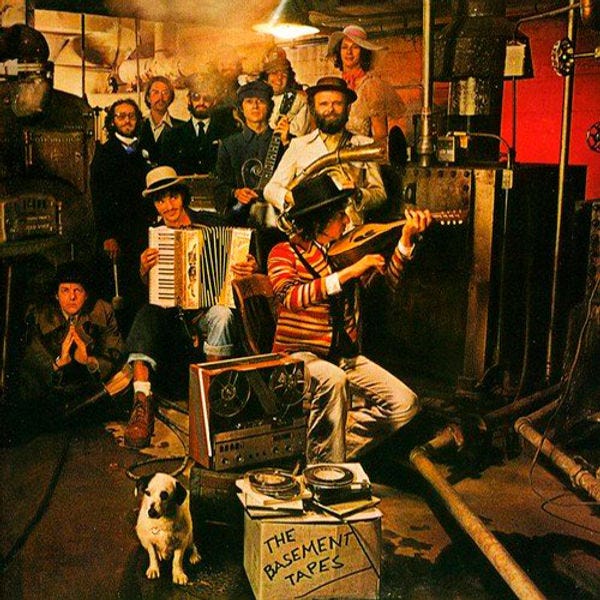
I’m North Dakota-Minnesota-Midwestern. I’m that color. I speak that way. I’m from someplace called the Iron Range. My brains and feelings have come from there.
-Bob Dylan
Like the many lakes that collectively form the headwaters of the Mississippi River, my brother’s record collection formed the headwaters of my musical journey down that Big River called Jazz.
Outside the “pop” music playing on the radio in the mid-1970s, that goldmine of thirty or so albums was the only other modern music I heard. Over the course of a couple of months, I methodically worked my way through all of them - one side at a time.
The jazz-rock/blues fusion albums in his collection, like John Mayall’s The Turning Point, Leon Russell’s Stop All That Jazz, and Santana’s Welcome, interested me the most - that’s where my journey started. However, there was another album in his collection that piqued my interest, Bob Dylan and the Band’s The Basement Tapes.
I knew only of Bob Dylan by what I heard on the radio - Blowin’ in the Wind and Lay Lady Lay, stuff off his Greatest Hits Vol. II album. His Blood on the Tracks album had not yet hit the radio waves. But when I put The Basement Tapes on the turntable in my room in our basement, it hit me hard. It was a strange album that had a raw, lo-fi feel. I can still feel the surprise after hearing the first song, Odds and Ends. I felt kind of odd, too.
Side 1 remains one of my favorite sides of any album. Then I flipped it over, and the first three songs of Side 2 were just as good, until Apple Suckling Tree - I didn’t care for that one. It gave me a chance to pause. That experience, listening to Side 1 and the first three songs of Side 2, made me ask myself, “Who is this Bob Dylan?” I flipped the album over and played Side 1 again:
Now, I stand in awe and I shake my face
You break your promise all over the place
You promised to love me, but what do I see?
Just you coming in spilling juice over me
Odds and ends, odds and ends
Lost time is not found again
This brings to mind a scene from the 1973 film Pat Garrett and Billy the Kid, which I think explains a lot about Bob Dylan.
Pat Garrett, played by James Coburn, asks Bob Dylan, “Who are you?”
Dylan answers, “That’s a good question.”
Here’s the clip:
In a later scene from the film, we learn Bob Dylan’s character calls himself “Alias.”
That makes sense to me - by being nobody, Bob Dylan could be everybody.
Some years later, in an interview, Rita Coolidge explained how Dylan stole hats from the set of Pat Garrett and Billy the Kid, filmed about six years after The Basement Tapes was recorded. Evidently, every day after shooting Dylan would keep the hats and store them in the closet of their home in Mexico, where he and his family lived while shooting the film.
I think the collection of songs from The Basement Tapes is like those hats. They’re all unique, with not much in common, except that they’re all hats. Each has a different story to tell and a different feel when you wear it.
With that in mind, I have no interest in the discographical minutiae surrounding these songs and the recordings; to me, they were just a collection of songs that sparked an interest in my young heart. Framed in the context of a carnival, or minstrel show, as the album cover suggested, I heard in the songs stories of the blues, about love lost and unrequited, about boredom, and the pull of travel. All things I now realize were part of my soul.
“You see,” Dylan told biographer Anthony Scaduto, “I hadn’t really known before that I was writing about myself in all those songs.” Sitting in my basement, eyes closed, rocking back and forth in my chair with big headphones over my ears, for some odd reason, I could identify with him.
This week on that Big River called Jazz, we dig our paddles into part two of this Bob Dylan series, the world of The Basement Tapes.
When Bob Dylan’s father opened a furniture business in Hibbing, Minnesota, his family moved from Duluth up to the Iron Range. Hibbing grew up around the Hull–Rust–Mahoning open-pit iron mine located in the Mesabi Range. It was the largest open-pit mine in Minnesota:
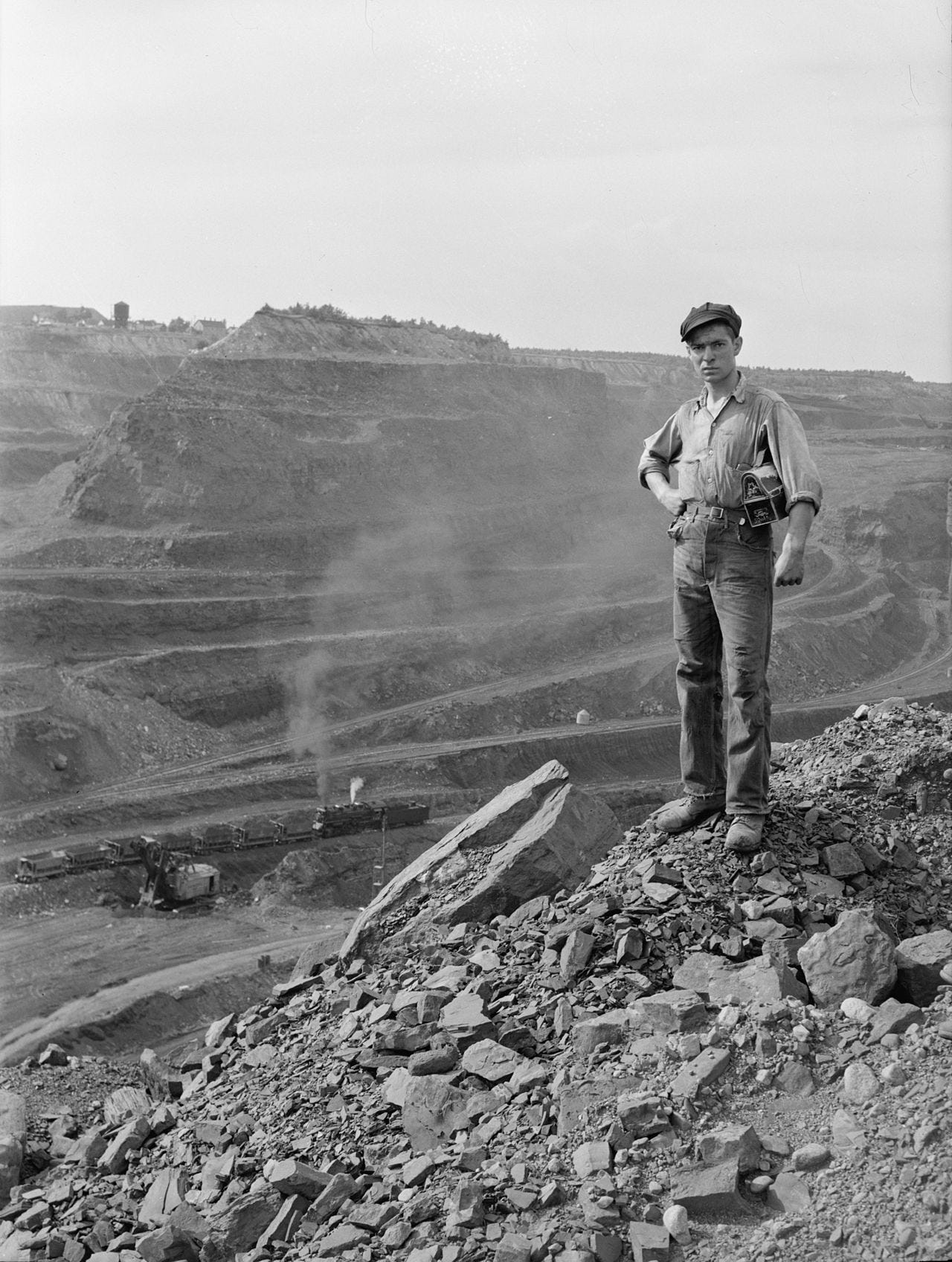
Taconite iron ore was transported along an old logging spur of the Duluth and Iron Range Railroad and shipped by steamer across Lake Superior to places like the Ford Motor Co. in Michigan. The SS Edmund Fitzgerald was carrying about 26,000 tons of taconite pellets when it sank to the bottom of Lake Superior on November 10, 1975.
I’ve been to Hibbing a few times, and it’s the same as many of the northern Minnesota mining towns, like Babbitt and Virginia. Unless you’ve lived through the long winters in Minnesota small towns like these, you can’t understand what it’s like. So I won't try to explain it. But this was the industrial, working-class world in which Bob Dylan grew up, and the landscape that shaped his life.
When Dylan left Hibbing in 1959 for the University of Minnesota, his life began to move quickly. In January 1961, he arrived in New York City with nothing but a guitar and a few songs, and by October 1961, John Hammond signed the 20-year-old Dylan to a record contract with Columbia Records. In his memoir, Dylan wrote:
I could hardly believe myself awake when sitting in his office, him signing me to Columbia Records was so unbelievable. It would have sounded like a made-up thing. …It felt like my heart leaped up to the sky, to some intergalactic star. …I couldn’t believe it. It seemed too good to be true.
By March 1962, he released his debut album, Bob Dylan, and was on his way. That debut album consisted mainly of covers of blues songs by Jesse Fuller, Bukka White, Blind Lemon Jefferson, and traditional spiritual songs, In My Time of Dyin’ and Man of Constant Sorrow. On the other hand, his next album, The Freewheelin’ Bob Dylan, recorded the following year, consisted mainly of original songs influenced by the politics of the day, old spirituals, and love.
Slowly, the Dylan of Hibbing, Minnesota, became consumed by the big city music-making machine. To get some fresh air, in the summer of 1964, Dylan spent much of the summer in Woodstock, a small town in upstate New York, where his manager, Albert Grossman, had a place. During that time, he wrote the songs for his seminal album, Bringing It All Back Home. But he soon found himself back in the grindstone of the city and touring again.
Around 1965, Dylan managed to buy a house in the Byrdcliffe Art Colony area, a historic, utopian arts community founded in 1902 near Woodstock. He continued recording and traveling until July 29, 1966, when he crashed his 500cc 1964 Triumph Tiger 100 motorcycle near his home in Woodstock, suffering cracked vertebrae and a mild concussion. He recovered, but the accident changed his life.
Dylan wrote in his memoir Chronicles:
Truth was that I wanted to get out of the rat race. Having children changed my life and segregated me from just about everybody and everything that was going on. Outside of my family, nothing held any real interest for me and I was seeing everything through different glasses.
The accident forced Dylan to settle down in Woodstock to focus on his family. It also fostered an environment for deep creative work out of which came The Basement Tapes sessions with his touring band, The Hawks, later to be known as The Band.
During this retreat to the countryside, Dylan fundamentally altered his musical direction, moving towards a quieter, more introspective sound influenced by folk and country, a roots music with an American Gothic feel. The Basement Tapes marked an important and clear break from and alternative to the growing avant-garde and psychedelic rock sounds offered during the media-fabricated Summer of Love. His next and most enigmatic album, John Wesley Harding, was an even deeper country affair, recorded in Nashville after but released in December 1967, well before The Basement Tapes was released.
Woodstock domesticated Dylan. In The Last Waltz, Garth Hudson said this about the environment surrounding The Basement Tapes sessions:
Chopping wood and hitting your thumb with a hammer, fixing the tape recorder or the screen door, wandering off into the woods with Hamlet [the dog Dylan shared with the Band] ... it was relaxed and low-key, which was something we hadn’t enjoyed since we were children.
In a 1975 radio interview with Mary Travers, Dylan recalled:
We were all up there sorta drying out ... making music and watching time go by. So, in the meantime, we made this record. Actually, it wasn't a record, it was just songs which we'd come to this basement and recorded. Out in the woods ...
In an interview with Rolling Stone’s Jann Wenner, Dylan recalled:
You know, that’s really the way to do a recording – in a peaceful, relaxed setting, in somebody’s basement, with the windows open and a dog lying on the floor.
All of this confirms a change in spirit that nurtured the folksy Americana that persists throughout The Basement Tapes.
The songs on the album were recorded between May and November 1967, which began at Dylan’s house in Woodstock, before moving to the basement of Big Pink, the house in West Saugerties, New York, rented by members of The Band. However, Dylan didn’t approve the release of the songs by Columbia Records until eight years later, in July 1975, between the releases of Blood on the Tracks and Desire.
The songs I liked when I first heard The Basement Tapes are still the ones I like today, a half-century later. And right out of the gate, I liked Odds and Ends:
At 1 minute and 47 seconds, it’s the shortest song on the album - short and sweet. I remember hearing Robbie Robertson explain somewhere how he would hold his breath during his guitar solos. So I hold my breath during his solos to see if I can make it to the end - this one is about 20 seconds.
The 1975 double album The Basement Tapes that I listened to consists of 24 songs: eight demos by The Band; 15 new Dylan compositions; and a traditional prison work song, Ain’t No Cane On The Brazos. Here’s that song recorded in the mid twentieth century by Ernest Williams & James (Iron Head) Baker:
This is The Basement Tapes’ version, Ain't No More Cane:
The Band’s tracks are more traditional songwriting than Dylan’s songs. On the other hand, many of Dylan’s songs strike me as a little strange, with a kind of odd folk lyric that is hard to follow. Dylan described it this way, “Folk music is the only music where it isn’t simple. It’s never been simple. It’s weird.” Ok, Yea! Heavy and a Bottle of Bread is kind of, well, weird:
In the second verse, what in the world does this mean?
It's a one-track town, just brown and a breeze too
Pack up the meat, sweet, we're headin' out
For Wichita in a pile of fruit
But it didn’t matter to me. It worked, as did the strange and brilliant nothingness of Clothes Line Saga:
And then again, the nonsense of Tiny Montgomery:
What is he trying to say with lines like these:
Skinny Moo and T-Bone Frank
They’re all gonna pig on down by the Fountain Bank
One bird book, and a buzzard and a crow
Tell ‘em all that Tiny’s gonna say helloScratch your dad
Do that bird
Suck that pig
And bring it on home
Pick that drain
And nose that dope
Tell ‘em all that Tiny says hello
It must not have mattered. That’s what I figured, anyway.
Some say the songs sound as if they’d been written using the abstract Cut-Up Method developed by Brion Gysin in 1959 and used by William Burroughs in Naked Lunch, published in the U.S. in 1962. Perhaps. However, I find them more akin to a random artistic process Paul Bowles used in writing his 1962 book A Hundred Camels in the Courtyard, which he described this way:
In 1960 I began to experiment with the idea of constructing stories whose subject matter would consist of disparate elements and unrelated characters taken directly from life and fitted together as in a mosaic. The problem was to create a story-line which would make each arbitrarily chosen episode compatible with the others, to make one lead to the next with a semblance of naturalness.
This sounds to me a little closer to what Dylan was doing with those songs, using a unique mosaic storytelling method within a folksy Americana setting. I found the effect amusing and playful.
I think another reason many of the songs from The Basement Tapes appealed to me back then was that they dealt with lost love. As a young romantic, I dreamed of having a girlfriend someday and “flying down in the easy chair,” but I never had the foggiest idea how that sort of thing would happen. So I lost myself in songs like Katie's Been Gone.
Katie laughed when I said I was lonely
She said, “There’s no need to feel that way”
Katie said that I was her only one
But then I wonder why she didn’t wanna stayDear Katie, if I’m the only one
How much longer will you be gone?
Oh, Katie, won’t ya tell me straight
How much longer do I have to wait?
Didn’t we all have a “Camp Katie” in our lives - out there somewhere?
But perhaps more than anything, what got me most about The Basement Tapes was that many songs were about movement. They were about gettin’. Someone was always: just sliding on out the door; making it over to that million dollar bash; goin' to Acapulco; going down to Tennessee; going back to Pittsburgh; pullin’ out for San Anton'; goin' down the road t' see Bessie Smith; goin’ on out and gas that dog; packin’ up the meat, sweet, and headin' out for Wichita or down to California; trainin’ on down to Williams Point; headin’ down to the river on a Saturday morn; or just goin' to meet again and wait.
I guess, like young Robert Zimmerman in Hibbing, Minnesota, when there's too much of nothing, it just makes a fella mean. I was a restless soul with wanderlust, and inside all these songs, I found myself moving.
Last year, while traveling down the Mississippi River in a canoe, I pulled into Helena, Arkansas, like a ton of bricks to spend the night and visit the Delta Cultural Center, where the legendary King Biscuit Time is broadcast. Originally sponsored by the King Biscuit Flour Co., it is the longest-running daily blues radio show in the United States, first broadcast by KFFA Radio on November 21, 1941.
Around the corner from the Delta Cultural Center, I found Bubba’s Blues Corner, an epic record store, which appears to have never officially "closed down" in the traditional sense, but it sure looked closed to me when I looked in. I noticed the reference on the window to Levon Helm, the drummer and vocalist for The Band, who passed away back in 2012:
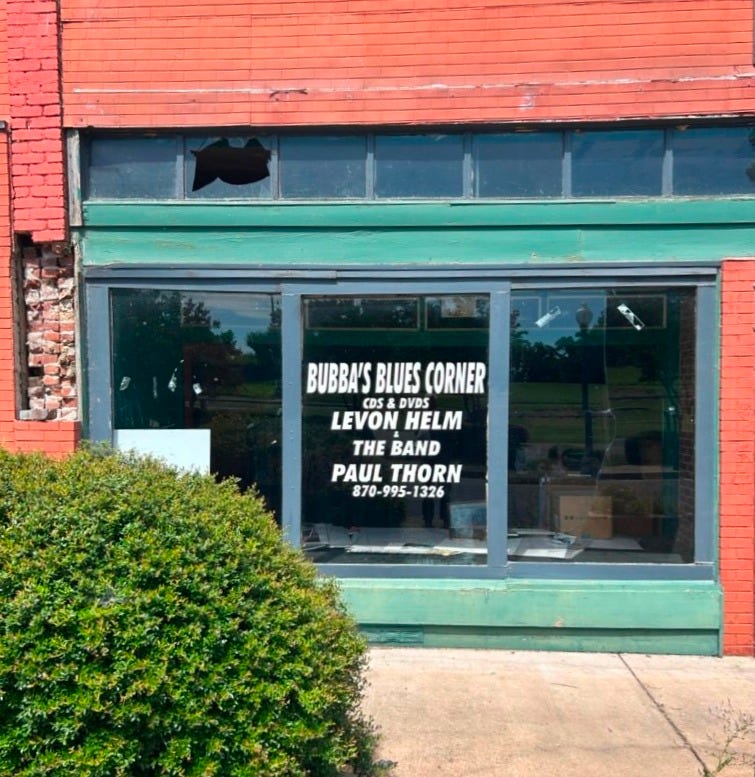
When I went over to the King Biscuit Blues Festival Office, I met Murray Rasberry “Munnie” Jordan, executive director of the King Biscuit Blues Festival. I asked her about the Helm reference, and she told me he was born in nearby Turkey Scratch, Arkansas, and worked at her father’s Pure Oil service station outside of Helena. His parents, Emma “Nell” and Jasper “Diamond” Helm, were cotton farmers who shared a strong affinity for music. She also told me that he credited the King Biscuit Time radio show, particularly drummer James “Peck” Curtis, for inspiring his musical career.
It was in nearby West Helena that Helm met another Arkansas native, Ronnie Hawkins, who was playing a show without a drummer. His piano player knew Helm and suggested that he join the band that evening on drums. It was Helm’s “big break.” While Helm was still in high school, Hawkins invited him to join his band, The Hawks. Here’s an early picture of Ronnie Hawkins and The Hawks, with Helm on drums:
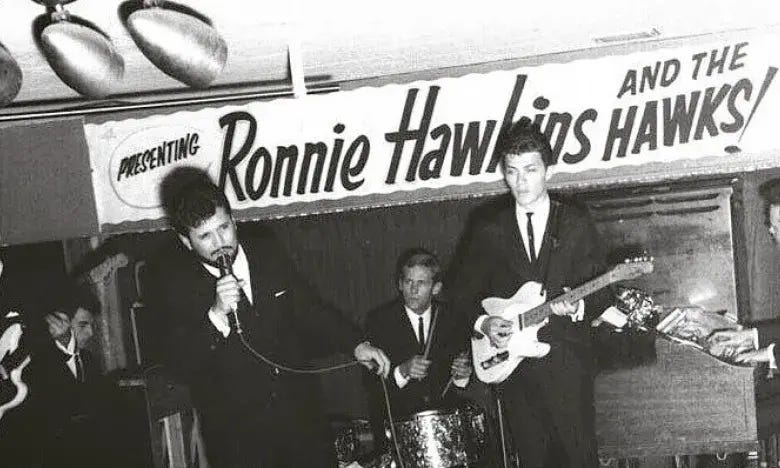
After graduating in 1958, Helm joined The Hawks as a full-time member. In 1959, they relocated to Toronto, signed with Roulette Records, and released a few hit singles. In the mid-1960s, The Hawks gained recognition for backing Bob Dylan on his 1966 concert tour as his first electric band. In 1968, after leaving Dylan, they changed their name to The Band and released their debut album, Music from Big Pink.
Another Midwestern artist who sought solace in the country was Paul Butterfield, who relocated to Woodstock in 1971 after the Paul Butterfield Blues Band broke up following the release of their sixth studio album, Sometimes I Just Feel Like Smilin’. It took him just over a year to build a new band, which he called Paul Butterfield’s Better Days. While in Woodstock, Butterfield became good friends with members of The Band and would later perform and record with Richard Manuel and Rick Danko in the New York area. He also performed with The Band at The Last Waltz concert at San Francisco’s Winterland Ballroom in 1976.
Butterfield’s Better Days band made two albums, both in 1973. While R&B was still in the mix, his more jazzy influence gave way to a roots music that celebrated a wide range of blues and country subgenres. Their first album is simply called Better Days. From the album, here is Done A Lot Of Wrong Things:
The album was recorded at Bearsville, just outside of Woodstock, New York. The studio was built in 1969 by Albert B. Grossman, Bob Dylan’s manager between 1962 and 1970.
Here are a few more for the road. The band Willie and the Bees was a mainstay on the East Bank of the Mississippi in Minneapolis, Minnesota, one of America’s funkiest and most flavorful music scenes, before Prince took over and the scene moved across the river to First Avenue on the West Bank. Willie Murphy, a local guy with a lot of energy, founded the band.
As it turns out, Willie and the Bees backed up Bonnie Raitt’s first album. They were also joined by Chicago Bluesmen Junior Wells and A.C. Reed, Jimmy Reed’s brother. Murphy produced the album, and it features Raitt’s cover of Murphy’s I Ain’t Blue:
Interestingly, “in between ping pong and fishing,” the album was recorded at 4000 Enchanted Lane, on Enchanted Island in Lake Minnetonka, about 15 miles west of Minneapolis. In a 2013 interview, Raitt remembers how her band got there:
Nobody would rent us a farm because we were a mixed-race bunch of ragged hippies and blues guys. Dave Ray and Sylvia, his wife at the time, found this guy who had a remedial reading summer camp, and it was isolated enough that they let us just take it over. So it… was very much like a summer camp. It was just a blast.
Such an incredible album should be recorded at such a majestic and unlikely place. As it turns out, in 1972, for her second album, Give It Up, Bonnie Raitt would go east to Woodstock’s Bearsville studio. For this album, Raitt used members of Butterfield’s Better Days band. Here’s her cover of Jackson Browne’s song Under the Falling Sky with Butterfield on harp:
Grossman’s Bearsville recording studios would be just one component of the complex that would eventually include Bearsville Records, Turtle Creek Barn and Apartments, Location Recorders, the Bearsville Theatre, and multiple restaurants.
On February 6th and 7th, 1975, at Turtle Creek, Muddy Waters traveled to Woodstock to record his The Muddy Waters Woodstock Album, produced by Levon Helm and Henry Glover. It was released later that year by Chess Records, his final release for the label that gave him his start. It featured The Band’s Levon Helm and Garth Hudson, and also Paul Butterfield, and won a Grammy in 1976. Here’s the Bobby Charles tune Why Are People Like That:
After recording Astral Weeks, Van Morrison and his wife, Janet Planet, moved into a home on a mountain top in the Catskills near Woodstock. It was there that he wrote the songs for his next album, Moondance. Recorded with musicians from the Woodstock area, it was released in early 1970. Here’s a favorite, Into the Mystic - I love the bass by underrated Chicagoan John Klingberg, who passed away in 1985. He was only 39:
After writing the songs for his Tupelo Honey album, Morrison decided to move away from Woodstock when the lease on his house expired. In April 1971, before recording for that album began, he and his family moved to Marin County, California, feeling that the 1970 film Woodstock altered the quaint character of the community. In a Melody Maker interview with Richard Williams, Morrison said, "Everybody and his uncle started showing up at the bus station, and that was the complete opposite of what it was supposed to be.”
One of the things I like about the Woodstock music scene is that it ran against the tide and focused on a more organic and natural sound that flew into the mystic. Rather than the psych and progressive rock or protest music, the rest of the world was into, it celebrated a type of relaxed Americana musical presentation that reflected blues and folk. It was arguably closer to the ground than the music that fueled the Summer of Love on the other coast.
Looking back in 1978, in Clinton Heylin’s Bob Dylan: Behind the Shades Revisited, Dylan described The Basement Tapes project the following way:
At that time [in 1967] psychedelic rock was overtaking the universe and so we were singing these homespun ballads…They said it was ahead of its time, but actually it was behind its time.
In his 1997 book Invisible Republic, I find Greil Marcus’ deep comparison of The Basement Tapes to Harry Smith’s Anthology of American Folk Music a little too far-fetched for me; however, I do see a shadow world, his invisible republic, in some of Dylan’s songs. He writes that:
In the basement tapes, an uncompleted world was haphazardly constructed out of the past… The uncompleted world of the basement tapes was a fantasy beginning in artifacts refashioned by real people, dimly apprehended figures who out of the kettle of the folk revival appeared in the flesh to send an unexpected message.
With his songs in The Basement Tapes, I think Dylan was able to jumble together a type of alternate reality and his mid-century realism, which may have seemed old-fashioned in the music world of the late 1960s. But wasn’t that exactly the point?
I liked The Basement Tapes’ relaxed blues-infused songs that dealt with topics and feelings rattling around in my teenage brain. But perhaps most of all, it was that many songs never took themselves too seriously. It doesn’t take much to close my eyes and find myself sitting in my hometown basement listening again to The Basement Tapes and then hopping on my bike and riding out into town, looking for my lo and behold; however, all the while feeling that gentle melancholy that you ain’t goin’ nowhere.
I can tell you that on my 40-day canoe trip down the Mississippi River, the songs that came to my mind most often were songs from The Basement Tapes. I would just start singing them. In the morning, I’d find myself singing, “I had a hard time waking this morning. I had a lot of things on my mind…” or “I'm going down to Rose Marie's. She never does me wrong. She puts it to me plain as day, and gives it to me for a song…” As I paddled in the Lower Mississippi River, with no dams and locks to control the river like on the Upper Mississippi River, it’s amazing how the river towns rely on levees to keep the mighty river at bay, and I’d find myself singing, “Crash on the levee, mama. Water's gonna overflow. Swamp's gonna rise, no boat's gonna row…”
We never really know why certain songs or albums find a way into your heart and stay there. It’s such a personal thing. They just follow you around, wherever you go, even when you ain’t goin’ nowhere.
Next week on that Big River called Jazz, we’ll dig our paddles into the waters of my favorite album from The Band.
Please hit this link to buy me a cup of coffee, if you’d like to show your guide some appreciation for this and past journeys. I thank you in advance for your kindness and support.
If you like what you’ve been reading and hearing so far on our journey and would like to share this with someone you think might be interested in learning more about our great American art form, Jazz, just hit the “Share” button.
From Astaire to Sun Ra: A Jazz Journey is a reader-supported publication. If you feel so inclined, subscribe to my journey by hitting the “Subscribe now” button.
Feel free to contact me at any time to talk shop. I welcome and encourage that.
Until then, keep on walking….