
Skip James
A seminal blues master...

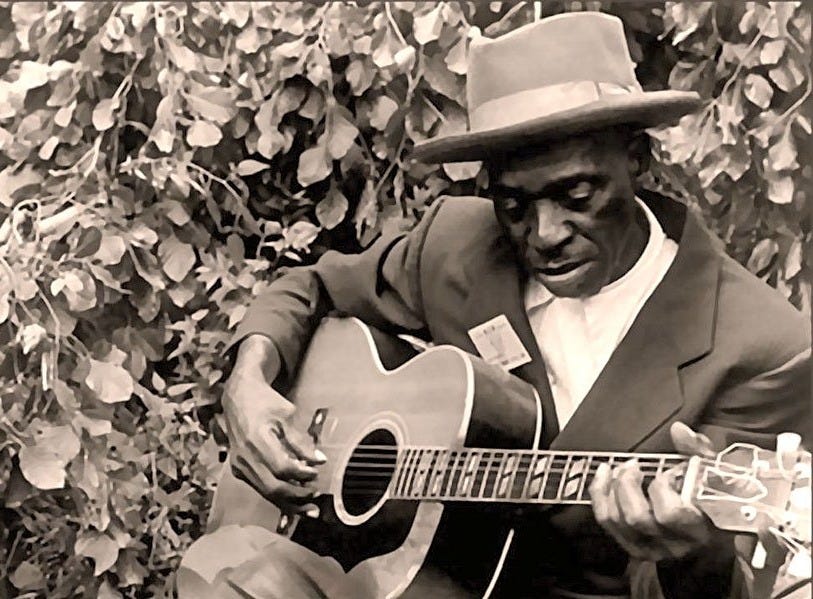
I was raised in the rural, an’ I speak a lots from personal experience. See, what you hear me sing is not just what you hear somebody else sing; I done experienced those things and experimentated some.
-Skip James
Today’s journey is a companion piece to last week’s Blind Lemon Jefferson’s recordings on Paramount Records, which you can find here:

The Wisconsin Chair Company was originally established in the 1880s. By the end of the 19th century, they were the largest employer in Ozaukee County, just north of Milwaukee:
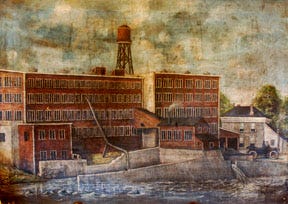
In an effort to sell phonographic cabinets, the company decided in 1917 to start its own record label. The label was called Paramount Records. The factory was formerly located near Falls Road and South Green Bay Road, next to the Milwaukee River. Here’s a marker at the old location:
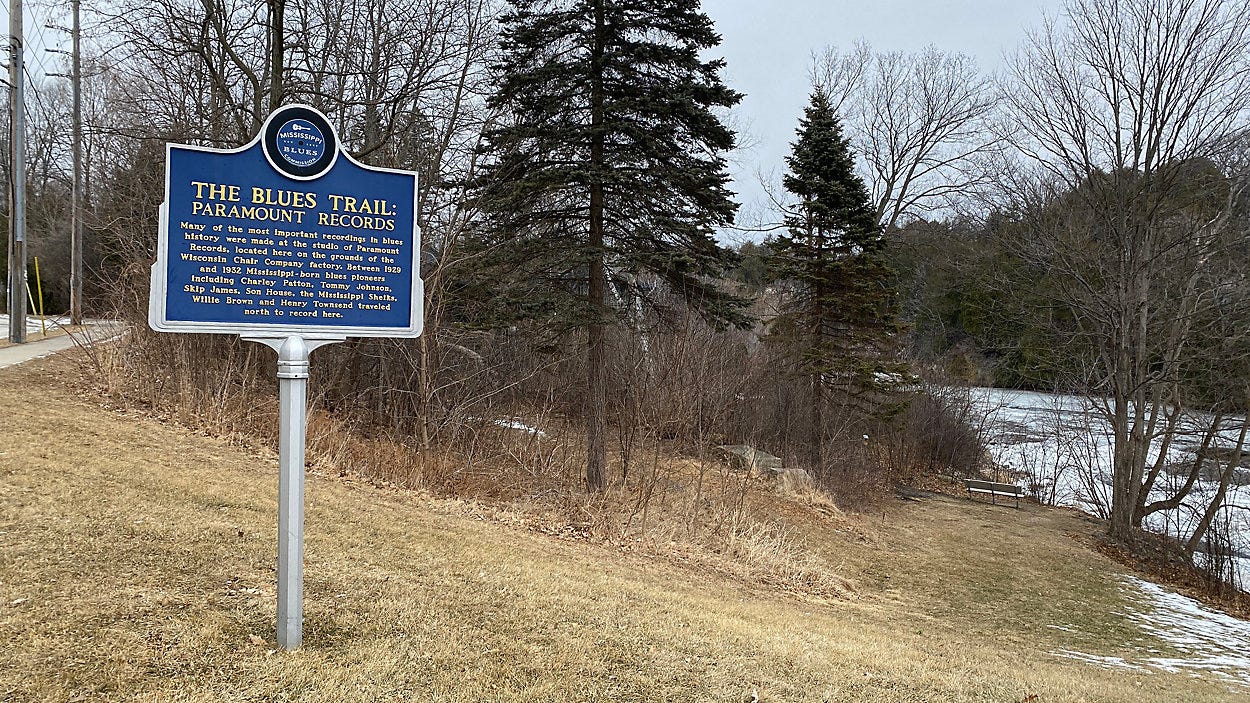
Although records were pressed in Grafton, recordings were initially produced at its New York Recording Laboratories studio in New York City, and by the early 1920s at the Marsh Laboratories in Chicago, where Black producer J. Mayo Williams supervised many recordings. He produced Blind Lemon Jefferson’s first recordings with Paramount in late 1925 or early 1926 in Chicago. However, by the time of Skip James’ Paramount sessions, a dedicated recording studio had been opened in Grafton. The studio produced roughly 1,600 recordings by the time it closed, the last in July 1932. The building was demolished in 1938.
In February 1931, during his only trip to Grafton, Wisconsin, Skip James played some of the most haunting and moving blues ever recorded. Although these Paramount recordings are considered masterpieces today, they sold very poorly back then. Dejected, James languished in obscurity for more than 30 years before he was rediscovered and performed again at the 1964 Newport Folk Festival.
This week on that Big River called Jazz, we’ll dig in our paddles and discover the world of Skip James.
Nehemiah Curtis James was born on September 9, 1902, and raised on R.K. Whitehead’s Woodbine Plantation near Bentonia, a small town about 35 miles northwest of Jackson, Mississippi. His mother was the plantation cook.
According to James, in a mid-1960s interview with author Stephen Calt:
First time I ever heard a guitar was in a country juke joint in Bentonia. Henry Stuckey and Rich Griffith was rappin’ out Drunken Spree behind a man with a fiddle. They was frallin’, and folks were dancin’ in a big house. Cause I couldn’t stay out no way, I hadda slipped off from home. Grandmother would have whipped me to death, man, if she’d a know I stayed off at that frolic.
It was his love for dancing that earned him the nickname “Skip.”
In my young days I used to like dancing, and I’d skip around at the parties people used to have in their houses, so they called gave me the name “Skippy.”
When he was 12, his mother bought him a guitar for $2.50, and he started to learn songs. Around 1917, Henry Stuckey gave him guitar lessons. He learned the distinctive Bentonia school style of guitar playing, which featured odd tunings and chord voicings with a minor tonality not found in other styles of blues music.
James attended Yazoo City High School, where he also learned to play the piano. After graduating from high school, James left town and at times lived in Arkansas, Texas, and Tennessee. He was never a full-time musician; rather, he made a living as a general laborer, dynamite blaster, gambler, pimp, and bootlegger. Music was a hobby, and he performed on street corners and barrooms for extra cash.
While working at a lumber mill in Marked Tree, Arkansas, he met Will Crabtree, a professional musician who mentored him and encouraged him to take his music more seriously. When James moved on to Memphis, he played in barrelhouses. When he got back to Mississippi, he met Little Brother Montgomery and came under his spell.
While staying in Jackson, Mississippi, James took his first step toward becoming a Paramount Records recording artist. However, he still saw himself as an entertainer and found the standard blues songs of his day to be just party music. He thought his songs were much darker, and in an interview with Calt, he said he played them to “deaden the mind” of female listeners and cast a spell. In his book, Blues & the Soul of Man: an autobiography of Nehemiah “Skip” James, Eddie Dean wrote:
In 1931, he got to test his powers. Throughout the ‘20s, business boomed for “race records” produced for a black audience, and companies scoured the South for blues singers. After auditioning for veteran talent scout H.C. Speir, in a Jackson record store, James earned a recording.
At the audition, James tuned his guitar to D minor and started to play Devil Got My Woman:
After hearing James play, Spier was hooked. He purchased him a ticket to Wisconsin and handed him $13 for expenses. James arrived in Grafton in February 1931, in the dead of winter.
Art Laibly, who produced Grafton’s legendary sessions with Blind Lemon Jefferson, Charley Patton, Son House, Willie Brown, and Lonnie Johnson, was on hand to supervise James’ session. From the two-day session, 18 songs were released by Paramount, the first 13 on guitar and the last five on piano.
On the first day, after a sound check, he recorded his audition song Devil Got My Woman. Here’s another classic from that first day, Cypress Grove Blues:
The next day, James recorded five piano songs. One of the songs he recorded was 22-20 Blues. In an interview with Calt, James recalls the events leading up to the song’s recording:
I just only had three minutes to compose that song. And Mr. Laibley, the manager of that recordin’ studio, went up to me and he ask me, “Skip, the .44 Blues [recorded by Roosevelt Sykes on OKeh] is out, rushin’ pretty good, havin’ fast sales. Do you think you could compose us a blues about a gun that would kinda come up to that requirement? Make a pretty fast sale?” I called two of three.
I said, “I don’t know, how about .38 special?”
“No I got that…”
I say, Well, how ‘bout .44-.40?”
“I got that already…” And I call a couple more times - He say, “No, I’ve had those.”
I say, “I don’t know any real guns, but .22.”
He say, “How about .22-.20, how’s that?”
I say, “I guess so.”
He say, “You ain’t got but three minutes now.”
So roughly three minutes later, James recorded this:
The song would become an inspiration for Robert Johnson’s 1936 song 32-20 Blues. Also, James’ Devil Got My Woman was the likely inspiration for Johnson’s Hell Hound on My Trail.
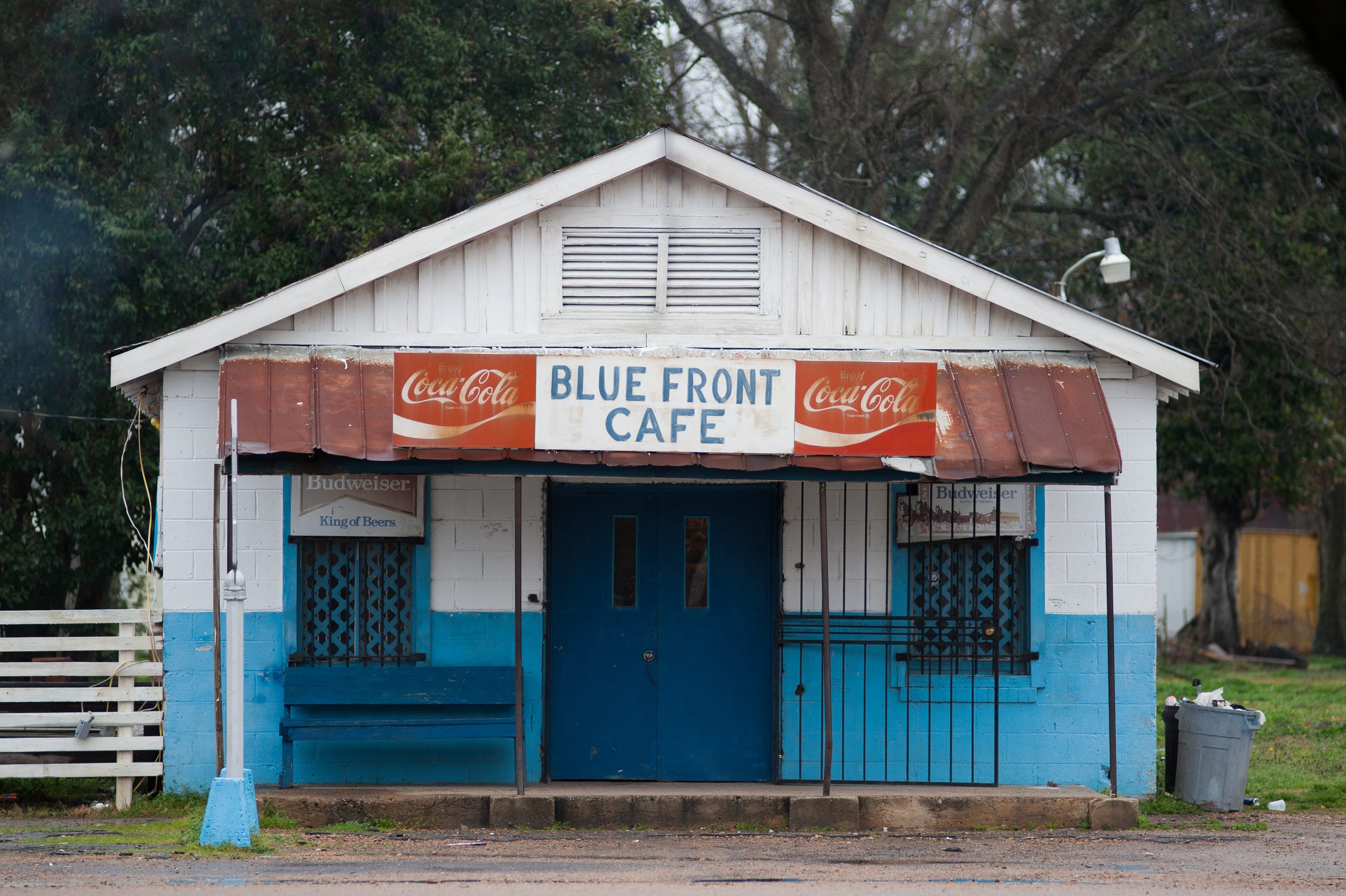
After the Grafton sessions, James returned to Jackson, Mississippi. However, with low record sales, the Depression carried him into obscurity, and James left commercial music. In 1932, he was ordained as a Missionary Baptist minister, and, in 1946, as a Methodist minister. For over two decades, he served, preached, led gospel groups, and, from time to time, played around at the Blue Front Cafe, a juke joint in Bentonia, Mississippi:
However, when Sleepy John Estes was rediscovered in 1962, living in poverty in Brownsville, Texas, a blues revival was launched in America, and things were about to change for many of the forgotten bluesmen.
In 1963, musician John Fahey, founder in the late 1950s of Takoma Records, a small but influential label named after his hometown, Takoma Park, Maryland, located Bukka White working in a tank factory in Memphis, Tennessee. Also in 1963, American University student Tom Hoskins located Mississippi John Hurt in Avalon, Mississippi. Unfortunately, Skip James remained off the radar, wondering, "When will my time come?” He didn’t have to wait long.
In the 1950s, Dick Spottswood was one of the few people who’d ever heard of Skip James. In 1952, still a high school student, he went to an Adams Morgan music store in the Washington, D.C., area and, while digging through 78 rpm records, found a near-mint copy of Skip James’s Paramount record, Hard Time Killing Floor Blues. He bought it for a dollar. This was the beginning of the rediscovery of Skip James.
Over the years, Spottswood spread the word about James’ music through his D.C. radio blues program. In the summer of 1964, a trio of blues enthusiasts led by Fahey, who was then a student at the University of California at Berkeley, drove across country to try to find the lost Skip James. Out of sheer luck, they found him bedridden in a Tunica, Mississippi, hospital. They paid for his discharge and his back rent and told him that they’d take him to the Newport Folk Festival, where Mississippi John Hurt had been a big hit the previous year.
James didn’t even own a guitar, so Fahey loaned him one. After hearing him play a few songs, Fahey tells how James revealed secrets to “chords nobody else on this planet knows. Beautiful, terribly intense, hitherto unknown chord positions… Great Sphinx chords. I could never have found them.”
They all piled into Fahey’s car and drove north to Washington, D.C. A few weeks later, James was playing at the 1964 Newport Folk Festival. Here is an iconic photo Dick Waterman took at the festival that captures that moment James sang his first word:
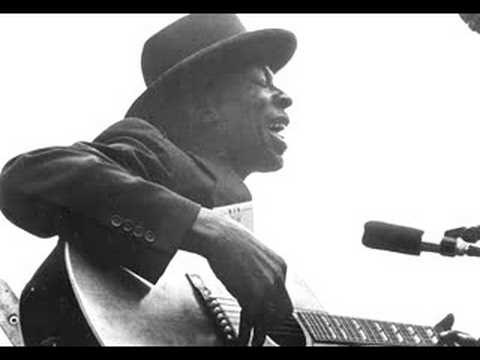
In the Wim Wenders 2003 film The Soul of a Man, Waterman describes that moment:
I have some sense of history, the arc of history being made here, so I want to get the first note, first word, first verse, first song… This is the precise first note of rediscovery.
It had been 33 years between the time James traveled North to Grafton to record with Paramount and that performance at Newport in 1964. Here’s that 1964 performance:
It was a remarkable moment in time. In a festival that included Bob Dylan, Johnny Cash, Pete Seeger, Joan Baez, Judy Collins, Peter, Paul, and Mary, and blues legends like Muddy Waters and Mississippi John Hurt, it was Skip James who stole the show. Waterman recalls:
He stepped out of 1931, and he was riveting, electrifying, charismatic - just stole the festival. Skip James at Newport 1964 was what people left talking about. You didn’t even have to be a blues fan to comprehend the story that a man stepped out of 1931 and just was amazing. He only knew three ot four songs and be brought magic.
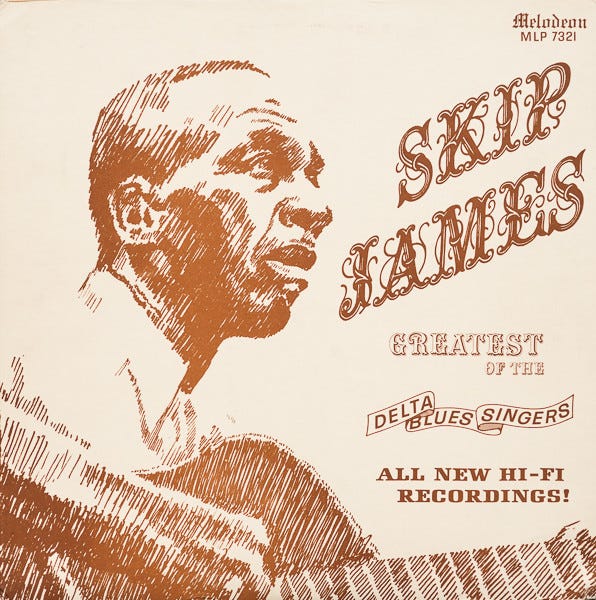
In December of 1964, Spottswood invited James to his home to record the material released in July 1965 as Greatest of the Delta Blues Singers. It was released on Spottswood's Melodeon Records:
In January 1966, a year and a half after his big debut on Melodeon, James went to New York City and recorded Skip James - Today! for the Vanguard label. From that session, here is Special Rider Blues:
Here’s an amazing video of Skip James sitting between Son House and Bukka White at the 1966 Newport Folk Festival playing his song Cherry Ball Blues:
During the summer of 1967, James gained international appeal while touring Europe as part of the American Folk Blues Festival. When he got back to the States, he settled in Philadelphia, playing at folk and blues festivals and clubs until he died on October 3, 1969, at Pennsylvania Hospital. He was 67 years old. He was buried in Merion Cemetery in Bala Cynwyd, Pennsylvania.
In 1994, 25 years after his death, Skip James perhaps finally achieved the level of success he had always hoped for and thought he deserved. First, the Yazoo label released Skip James – The Complete Early Recordings 1930. Second, Fahey and his partner at Takoma Records, Ed Denson, signed James to a recording contract and, in 1964, recorded him in Gene Rosenthal’s basement studio in Silver Spring, Maryland. Although these were James’ first recording session since his rediscovery, legal issues regarding the songs' rights prevented Takoma from releasing them in 1994 as She Lyin’ on the Genes label. It was James’ second studio album. Rosenthal’s basement studio sessions are supplemented in this release with live performance recordings from the same period made by Rosenthal at the Ontario Place Coffee House in Washington, D.C. And, finally, Stephen Calt published the first Skip James biography, I’d Rather Be the Devil.
Here’s one more for the road. During his Grafton Paramount sessions, James recorded I’m So Glad:
In late 1966, the British rock band Cream, with bassist Jack Bruce, guitarist Eric Clapton, and drummer Ginger Baker, released their debut album Fresh Cream. A song from the album was this cover of James’ I’m So Glad:
Skip James influenced a generation of blues and pop artists throughout the years. Beyond Cream, the list includes Deep Purple, John Mayall, Alan Wilson from Canned Heat, Lucinda Williams, Beck, The Derek Trucks Band, John Martyn, The Kronos Quartet, and Chris Thomas King, to name just a few.
Skip James is remembered as perhaps the most stylistically original blues performer from the Mississippi Delta. In 1992, he was inducted into the Blues Hall of Fame.
This week, I have included many videos of Skip James performing. This was intentional because, for me, watching him play is transcendental. The pace of his songs, the way he plays the guitar, his improvisation, and the way he looks up at the sky as he sings in that high-pitched tone are described well here by Waterman:
A lot of bluesmen worked to faces. They worked to the front row, or they told stories. Skip dealt in the abstract. He played his music out over your head into the great beyond.
Watching and listening to him play is a spiritual journey. You can see what I mean from this performance of Worried Blues at the time of the 1965 Newport Festival:
From his 2019 book, Eddie Dean may have said it best:
Skip James’ mythos is less compact than [Robert] Johnson’s. James survived his misspent youth, and the story of his later years provides plenty more of the kind of misery that fueled his music. Where Johnson supposedly cut a single, grand deal with the devil - trading his soul for mastery of his form - Skip James seems to have struck deal after deal and never come out ahead. In a way, James’ story is the truest story of the blues: he led an open wound of a life, and all he got for it was minor-league, post-mortem stardom.
Next week on that Big River called Jazz, we’ll dig our paddles into the waters of Greenwich Village.
Please hit this link to buy me a cup of coffee if you’d like to show your guide some appreciation for this and past journeys. I thank you in advance for your kindness and support.
If you like what you’ve been reading and hearing so far on our journey and would like to share this with someone you think might be interested in learning more about our great American art form, Jazz, just hit the “Share” button.
From Astaire to Sun Ra: A Jazz Journey is a reader-supported publication. If you feel so inclined, subscribe to my journey by hitting the “Subscribe now” button.
Feel free to contact me anytime to talk shop. I welcome and encourage that.
Until then, keep on walking….
If I were trying to describe the Blues to someone, I think I would play them Skips, "The Devil Got My Woman." He brought magic! Indeed he did. 🤘😎🤘
I've read Calt's book on James. A good portion of his income during the last couple years of his life came from the royalties he received from Cream's cover of I'm So Glad, but according to Calt he didn't write it. It was adapted from a mid '20s Broadway show tune. James was obviously a complicated man with something of an unsavory past and some horrible attitudes, but I think he was the first blues player with the self awareness to realize he was making art.
My introduction to him wasn't Cream, I didn't hear that until much later and it's not a patch on the original. I heard John Martyn's free adaptation of Devil Got My Woman, entitled I'd Rather Be the Devil, on his Live at Leeds album with Danny Thompson and the Spontaneous Music Ensemble drummer, John Stevens. A few years later, Fred Frith recorded Hard Time Killing Floor Blues, and Henry Kaiser did Special Delivery Blues as instrumentals on their second duo album, Who Needs Enemies. Then David Soldier arranged a medley of three delta blues for his Soldier String Quartet, including James' 20-20 Blues, Patton's Moon Goin' Down and Waters' Country Blues #2. He assiduously avoided straightening out the rhythms and the microtonality in those tunes, which he said rose organically from the melodic phrasing. For instance he notes that 20-20 Blues has measures in 4/4, 5/4, 6/4 and 7/8. More than anything, it was Frith's, Kaiser's and Soldier's interest in James' music which prompted me to seek out the 1931 recordings when they were finally compiled and released.