
Remembering Sun Ra
Love in outer space...

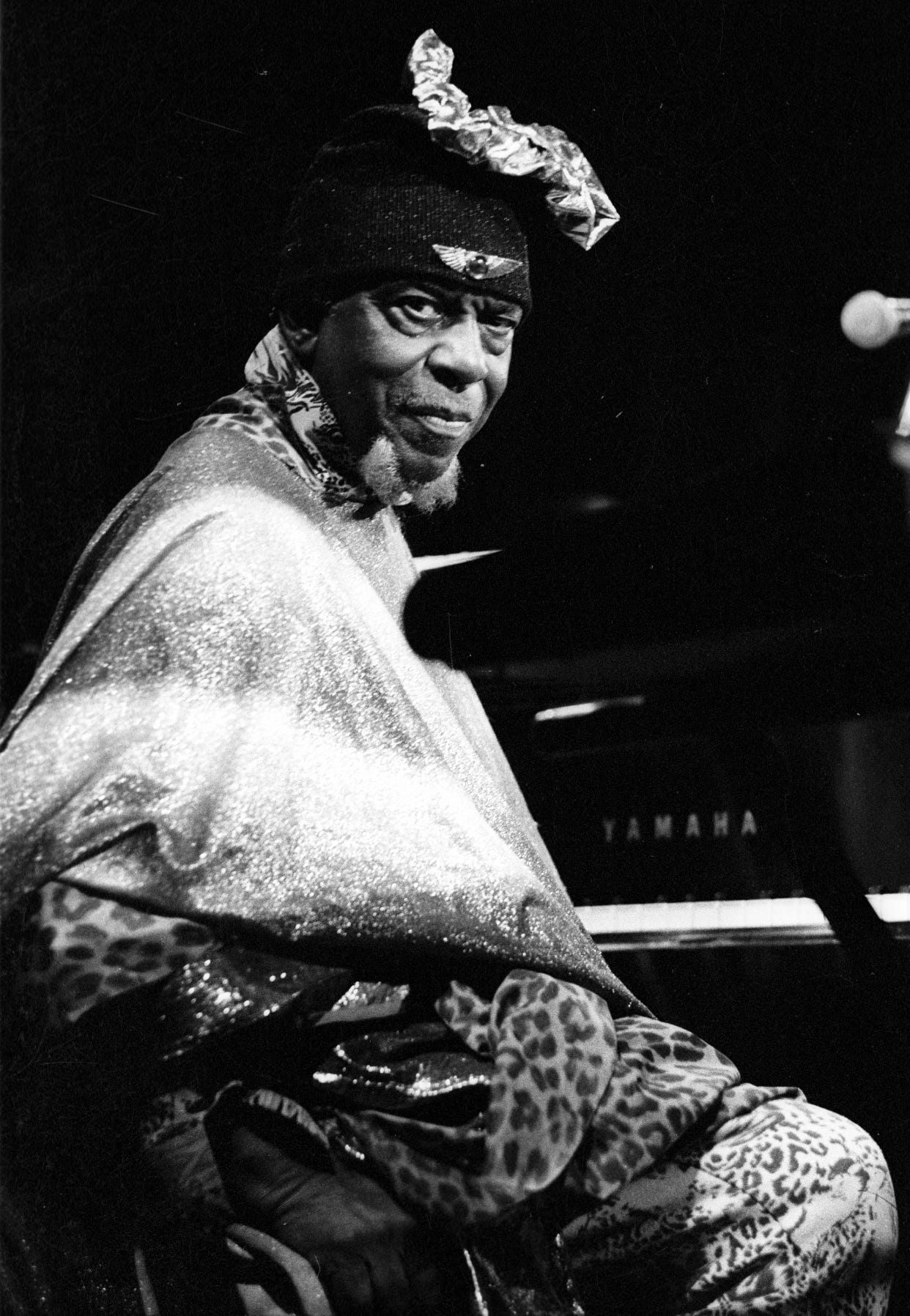
And yet, who knows very much of what jazz is really about? Or how shall we ever know until we are willing to confront anything and everything which it sweeps across our path?
- Ralph Ellison
In celebration of Sun Ra, who passed away on May 30, 1993, we’ll dig in our paddles to explore the world of Sun Ra.
There are many great sources to learn about Sun Ra, like John Szwed’s Space Is the Place: The Lives and Times of Sun Ra and the new PBS American Masters show Sun Ra: Do the Impossible. But today, I’ll share a little bit about my journey.
I first read about Sun Ra and his Arkestra in 1986 in The Wire magazine while I was stationed in West Germany, near a British Army base in Soltau. I found it in the commissary’s magazine rack. The Wire debuted in the UK as a quarterly jazz magazine in the summer of 1982. Then, in August 1984, it changed to a monthly schedule and is still going strong today.
Here is that first issue I bought in April 1986 - you can see Sun Ra’s name on the cover by Lester’s right ear:
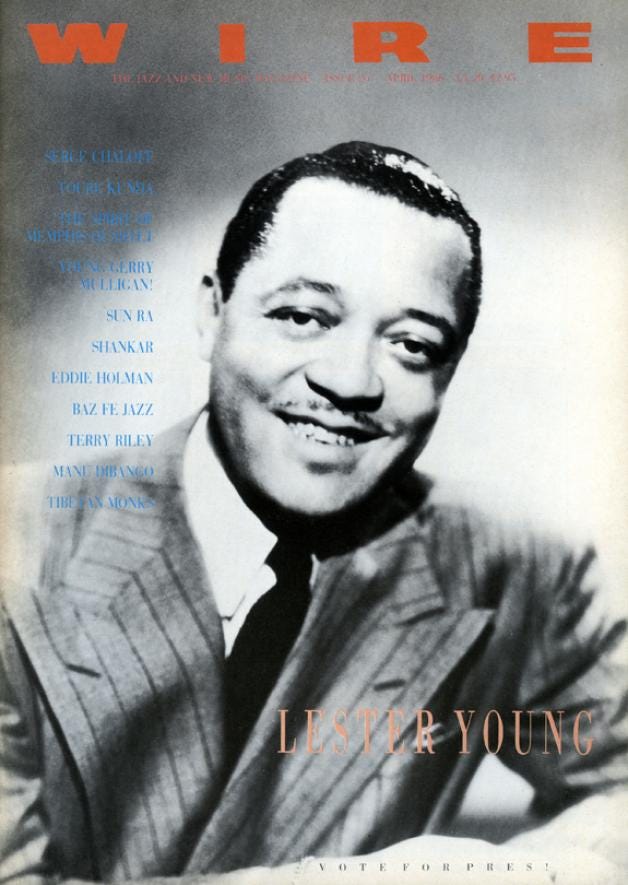
In the magazine’s Soundcheck section, Andy Gill wrote a review of Sun Ra’s 1985 Children Of The Sun and Hiroshima records. As I re-read it now, I realize he was not kind:
Quality control, it’s safe to say, was never one of Ra’s strong suits. Where a Dolphy or an Ayler did little, but significantly little, the Fat Man from Saturn has meandered unchecked through his own personal musical cosmos, giving listeners as little guidance as he can get away with, while himself getting away with releasing some pretty ropey rubbish…
Since then (1980), he’s put out a further 15 albums, not one of which, I’m afraid comes close to classic status. Some, like the three volumes of Live at Praxis ‘84, are simply unedited live performances, while others are rag-bags of out-takes and historical fragments of dubious heritage.
As a result, I was not in a hurry to dig my paddle into Sun Ra, but the review did intrigue me.
When I returned to California in the spring of 1987, I rented a small duplex on Torres Street in Carmel, off Ocean Avenue, got a part-time job at an antique store, and settled back into life in the States.
Before long, I had taken a volunteer position as a DJ at KAZU in Pacific Grove, where I met a great group of DJs who liked jazz but were mostly fans of gospel and blues. We kept each other informed about all the bands coming to town, since this was pre-Internet and most of the shows were passed along by word of mouth. They also knew where to find the best used records in the Bay Area. During those days, I mostly hung out in Camel Valley and the Monterey Bay area, where the Jazz scene was limited. It wasn’t until I decided to find a full-time job in Silicon Valley in 1988 that my jazz journey hit full stride.
I found a job and rented a room in a guy’s house in Campbell, an ideal location for trips to Santa Cruz and San Francisco, where the jazz scene was vibrant. This was when Frank Morgan was making his comeback. Cedar Walton’s trio backed him a lot, with Tony Dumas on bass and Billy Higgins on drums. Sonny Rollins, Lester Bowie’s Brass Fantasy, Dizzy Gillespie, Les McCann, & Eddie Harris, and all the big names made West Coast stops. I never missed a show. By this time, my taste in jazz was also broadening. In 1989, while following Marilyn Crispell’s career, I came across Graham Lock’s Forces in Motion.
Forces in Motion is a deep dive into Anthony Braxton and his quartet’s twelve-date England tour in the winter of 1985; however, Lock offers much more than that. His excellent analysis of the music of Roscoe Mitchell, Joseph Jarman, and the Art Ensemble of Chicago drew me into listening to AACM music. But the biggest offering was his analysis of Sun Ra, whom I had nearly forgotten about. The first chapter of his book is titled “Astro Black Mythology,” and at the end of that chapter, Lock wrote:
There are people who decry Sun Ra’s work as escapist or opportunist. Even within the Black community he has his detractors: Betty Carter, for instance, has said, “It’s nothing but bullshit. Sun Ra has got whitey going for it.” If spending three decades in relative poverty is opportunist, then Sun Ra is guilty. It’s true too that his concerts are spectacular, entertaining, and often funny, but I think it’s clear that essentially Sun Ra is both serious and magical - perhaps, serious because he is magical. As Julio Finn points out: “The fact is that far from being a substitute for it, magic was a form of blacks’ political agitation; the fact is that the Afro-American has never accepted the status quo.” And Amiri Baraka, writing as LeRoi Jones in 1966, declared, “Sun Ra speaks of evolution of the cosmic consciousness, that is future or as old as purusa.” So Mister Ra is not a freak, a con-man, a madman, or even a singular genius: genius he may be….
That chapter put me into Sun Ra’s gravitational pull. Now, I was on the lookout for Sun Ra and his Arkestra.
Back in the late 1980s, it was very difficult to hear any Sun Ra music. Very few, if any, radio stations played his music because few people owned his records. All of Sun Ra’s Saturn records were impossible to find. Your best bet would be to catch him at a show, if you were lucky enough to know he was in town, as advertising was limited to word of mouth, magazines, or fliers from actual gigs. So when I heard that he was playing in San Francisco, I finally had the chance to see what he was all about.
Interestingly, the first time I ever heard a Sun Ra song was the first time I saw him - on Halloween night in 1988:
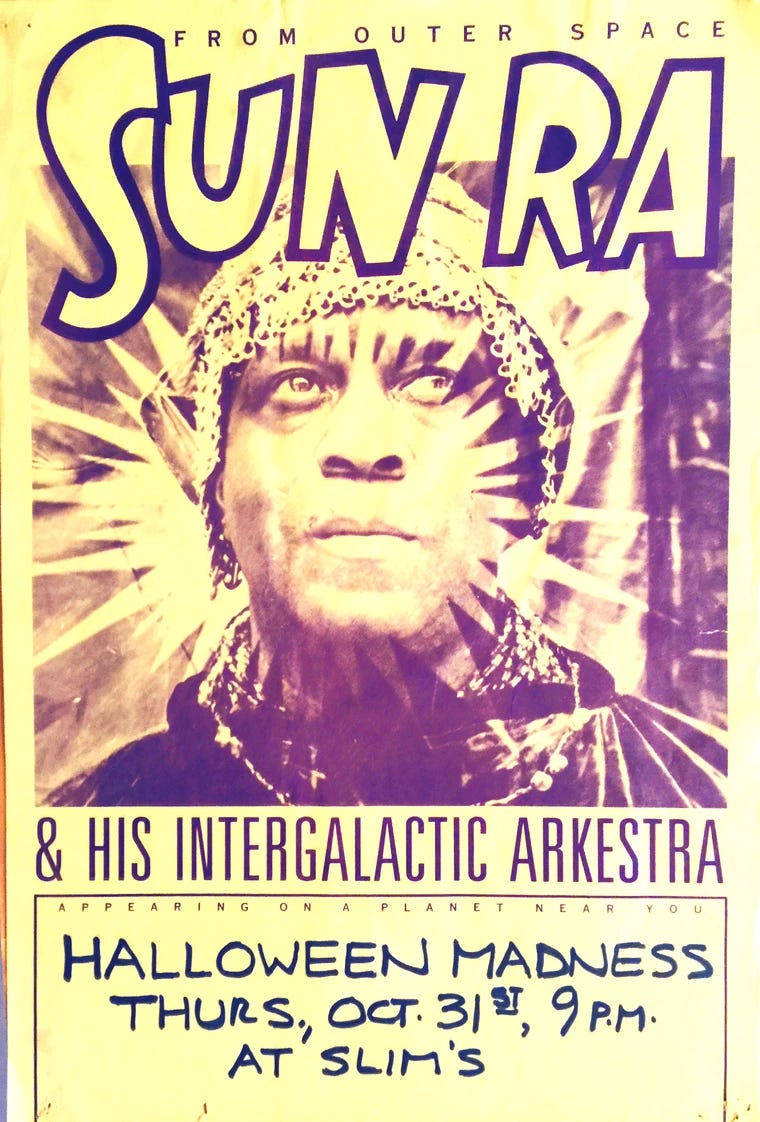
That show completely knocked me out. Besides Sun Ra, I was captured by the presence of June Tyson and John Gilmore, who seemed like angels on the stage. That show changed my life. I had become a disciple.
There’s a three-dimensionality to Sun Ra’s Arkestra that, like Willem Breuker’s Kollektief, can’t be conveyed through listening to their LPs or even watching videos of their concerts. This was beautiful music with an edge. It is simply something that must be seen live to be fully appreciated. It is musical magic.
I would go on to see him a few more times in 1989: again at Slim’s, then at Koncept’s Cultural Gallery in Oakland, and at The Catalyst and Kuumbwa in Santa Cruz. And again, in early 1990, at another show at Koncept’s Cultural Gallery.
It’s difficult to explain how Sun Ra’s Arkestra sounded in 1989 and 1990, but it was a well-oiled machine. They were heavy into traditional Fletcher Henderson and Duke Ellington numbers but also mixed in Sun Ra originals that often featured African and Egyptian-influenced trance songs, with June Tyson and Wisteria El Moondew (Judith Holton) floating around the stage. I found the music mesmerizing, like Weather Report’s Badia the first time I heard it in high school.
I’ve tried to find a few recordings that best reflect how Sun Ra’s Arkestra sounded when I first saw them in the late 1980s, beginning with the African-influenced Friendly Galaxy from his 1990 Purple Night:
At the time, Sun Ra was playing mostly piano, and Marshall Allen would play wonderful meandering solos, as you hear on Sunrise from his 1989 Blue Delight, which is another favorite:
I wonder what The Wire’s Andy Gill would have written about Blue Delight and Purple Night?
From the first time I saw June Tyson and heard her sing, I fell secretly in love. The song was Sunset On The River Nile, one of my favorite Sun Ra songs:
The first Sun Ra album I ever saw, I bought. It was Out There A Minute, released by Blast First in 1989. I played the bejesus out of that record:

I can’t recall where I bought it, probably at the Tower Records in San Francisco. That record was the start of my Sun Ra collection, and it remained my only document of Sun Ra’s music until around 1991, when my friend Luis and I were able to buy Sun Ra’s early Saturn music for the first time, reissued on the Evidence label. I can’t remember how I learned about this epic Sun Ra Saturn CD release project, but I’d bet it was from The Wire. That was a breakthrough.
Luis and I split the costs of the first five CDs. I bought Jazz in Silhouette, Super-Sonic Jazz, and Sound Sun Pleasure, and Luis bought Holiday for a Soul Dance and Monorails and Satellites. This way, we would have all five Saturn releases available to play at Wessex Books store in Menlo Park, California, where we worked the night shift on Friday and Saturday.
Up until that point, I had only read about Sun Ra’s Saturn albums. I had never even seen one in print. So putting the first one in the store’s CD player was a voyage of discovery. I can’t remember which one we played first, but it was probably Jazz in Silhouette. It was fun to watch people's reactions in the bookstore as we spun those Saturn CDs.
Luis and I went to all the used record stores in the Bay Area and Santa Cruz, looking for Sun Ra albums. We always came up empty. However, on one of our last trips to Amoeba Music in Berkeley, before I moved to Chicago, we ran across some Saturn records in generic white album covers. I have no idea how they got there. There were only three releases, but about 25 of each one. I bought a copy of each one. Those three were my first Saturn records. Here they are:

A few months later, by the time I had moved to Chicago in 1992, I was a committed Sun Ra collector, pursuing his music.
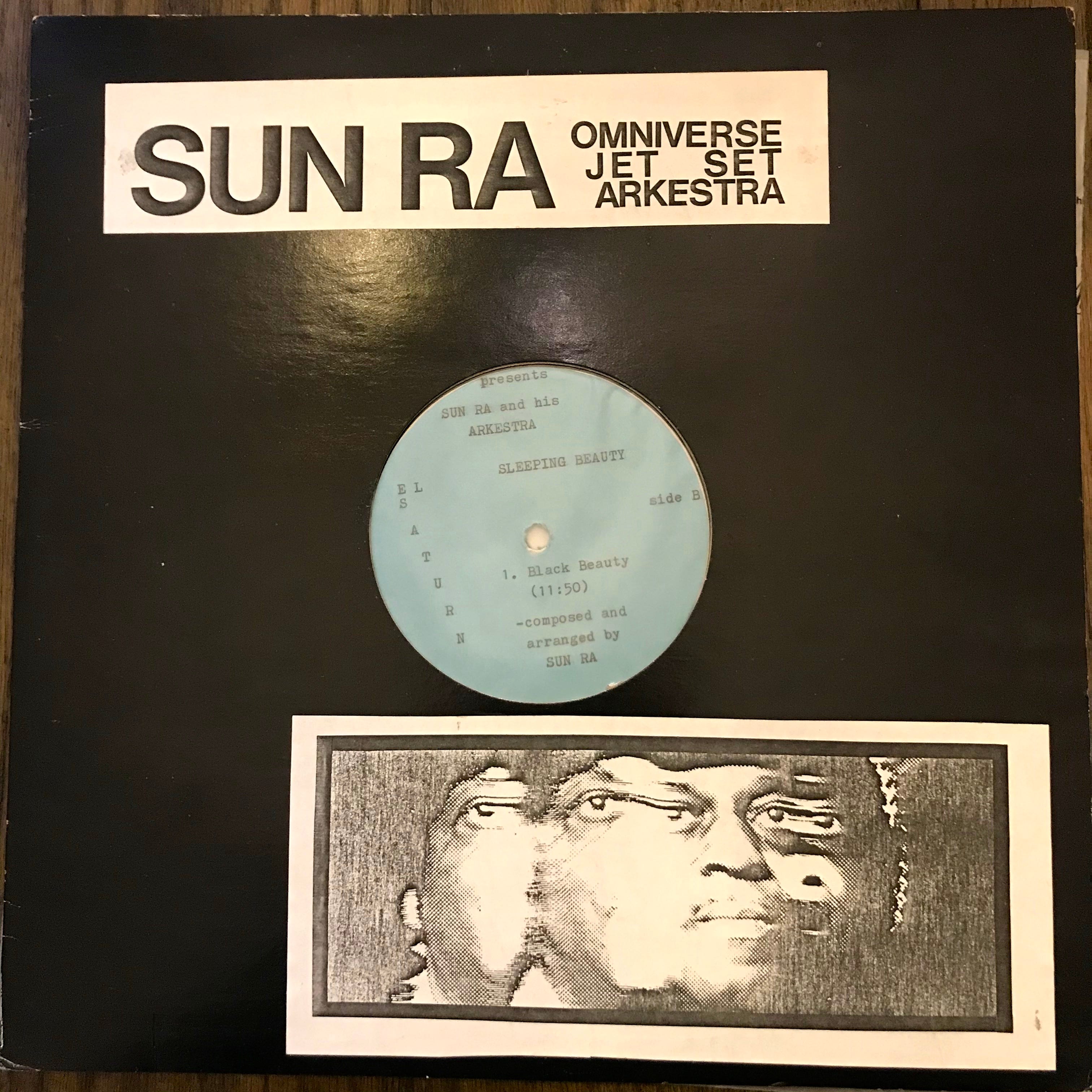
I had read that Sun Ra’s Arkestra grew out of Chicago, but I did not really expect to find any of his records there. But fate smiled at me - or I should say, fate was in a pleasant mood. One Saturday morning, a miracle happened. At the Jazz Record Mart, I found a stash of five Sun Ra albums in the new arrivals bin. Here are three of the five:
Sleeping Beauty, with the title track typed as Black Beauty:
Over The Rainbow, with Sun Ra’s cover art design:

And finally, Media Dreams, which might be the original sample label art design:


I would return to the Jazz Record Mart every Saturday morning at opening and head to the new arrival bin. Interestingly, from time to time, I would find more Saturn albums. It was as if they knew I was coming.
Unfortunately, Sun Ra suffered a stroke in November 1990, and I never got to see him perform again. I did get to see the Arkestra, with John Gilmore as the leader, one last time in February of 1991, at a benefit at Koncept’s in Oakland. Then, in October 1992, he suffered a second stroke and left this planet on May 30, 1993. He was 79 Earth years old. Thankfully, Marshall Allen has kept the Arkestra alive and well.
In many ways, it all started for me with Sun Ra. And perhaps no single song defines my journey more than the first song from the double LP In Some Far Place: Roma ‘77, released in 2016 by the Strut label. It is fittingly titled “Introduction.” In my mind, I hear Sun Ra on the bass chords and Fred Astaire lightly dancing across the notes on the upper register, and it makes my heart soar like a hawk:
My jazz journey has been a strange one, starting with Fred Astaire on TV in the 1970s and then moving to the Blues-Jazz fusion of John Mayall and the Rock-Jazz fusion of Santana, which ultimately, two decades later, led me all the way to Sun Ra. Along the way, there were many side trips on rivers less traveled, but I was always searching for the heart of America’s greatest art form: Jazz. In the end, I share my journey with you so that you might find your own.
Next week on that Big River called Jazz, we’ll dig in our paddles to explore the waters of Detroit artists present and past. Present: the 50th Anniversary Concerts of the Northwoods Improvisers. Past: the legendary Yusef Lateef.
Please hit this link to buy me a cup of coffee if you’d like to show your guide some appreciation for this and past journeys. Know in advance that I thank you for your kindness and support.
If you like what you’ve been reading and hearing so far on our journey and would like to share this with someone you think might be interested in learning more about our great American art form, Jazz, just hit the “Share” button.
From Astaire to Sun Ra: A Jazz Journey is a reader-supported publication. If you feel so inclined, subscribe to my journey by hitting the “Subscribe now” button.
Feel free to contact me anytime to talk shop. I welcome and encourage that.
Until then, keep on walking….
Wonderful article! I love hearing about your circuitous pathway to discovering Ra's unknown worlds.
Thanks for this piece on Sun Ra.
I was fortunate enough to see the band a few times with Sun Ra leading it.
Each time was very memorable.
I now have several of the Saturn L.P.’s with plastic covered cardboard sleeves, decorated with markers by hand. I most recently saw the band twice, led by Knoel Scott. They were wonderful both times.
Keep up the good work!
David Beckett