
Nudie Cohn
The rodeo tailor...

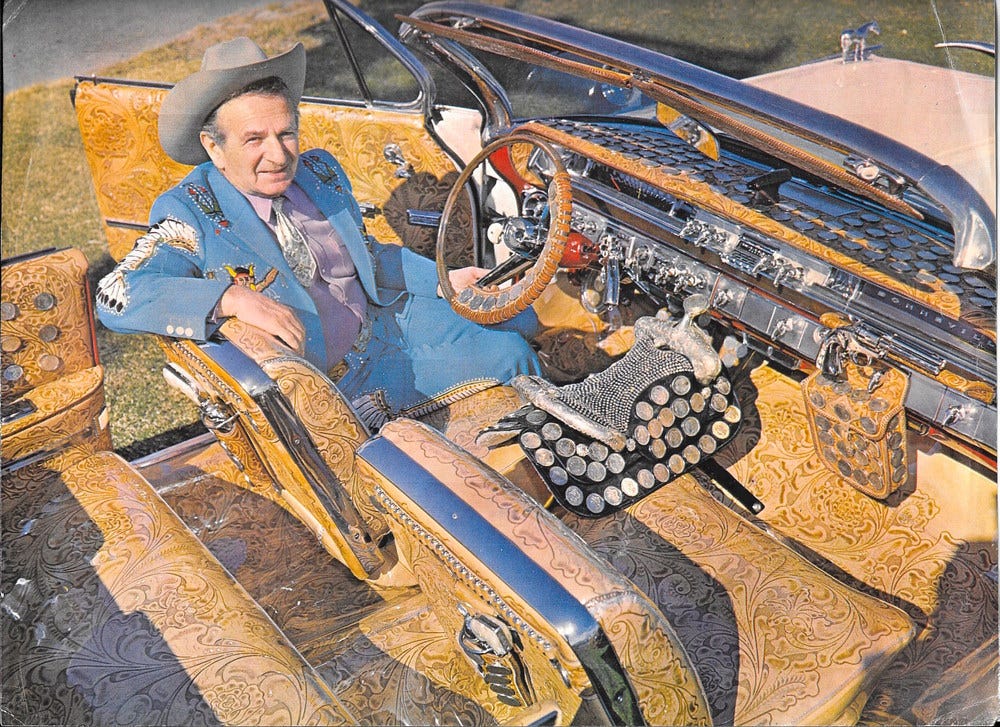
The sound systems were so lousy back then that the crowd couldn’t hear the music, so the clothes had to be loud.
-Buck Owens
During junior high school, my ice hockey coach gave me the nickname “Tex.” He called my T. Texas Tyler (a take on my middle name, Tyler, which people started calling me in those days) or Tex Williams (a take on my given first name, William). After a while, he just shortened it to “Tex.”
Why I was called by my middle name rather than my first name is a long story for another day. But the nickname stuck, and many of my old high school buddies, some newer friends, and my sister still call me “Tex.” Anyway, I didn’t know either of those two Texas guys. I’ve since looked them up, and I figure my hockey coach must have liked country music.
Tex Williams’ story starts with Spade Cooley’s Western swing Orchestra in LA.
Western swing was extremely popular throughout the West in the years leading up to World War II; however, it blossomed on the West Coast during the war. The Dust Bowl sent hundreds of thousands of displaced farmers and workers called “Okies”, regardless of their state of origin, streaming west on Highway 66 seeking a sliver of the California dream. They brought with them their working-class culture and their music, a difficult-to-define style with elements from many musical genres, including pop, blues, jazz, Dixieland, traditional folk and fiddle, and ragtime.
One of the most popular bands in California playing this style was Spade Cooley and his Orchestra, who performed at the Venice Pier Ballroom in Los Angeles. In 1942, Cooley’s promoter at the time, Foreman Phillips, was the first person to identify Cooley’s big Western dance band music as Western Swing. In 1945, Spade Cooley's Western Swing Song Folio was the first Western Swing songbook.
To capitalize on the pioneering success of the Bob Wills–Tommy Duncan pairing, Cooley hired vocalist Tex Williams, who had that mellow, deep baritone sound made popular by Duncan. In the summer of 1946, the Cooley band fragmented after the bandleader fired Williams. So Williams went at it alone. He assembled his backing band, the Western Caravan, appeared in some movies, and played polkas for Capitol Records. However, success for Williams was fleeting, and he fell on hard times. Then a chance meeting with a man called Nudie Cohn helped turn both their careers around.
This week on that Big River called Jazz, we’ll dig in our paddles and discover the early years of Nudie Cohn.
Nuta Kotlyarenko was born in Kyiv, Russia, in 1902. His father was a bootmaker, and his mother raised geese and ran a theater concession stand. As a young boy, Nuta enjoyed working as a tailor’s apprentice; he loved the feel of the fabric and was fascinated by the shapes and colors he could create.
In the early 1900s, pogroms across the Russian Empire killed thousands of Jews, and Nuta Kotlyarenko’s parents rightfully feared for their lives. In 1913, they decided to send 11-year-old Nuta and his brother Julius off on a ship bound for New York City.
They entered America through Ellis Island, and his name was changed to Nudie Cohn. Later, he said the agent did him the greatest favor of his life.
First, he settled in Brooklyn, where he earned his living any way he could: shoeshine boy, errand runner for vaudeville star Eddie Cantor, and, eventually, boxing. Weighing in at a skin-and-bones 106 pounds, the teenage Cohn had an obvious disadvantage in the ring, but the crowd loved his scrappy demeanor and strong will to survive.
The boxing gig took him to Mankato, Minnesota, where he met his future wife, Bobbie Kruger, at her parents’ boarding house. They fell in love, moved to New York City, and in 1934, opened Nudie’s for the Ladies in Manhattan, where he designed rhinestone-embellished costumes for chorus girls and strippers. In the early 1940s, they relocated to Los Angeles, and Cohn began making stage wear for Western swing musicians he and Bobbie befriended at local nightspots.
In the mid 1940’s, Nudie had to have hernia surgery, and with no insurance, he lost everything. He was nearly ready to move back to New York, but had one more idea to try out before he left. How about making outfits for celebrities?
So in 1947, Nudie Cohn sought out rising country music star Tex Williams, who had just left Spade Cooley’s band. He finally found him mowing his lawn and made an offer. Tex was also nearly broke. But he loved the idea of a custom signature suit, so they made a deal to auction off Tex’s horse and use the money to buy Nudie a sewing machine. Nudie started making outfits for Tex, who became a singing advertisement for Nudie as he and his backing band began drawing record crowds performing at LA’s Riverside Rancho nightclub.
As their creations gained a following, in 1950, the Cohns opened Nudie’s of Hollywood on the corner of Victory and Vineland in North Hollywood, where they cultivated a clientele of celebrities. Before long, everyone who was anybody wanted to don a Nudie Suit. When sales soared in the 1960s, Nudie moved the business to a larger location at 5015 Lankershim Boulevard in North Hollywood and renamed it Nudie’s Rodeo Tailors.
Another one of Nudie’s first customers was American country and honky-tonk singer-songwriter Lefty Frizzell, who had toured with Hank Williams. In the early 1950s, Frizzell dominated the country charts with #1 hits like If You’ve Got the Money (I’ve Got the Time):
It was Frizzell’s wardrobe that inspired Nudie’s signature design innovations.
The first time Nudie met him in 1951, he thought Frizell would look terrific wearing rhinestones and made him an outfit with a smattering of the reflective crystals. Frizzell was delighted with the audience response to his flashy new stage costume. From then on, every time he ordered a suit, Lefty instructed him to “put on a few more rhinestones, Nudie, put on those rhinestones!”
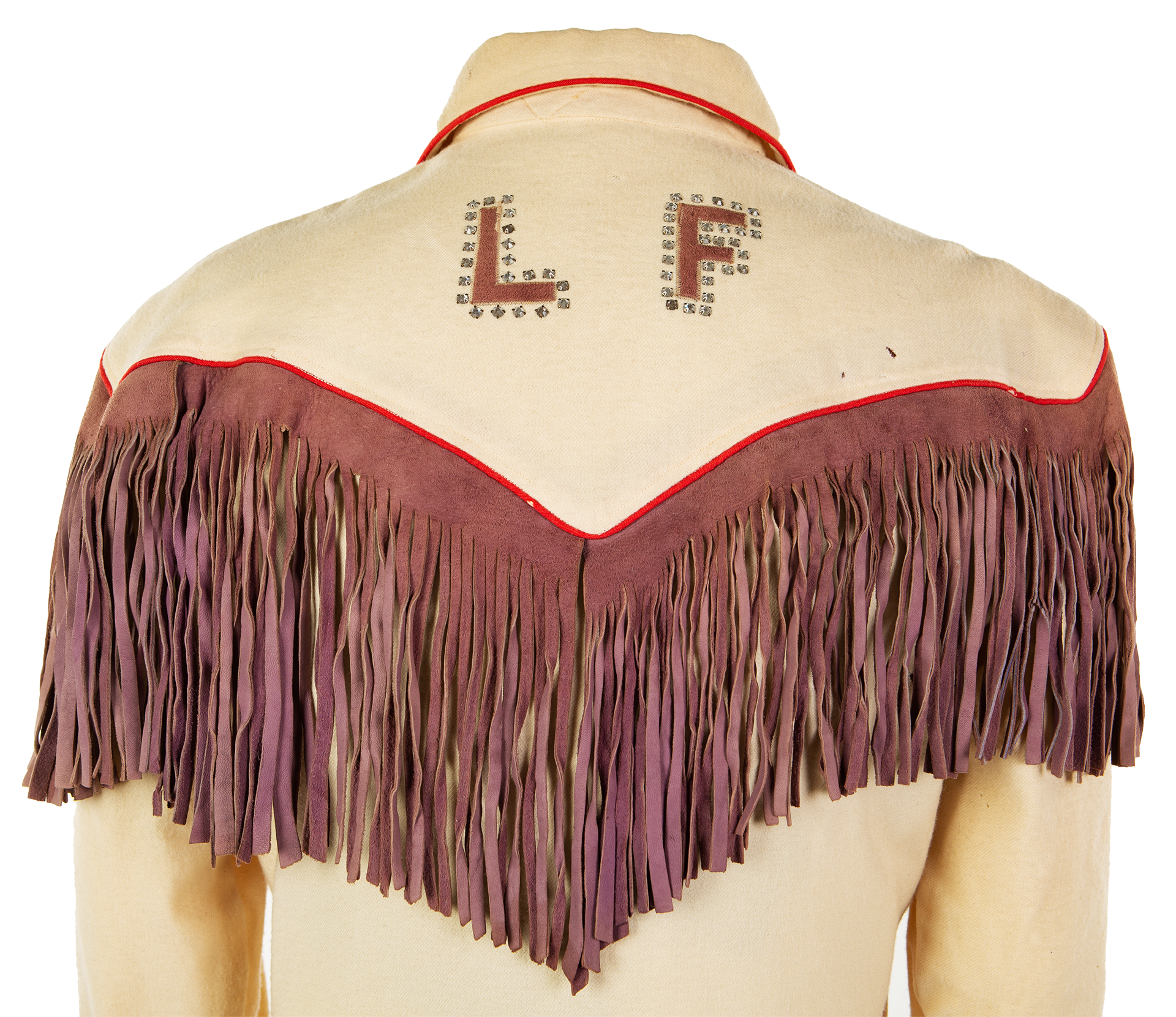
And dig the kicks - Nudie even added the rhinestones to Frizzell’s boots:
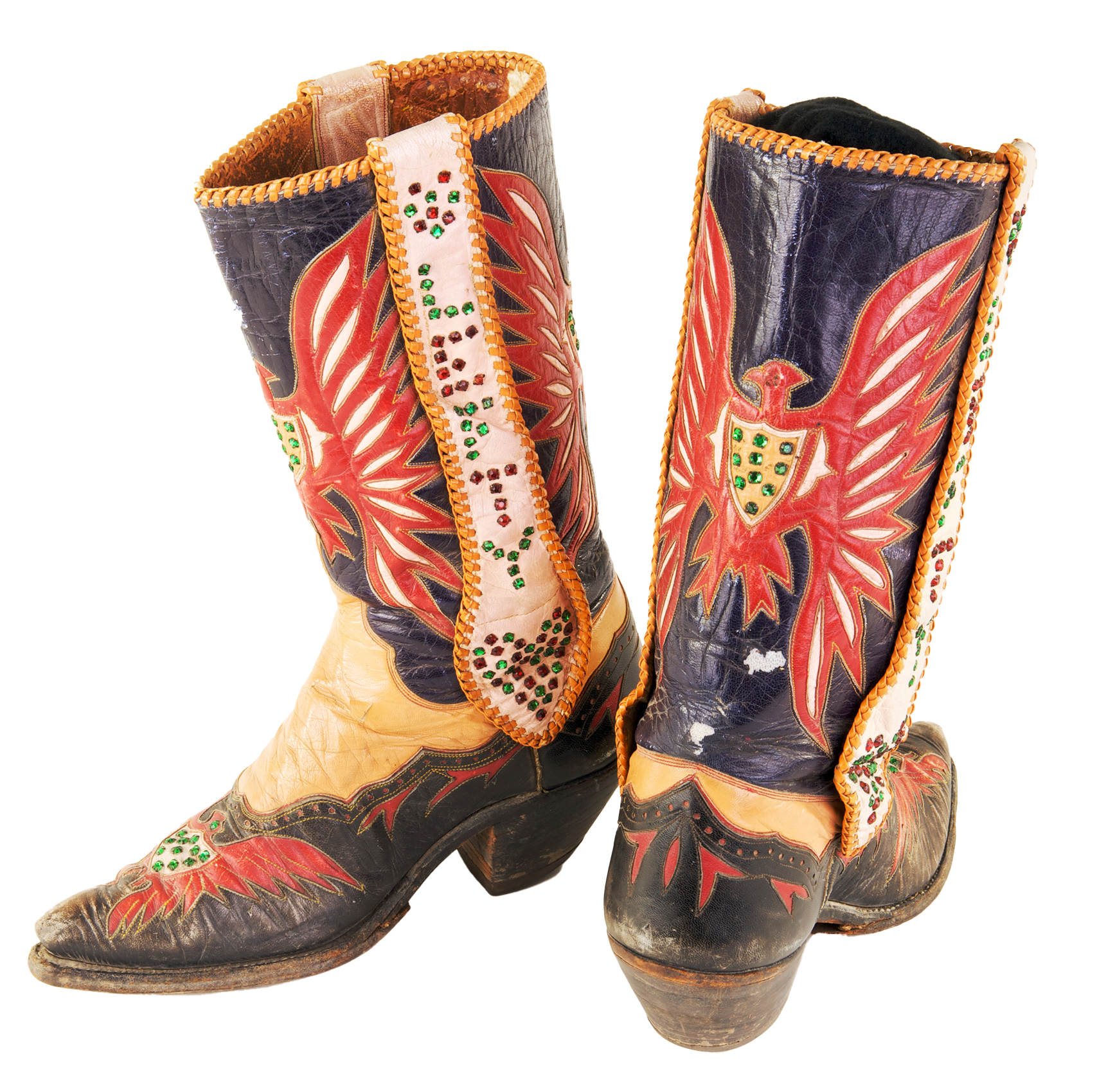
The success of Frizzell’s Nudie suits brought more country singers to the Nudie’s of Hollywood door.
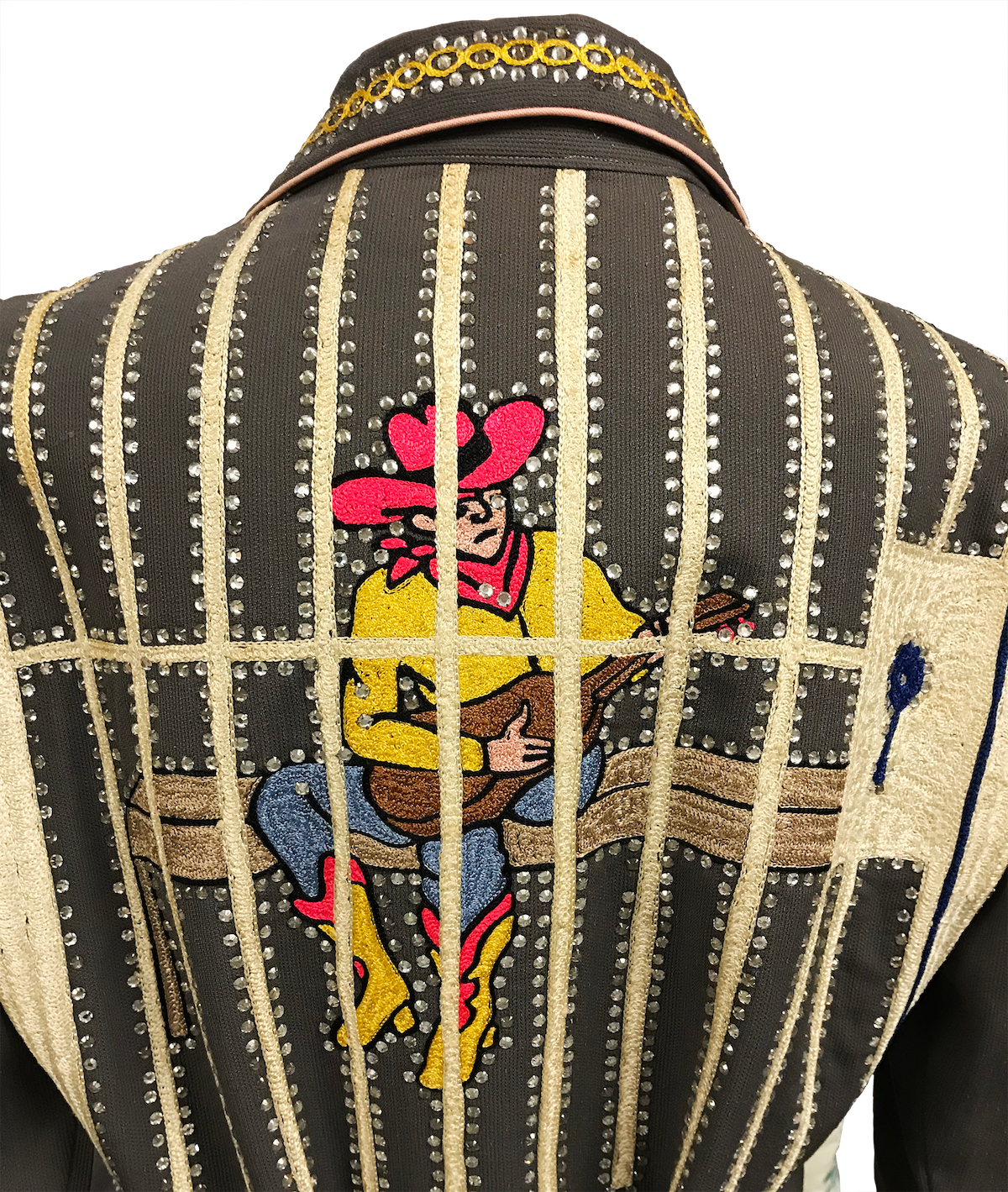
In 1961, to celebrate his 1955 chart-topping hit In the Jailhouse Now, Nudie provided honky-tonk hero Webb Pierce with this vividly embroidered, rhinestone-enhanced number:
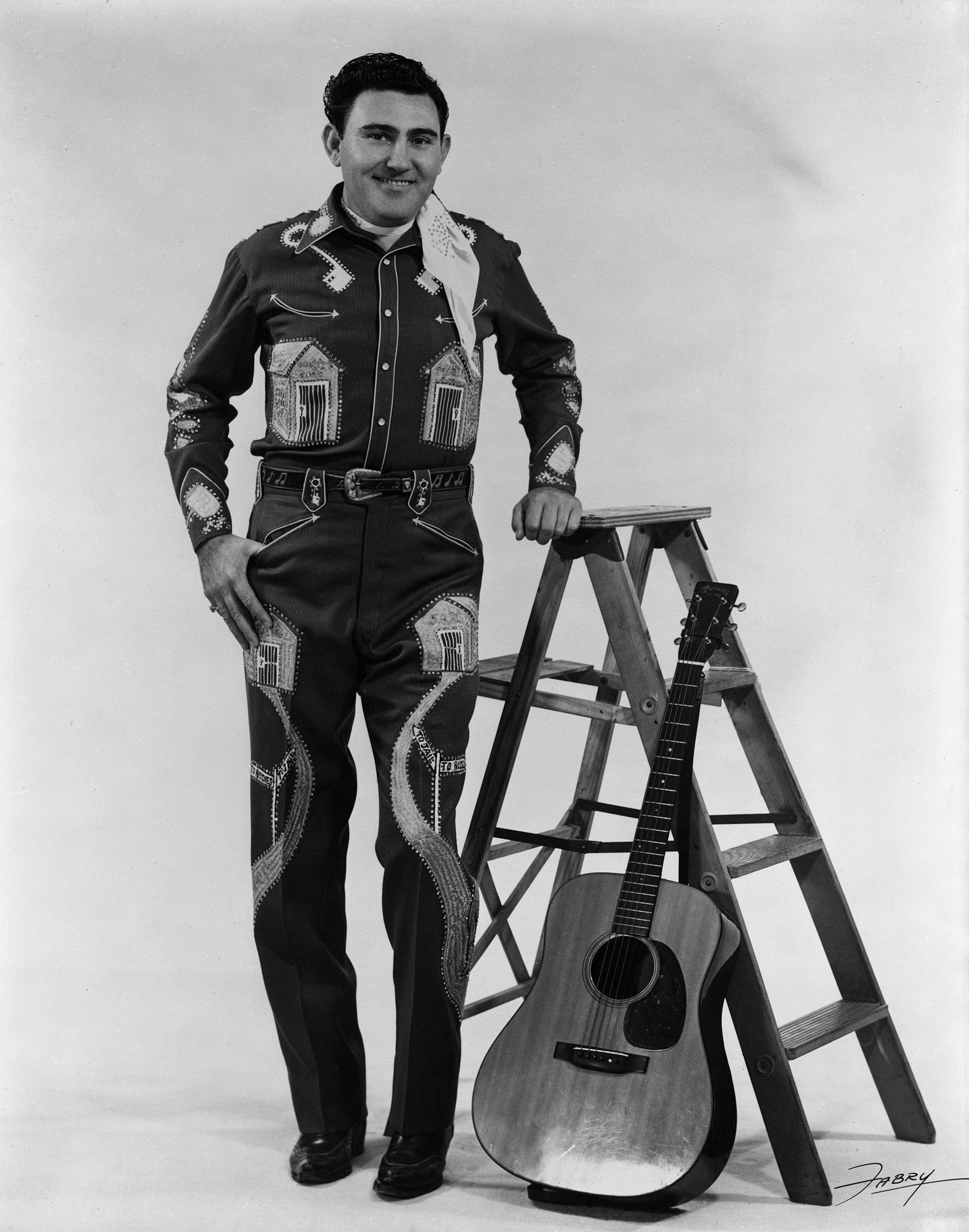
Here’s the back of that number:
Before long, his celebrity clientele included country and rock royalty—ranging from Hank Williams to Johnny Cash and Elvis Presley. However, perhaps singer-songwriter Gram Parsons did the most to crossover Nudie suits into mainstream pop culture.
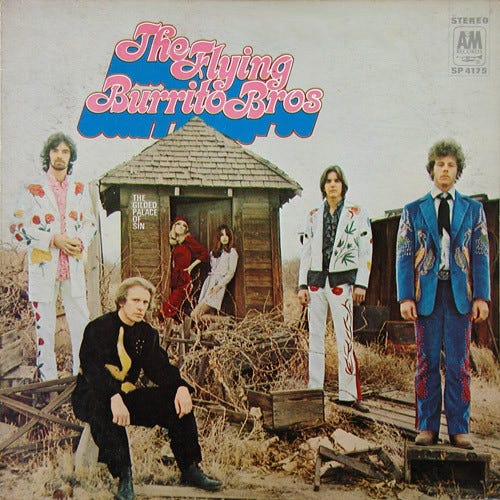
In 1968, trailblazing LA country-rock band the Flying Burrito Brothers went to Nudie’s Rodeo Tailors to be outfitted in the rhinestone-studded suits they associated with real country music. You can see the result on the cover of their debut album, The Gilded Palace of Sin:
In his book The Philosophy of Modern Song, Bob Dylan wrote:
Like with many who reinvented themselves, the details get a bit dodgy in places, but it appears that there was a little dust-up with the law about a drug-running charge, which resulted in a short jail stay. You can only imagine how amused Nudie must’ve been when Gram Parsons came in, all cannabis griggling and part of a generation that thought they invented drug use, and requested a drug-themed Nudie suit. Some folks to the right of “Okie from Muskogee” were surprised that Nudie was willing to make that suit but Nudie was nothing if not practical and as long as Gram’s money was as green as his weed, he got himself a suit.
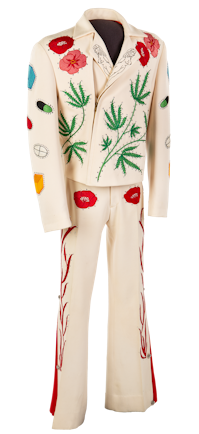
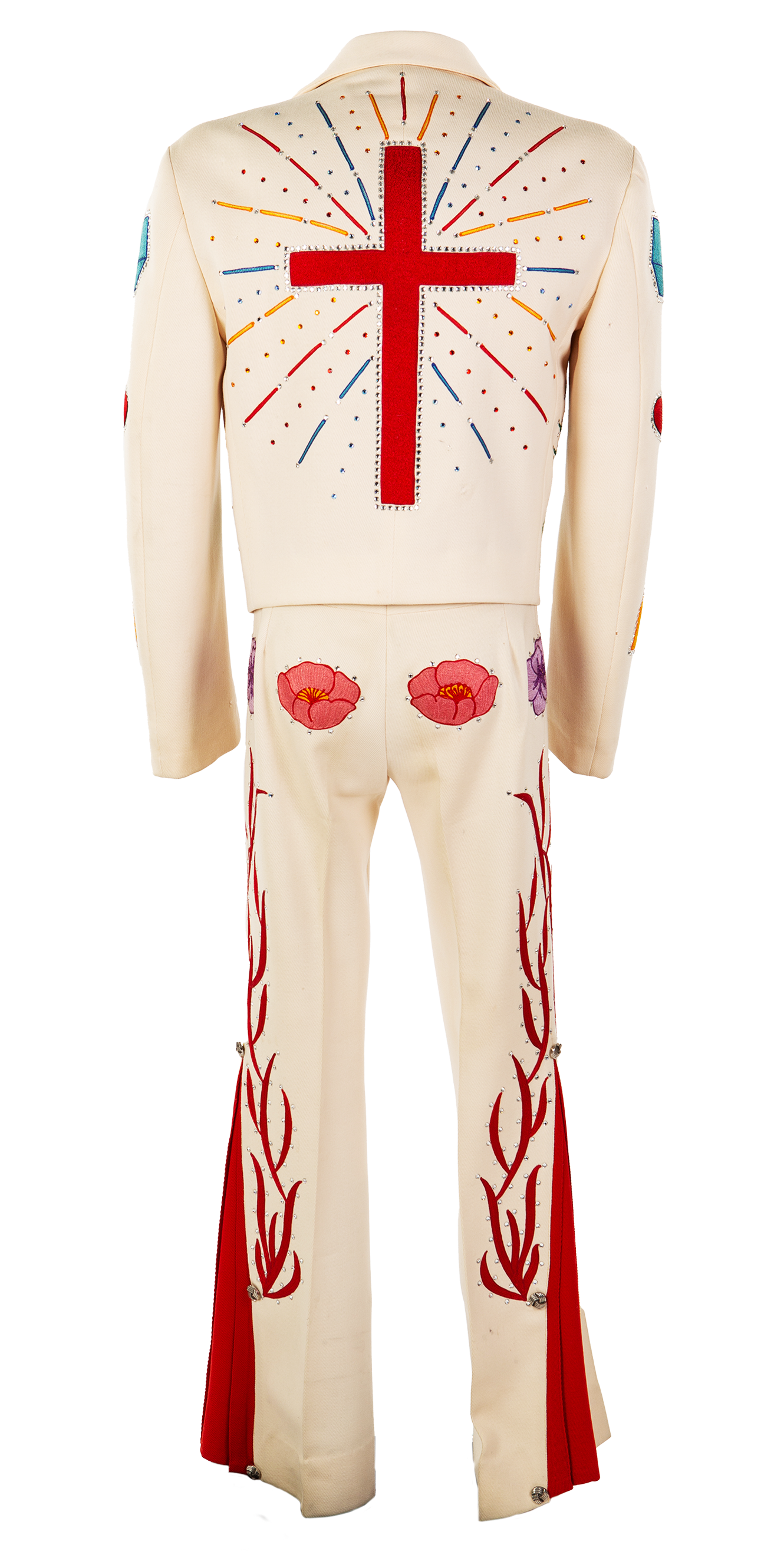
The group’s frontman, Gram Parsons, collaborated with Nudie’s head designer, Manuel Cuevas, to conjure up this iconic themed outfit that symbolized the duality of sin and salvation. The sleeves, front, and lapels of the motorcycle jacket are embellished with chain-stitched marijuana leaves, pills, poppies, and cartoonish pinup girls. The flames down the split-seam legs of the hip-huggers represent hellfire:
…and the embroidered cross on the back represents redemption:
Soon, Elton John wore a custom Nudie suit on the cover of his 1972 hit single Rocket Man, Keith Richards rocked a Roswell-themed Nudie suit with hovering UFOs, and ZZ Top appeared in Nudie suits on the cover of their 1975 album, Fandango.
Here’s one more for the road. When I looked up T. Texas Tyler, I found out he was also an American country music singer and songwriter. In 1946, he recorded Guitar Boogie Woogie for the 4 Star label:
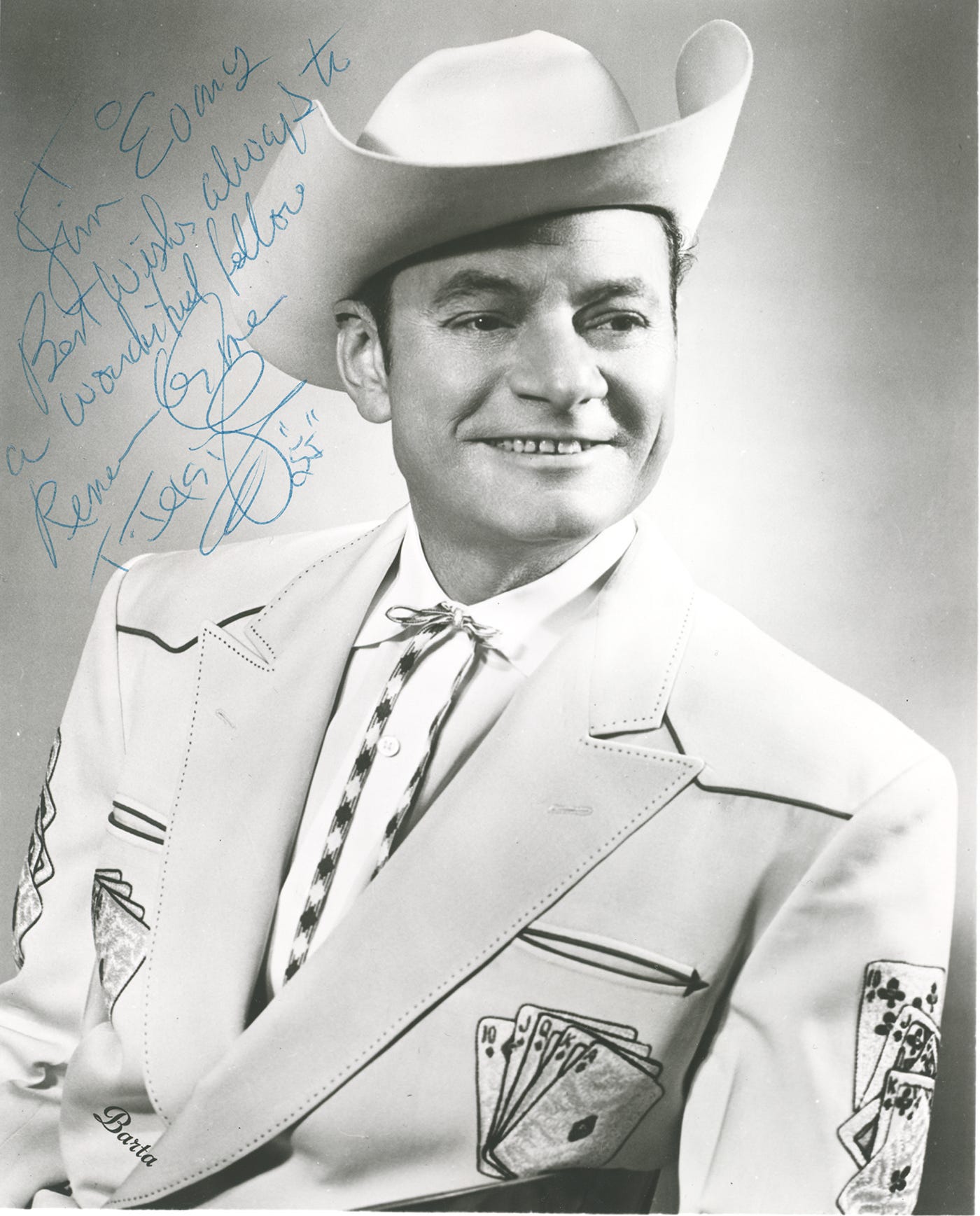
He was a frequent performer on the Grand Ole Opry and the Louisiana Hayride, and hosted his own television show, Range Round Up, in Los Angeles in 1950. However, a marijuana possession arrest in Texas slowed down his career, and he later became a gospel singer and Assembly of God minister. As it turns out, T. Texas Tyler was also a Nudie customer.
In 1950, Nudie designed this double-breasted jacket for T. Texas. Embellished with contrasting piping, smile pockets with arrowhead stitching, and embroidered playing cards with rhinestone highlights, the suit represented his signature hit, Deck of Cards, which reached #2 on the US Country charts in 1948. Here he is in that doozy:
If you were wearing this label:
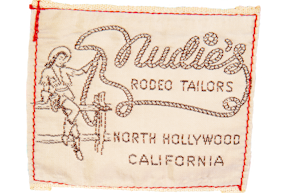
You had hit the big time. The Cohns had also finally made the big time.
I recall that back in my early junior high school days, we had a Jimmy Dean 45 RPM called Big Bad John. Columbia released the single in 1961, so I’m not sure how we came about that record, but it was a favorite of mine. I played the bejesus out of it. Here he is performing the tune on the Ed Sullivan Show in November 1961:
I liked to sing along and change the name John to Bill - “Big Bad Bill.” That was about the time my hockey coach started to call me “Tex.” I don’t know, but maybe it was starting to sink in a little. In 1964, Nudie Cohn appeared on the Jimmy Dean Show. Take a moment to check out this short video. Classic Americana.
With all this talk about Western swing in LA, I don’t want to offend Texan friends Liske, Jump, and the Blindman. Yeah, Cali had some Western swing in the day, but Bob Wills is still the King:
And so it goes on that Big River called Jazz…
Much of the information for this piece came from this source. If you’re down in Nashville, go to the Country Music Hall of Fame and Museum. It’s well worth the visit.
Next week on that Big River called Jazz, we’ll dig our paddles into the waters of Hal Russell.
Please hit this link to buy me a cup of coffee if you’d like to show your guide some appreciation for this and past journeys. Know in advance that I thank you for your kindness and support.
If you like what you’ve been reading and hearing so far on our journey and would like to share this with someone you think might be interested in learning more about our great American art form, Jazz, just hit the “Share” button.
From Astaire to Sun Ra: A Jazz Journey is a reader-supported publication. If you feel so inclined, subscribe to my journey by hitting the “Subscribe now” button.
Feel free to contact me at any time to talk shop. I welcome and encourage that.
Until then, keep on walking….
The Grateful Dead got Nudie suits for their Europe ‘72 tour. (But not Donna Jean Godchaux). I've only seen pictures from a couple of gigs with them. Couldn't figure out how to upload the photos, but there is even one of Garcia with Nudie.
For a slightly younger (but not young) crowd, Mike Mills of REM had some excellent Nudie suits. https://pyxis.nymag.com/v1/imgs/b67/a2e/a00e6ba7b7a66520191b7cba2a456a0c6f-GettyImages-593245928.2x.rdeep-vertical.w460.jpg