
McCabe and Mrs. Miller
The stranger song...

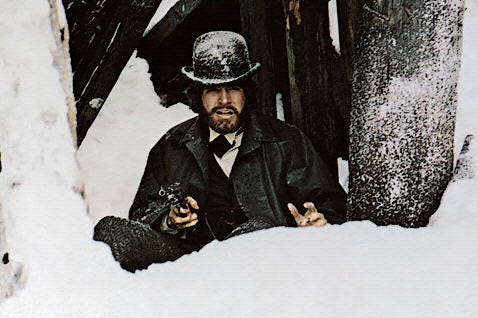
Well, I’ll tell you something. I got poetry in me. I do. I got poetry in me.
-Warren Beatty in McCabe & Mrs. Miller
As a young boy, my dad lived on three great rivers: the Mississippi, the Platte, and the Colorado.
He was born in 1931 in St. Louis, on the Mississippi River. Shortly after that, looking for work, his family moved to Lincoln, Nebraska, on the Platte River. During the depression, his dad moved the family again, this time west to Palisade, Colorado, near Grand Junction, where his dad worked as a foreman on a construction team building workhouses in the area. They lived in a tent on the bank of the Colorado River. Their meals were cooked using water from that great river. After a while, he and his brother helped his dad build a house in town.
He grew up in Palisade, on the western slope of the Rockies. During high school, he picked peaches after school. When he graduated, he joined the Air Force and was sent to London, where he met my mom. After the service, he moved back to Colorado and lived in Boulder.
Maybe it was from all that moving around that later in life, he loved to travel. During the winter of 1971, when I was 9 years old, he drove us all down to Mexico City in a station wagon. Most summers, he took us all camping at Madeline Island on Lake Superior, three hours east of Duluth, back when the island was pretty much the middle of nowhere. We’d drive on the dirt roads until he found a place he liked, and we’d set up camp right next to the beach.
He also loved going to the movies - the Westerns.
I recall the first movie my dad took us to in 1967. It was John Frankenheimer’s Grand Prix at the legendary Cooper Theater. I wrote about this here:

After Grand Prix, it was a steady diet of Westerns, starting in the summer of 1969 with Henry Hathaway’s True Grit starring John Wayne. I was 7 years old and remember this film vividly, as if I were still sitting in that theater. The big color screen was sensational, and I was captivated by the overall scope and beauty of the movie as much as the storyline.
Then, in December of 1969, he took us to see George Roy Hill’s Butch Cassidy and the Sundance Kid, starring Paul Newman and Robert Redford. As great as that movie is, I still recall being knocked out the most during the song Raindrops Keep Falling on My Head, sung by B. J. Thomas:
As a young romantic, I dreamed that one day my girlfriend would ride with me like Katherine Ross with Paul Newman in the scene.
The following year, he took us to see three more Westerns: A Man Called Horse, starring Richard Harris; Little Big Man, starring Dustin Hoffman; and Rio Lobo, Howard Hawks’ final film, and another starring John Wayne. All three classics.
Incidentally, John Hammond produced the score for Little Big Man, which was probably the first time I ever heard a harmonica played. In fact, the first instrument you hear at the start of the film is the harmonica - at the 1:00 mark of this video:
I was captivated by everything about the start of this film, but the music hit me the hardest. Hammond’s music played an important part in my early fascination with the blues. I was a blues man long before I ever became a jazz man.
The last movie I can recall my dad taking me to was in the winter of 1972. It was another Western, Sydney Pollack’s Jeremiah Johnson, and another starring Robert Redford.
Probably because it was rated R, a Western that came out the year before Jeremiah Johnson, in 1971, that my dad did not take me to see was McCabe & Mrs. Miller:
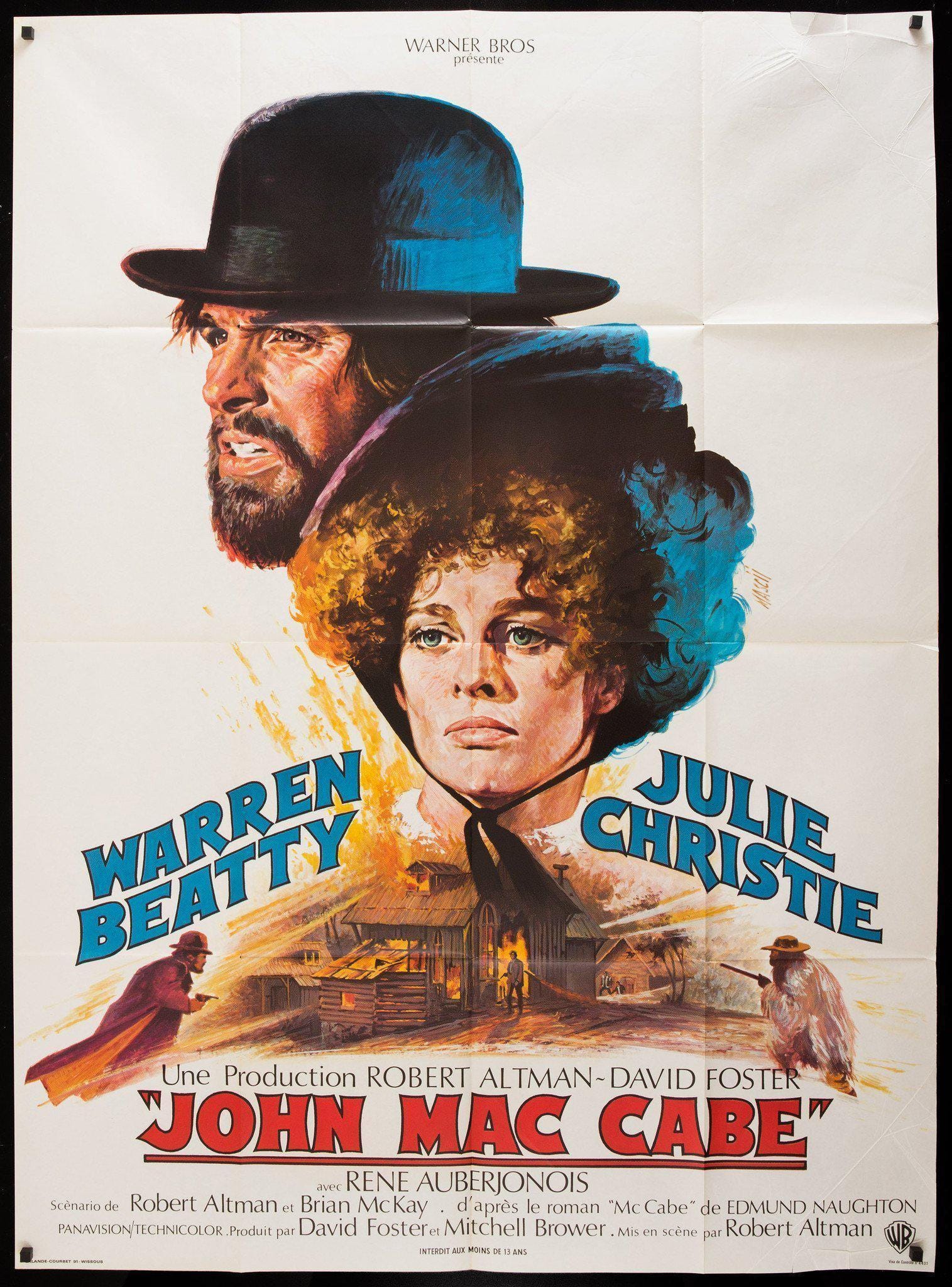
It was released on June 24, 1971. I wish I had seen it back when it came out. I wonder what impact it would have had on me as a 9-year-old. As it turned out, I didn’t see it until many years later, and it became one of my favorite Westerns.
I was lucky that my dad took me to such an amazing stretch of Westerns, which happened during four years between two Sam Peckinpah films, beginning in 1969 with The Wild Bunch and ending in 1973 with Pat Garrett and Billy the Kid. That was a period that reflected a transition in Westerns that focused on examining and revising the American traditions of Western movies. They aimed to strip away the heroic-cowboy conventions and upend the mythologies that adhered to America’s frontier conquest. Perhaps the most revisionist was McCabe & Mrs. Miller. I was aware of none of this back in the 1970s, watching these films with my dad. I was just enamored of the scenic beauty and fascinated by the raw violence.
About The Wild Bunch, Sam Peckinpah recalled:
We wanted to show violence in real terms. Dying is not fun and games. Movies make it look so detached. With The Wild Bunch, people get involved whether they like it or not. They do not have the mild reactions to it. When we were actually shooting, we were all repulsed at times.
I got a taste of this in True Grit, where Rooster Cogburn was a far cry from the mythical, clean-cut sheriff of earlier Westerns; however, when compared to the much grittier and darker characters in McCabe & Mrs. Miller, he pales in comparison.
This week on that Big River called Jazz, we’ll dig in our paddles and discover the world of McCabe & Mrs. Miller.
One need only watch the opening scene of McCabe & Mrs. Miller to know how the West was won - not with clean hands, but with cold and dirty hands. It challenged the heroic myths of earlier Westerns by featuring anti-heroes and moral ambiguity, focusing on the changing, often brutal, reality of the West. The film is considered one of the most authentic representations of wilderness life in the tragic Western landscape, where people were chained to boomtowns on the brink of economic and spiritual exhaustion.
McCabe & Mrs. Miller was directed by the legendary Robert Altman, who was born in Kansas City on February 20, 1925. He received a Jesuit education in Kansas City and attended Wentworth Military Academy in Lexington, Missouri. In 1943, he graduated from Wentworth Military Academy in Lexington, Missouri. Soon after graduation, at the age of 18, he joined the Air Force. During World War II, he flew more than 50 bombing missions as a co-pilot of a B-24 Liberator with the 307th Bomb Group in Borneo and the Dutch East Indies.
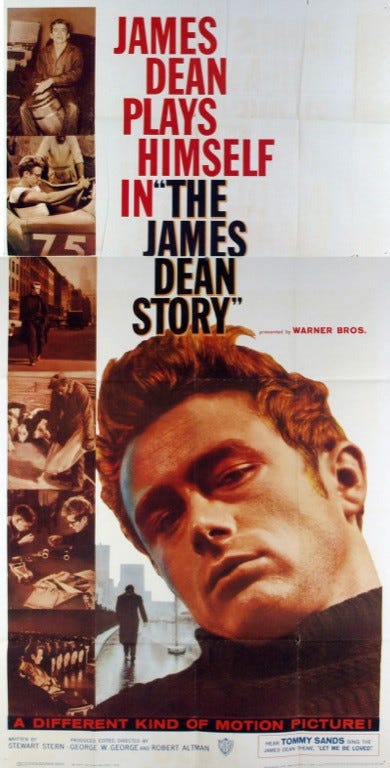
After the war, he began to learn his trade as a writer, producer, photographer, director, set designer, and film editor of industrial films for the Calvin Company in Kansas City. After a few misfire trips to Hollywood, he finally stayed in 1957. He co-directed The James Dean Story, a documentary rushed into theaters and released two years after Dean’s death to capitalize on the actor's recent cult status:
Also in 1957, World Pacific Records released a tie-in album, Theme Music from "The James Dean Story." It featured Chet Baker, Bud Shank, and other prominent West Coast musicians:
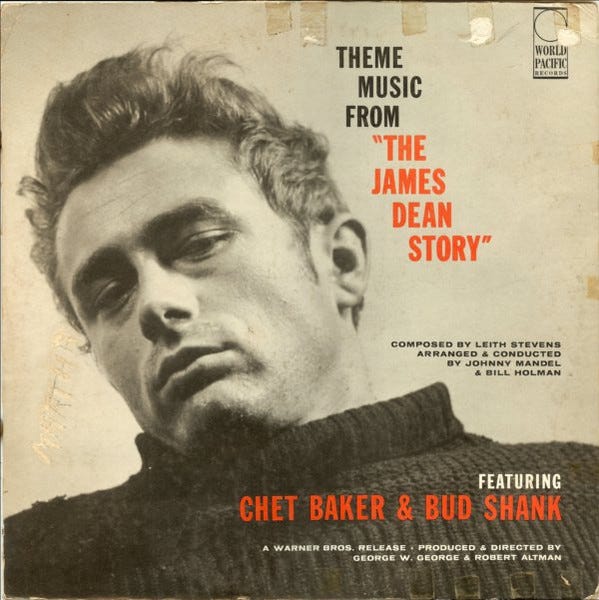
From the album, here’s Leith Stevens’ tune Fairmont, Indiana:
For the next six years, Altman wrote, produced, and/or directed for television. Then, in 1970, he directed the film M*A*S*H, widely hailed as a classic, winning the Palme d'Or at the 1970 Cannes Film Festival and racking up five Academy Award nominations. On the wheels of that success, the following year, he directed McCabe & Mrs. Miller.
An essential aspect of McCabe & Mrs. Miller was his choice of music to set the mood for the film. An important part of this was his choice of songs by a relatively unknown Canadian poet, novelist, and musician, Leonard Cohen.
Cohen’s biographer, Suzanne Simmons, recalls how Cohen got his start in music:
In 1966, Leonard knocked on the door of an New York City apartment, guitar on his back, briefcase in his hand, and a shy smile on his face. He had flown in from Greece, where he was living on a small island in a little house with no electricity or running water. But the money he made as a poet and novelist couldn’t pay even for that. He thought he’d try selling some country songs in Nashville – he had no intention of singing them; no one seemed to think much of his voice. But he stopped first in New York, where there was a thriving folk movement. On the other side of that apartment door was one of the biggest and best-loved artists of the New York folk scene: The one-and-only Judy Collins.
Collins loved his songs and featured his song Suzanne on her album In My Life. Collins would continue to record many of his songs. Collins recalls that when she first met him, he said he could not sing or play the guitar, nor did he think Suzanne was even a song:
And then he played me Suzanne ...I said, “Leonard, you must come with me to this big fundraiser I’m doing” ...Jimi Hendrix was on it. He’d never sung [in front of a large audience] before then. He got out on stage and started singing. Everybody was going crazy—they loved it. And he stopped about halfway through and walked off the stage. Everybody went nuts. ... They demanded that he come back. And I demanded; I said, “I’ll go out with you.” So we went out, and we sang it. And of course, that was the beginning
After performing at a few folk festivals, Cohen came to the attention of Columbia Records producer John Hammond, who recalled in his autobiography, On Record:
Back at Columbia [After recovering from his first heart attack] I had no sooner entered my office than I received a call from Bob Bach, once the co-host with Leonard Feather of a jazz show called Platterbrains and for the last fifteen years coordinator of What’s My Line? “No matter what else you do, John.” Bach told me, “go to the Canadian Broadcasting Company’s New York office and ask them to run a film for you on the Montreal poet Leonard Cohen.”
After watching the film and speaking with Cohen’s manager in New York, Hammond convinced Columbia to sign him. In October and November 1967, Cohen recorded his debut album, Songs of Leonard Cohen, which was released on December 27, 1967:
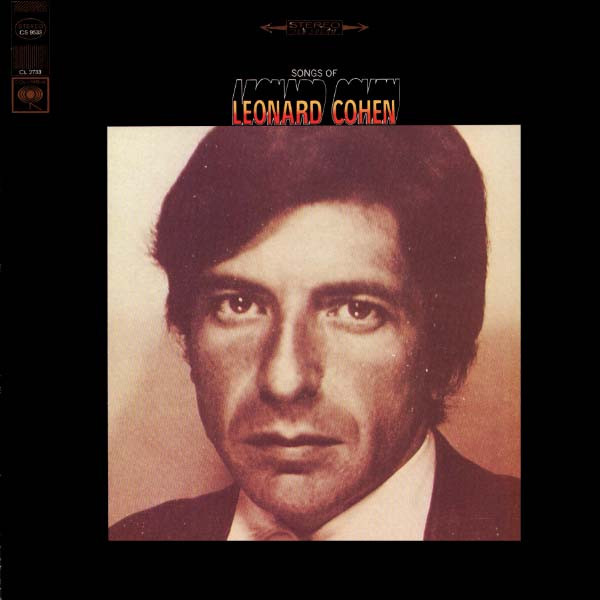
One song from the album, Hey, That’s No Way to Say Goodbye was covered wonderfully by Roberta Flack on her 1969 debut album, First Take, which I must have listened to 100 times or more before I ever knew it was written by Cohen:
Altman was a huge fan of Cohen’s new album, Songs of Leonard Cohen. A few years after it was released, just after finishing shooting McCabe & Mrs. Miller, Altman visited Paris and rediscovered it. He connected with Cohen and asked if he could use his songs in his film. Cohen agreed.
It’s important to note that at the time Altman asked to use his songs for McCabe & Mrs. Miller, Cohen was strictly a cult figure. Cohen’s Songs of Leonard Cohen never charted above sixty-three.
In the end, Altman chose three songs from Cohen’s first album, Songs of Leonard Cohen: The Stranger Song, Sisters of Mercy, and Winter Lady. Then, he asked Lou Lombardo, the film’s editor, to use the music to maintain a rhythm for the film, which I think he executed brilliantly.
According to an article by Robert Christgau for The Criterion Collection:
Before Altman even tried to negotiate permissions, he laid Cohen’s songs over his footage, and the mesh amazed him. “I think the reason they worked was because those lyrics were etched in my subconscious, so when I shot the scenes I fitted them to the songs, as if they were written for them. I put in about ten of them at first—of course, we way overdid it—and then we ended up with the three songs that were finally used, and I thought they were just wonderful.”
The three songs Altman featured in the film, in the order they appear, are: The Stranger Song, which is linked to McCabe; Sisters of Mercy, linked to the girls; and Winter Lady, linked to Mrs. Miller. The songs drift in and out throughout the film, and hang in the air around the characters like theme songs. However, as distinctive as Cohen’s songs are, they’re not the only music in the film. The non-Cohen music is almost ambient to the film, as you would expect in a remote mining and lumber town. However, incidental as it may seem, it is beautiful and intentional. There is David Lindley’s quiet guitar work throughout (Lindley was, as Cohen, relatively unknown at the time) and Brantley Kearns’ nice old-time fiddle work from time to time. There is also the sound of a music box and an interesting old-time jukebox that plays metal discs. All in all, I find that the score fits perfectly with the film’s Northwest mountain boomtown feel, a moody and wintry meditation on freedom, or perhaps more like the hope of freedom.
In short, McCabe & Mrs. Miller is a story about two people: a gambler who arrives in the unincorporated boomtown of Presbyterian Church, Washington, named after its only substantial building, a tall but mostly unused chapel; and a British cockney “madam,” who persuades McCabe to let her manage his brothel while he focuses on running a gambling hall. When a neighboring mining company tries to buy him out, things get interesting.
The film is a masterpiece and considered one of the most authentic representations of the often tragic wilderness life on the brink of economic and spiritual exhaustion that existed in the West.
In the film, Warren Beatty plays the mysterious gambler John McCabe:
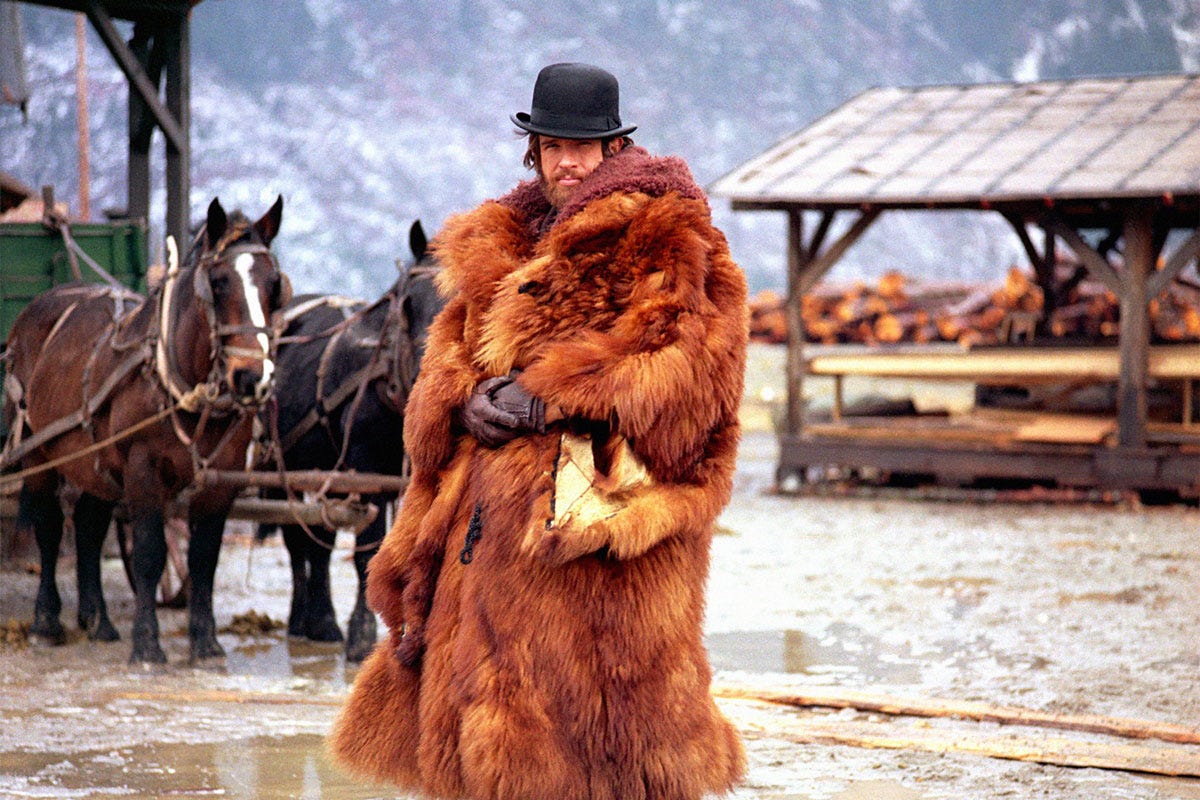
McCabe is “the Stranger.” To support himself, McCabe establishes a makeshift brothel, consisting of three prostitutes he purchased for $200 from a pimp in the nearby town of Bearpaw. His business partner is Julie Christie, who plays Mrs. Miller, the “madam.” Here’s a Contact sheet of Julie Christie for the film:
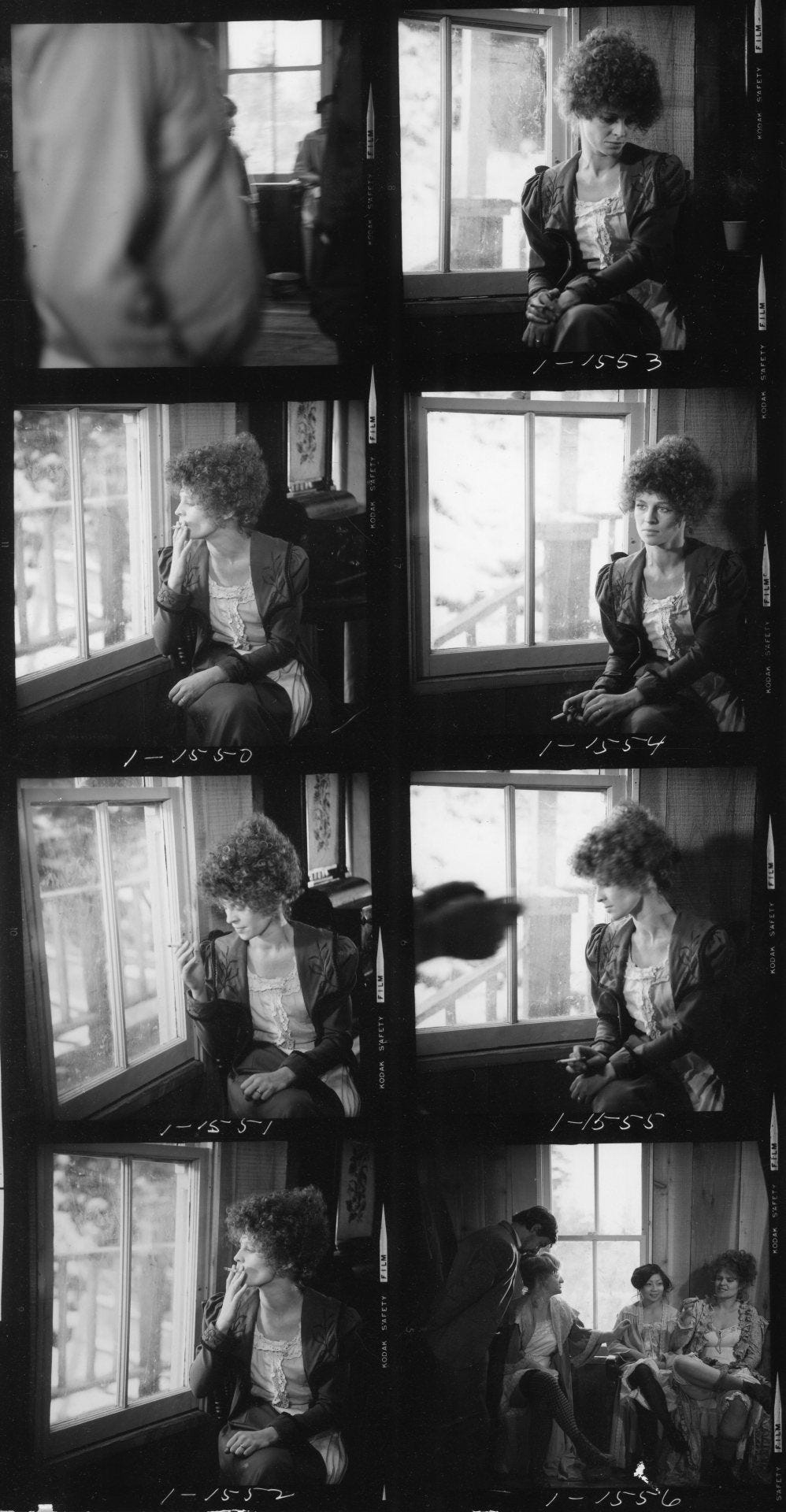
In 1999, Roger Ebert perhaps tells Mrs. Miller’s tale best:
Study the title. “McCabe & Mrs. Miller.” Not “and,” as in a couple, but “&,” as in a corporation. It is a business arrangement. Everything is business with her. What sorrows she knew before she arrived in Presbyterian Church are behind her now. Everything else is behind her now, too, the opium promises. Poor McCabe. He had poetry in him. Too bad he rode into a town where nobody knew what poetry was but one, and she already lost to it.
Mrs. Miller is “The Winter Lady.”
Julie Christie had risen to prominence several years prior, when she starred in the 1965 epic, Dr. Zhivago, for which she was nominated for an Academy Award but did not win; however, she did win the Academy Award for Best Actress for the 1965 movie Darling, which was filmed the same year. She was nominated again for her portrayal as Mrs. Miller in McCabe & Mrs. Miller, but lost to Jane Fonda for her performance in Klute, another great film.
True confession: In 1975, when I was 13 years old, on the last day it was shown in the theater, I snuck into the R-rated movie Shampoo, which starred both Beatty and Christie. I had seen Christie in Dr. Zhivago on TV and had a crush on her. After the movie ended, I asked the usher if I could have the movie poster, and he gave it to me. I still have it in the basement. Incidentally, Beatty and Christie starred together again in another great film, the 1978 Heaven Can Wait, which came out in the summer before my senior year in High School. I always thought they had great chemistry together.
Spoiler Alert for those who haven’t seen the film: Here’s the iconic final scene from this classic Western:
And why are you so quiet now
Standing there in the doorway?
You chose your journey long before
You came upon this highway
Next week on that Big River called Jazz, we’ll dig our paddles into the world of the Austrian philosopher Ludwig Wittgenstein.
Please hit this link to buy me a cup of coffee if you’d like to show your guide some appreciation for this and past journeys. Know in advance that I thank you for your kindness and support.
If you like what you’ve been reading and hearing so far on our journey and would like to share this with someone you think might be interested in learning more about our great American art form, Jazz, just hit the “Share” button.
From Astaire to Sun Ra: A Jazz Journey is a reader-supported publication. To subscribe, please hit the “Subscribe now” button.
Feel free to contact me at any time to talk shop. I welcome and encourage that.
Until then, keep on walking….
Whoa, that's eerie. Same here: True Grit -> Butch Cassidy and the Sundance Kid -> Man Called Horse -> Little Big Man. Those films are encoded in my DNA. And McCabe & Mrs Miller years later. Late 60's/early 70's Hollywood was telling us it was OK to not believe in Manifest Destiny. Thank you for that Leonard Cohen back story. Didn't know that!
North Vancouver BC is where a lot of the filming was done for McCabe,a fine film that holds up well in these AI times ,cheers,