
Ludwig Wittgenstein
Greatness or nothing...

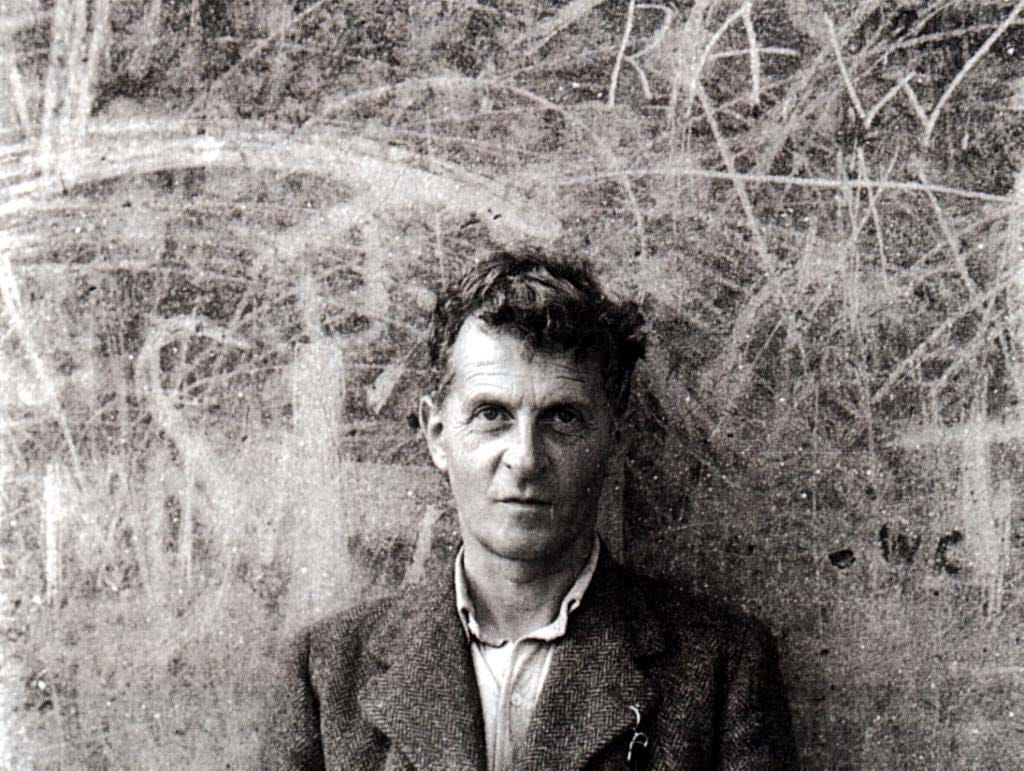
I wish to God that I were more intelligent and everything would finally become clear to me - or else that I needn’t live much longer!
-Ludwig Wittgenstein
When I was in the Army reserves back in the early 1990s, I was sent to Fort Jackson in Columbia, South Carolina.
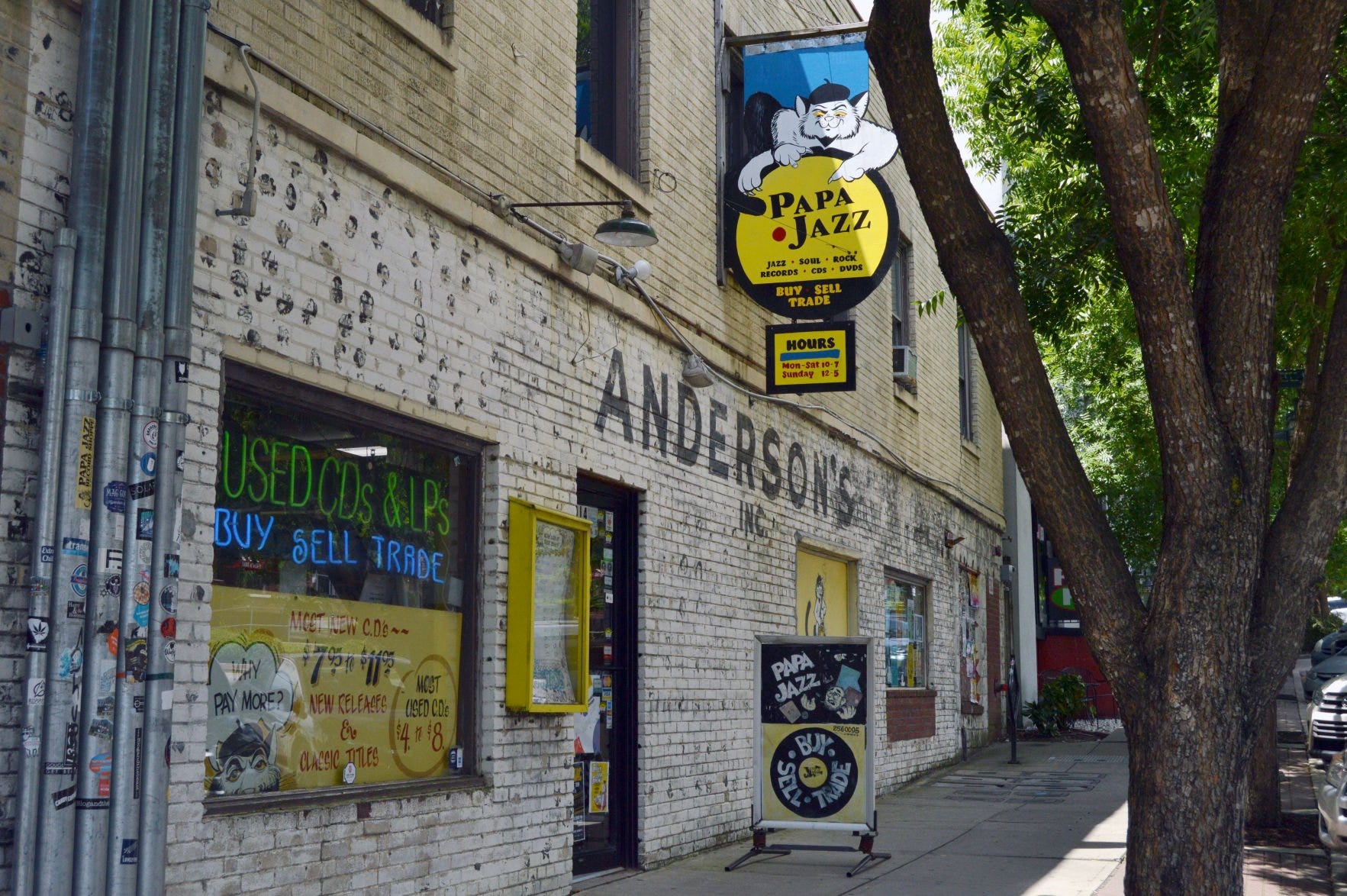
While I was there, I discovered the epic Papa Jazz Record Shoppe, which I’ve covered a few times before on our journey. You can take a virtual tour of the store here:
Something else I discovered in Columbia was Ludwig Wittgenstein.
Next door to Papa Jazz Record Shoppe was a popular coffee shop, where I spent a lot of time. One day, as I was reading a book, a guy started to tell me about this incredible book he was reading. The book was Wittgenstein’s Tractatus Logico-Philosophicus, of which, not surprisingly, I told him I had not heard of. Here is a copy of the excellent, newest translation by Damion Searls, released last year:
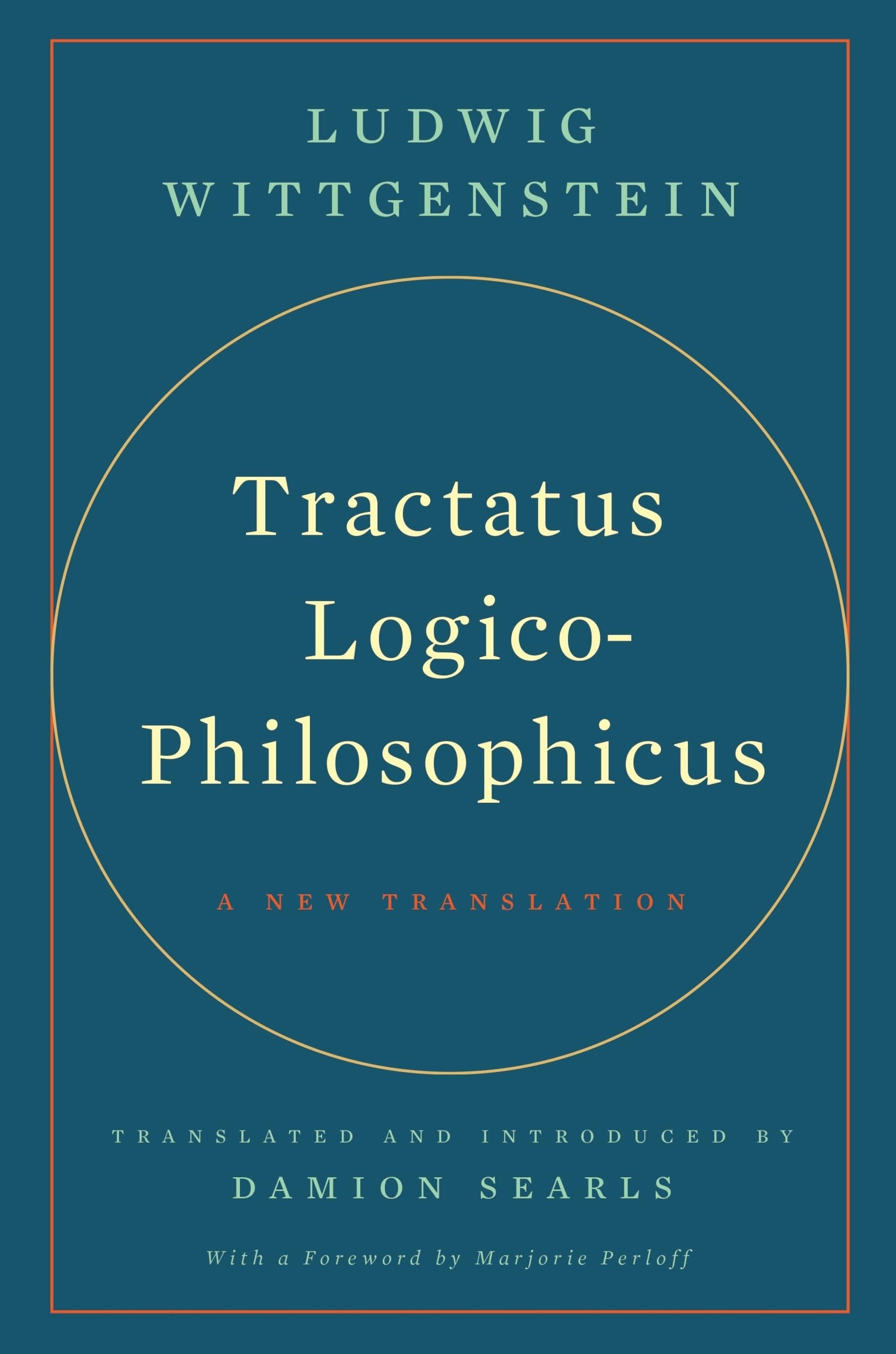
He told me it was one of the greatest books ever written. I was intrigued, and on the strength of his conviction alone, I located a used copy at Bell’s Bookstore in Palo Alto when I was back in California some months later.
When I started to read it, I put it down quickly. It was like jumping into jazz by listening first to Ornette Coleman’s Free Jazz: A Collective Improvisation. However, I was very captivated by Wittgenstein, the man, who lived in an ongoing struggle with his own nature. It was Wittgenstein’s commitment to intense self-assessment - his journey to discover and accept his “true” self - that intrigued me the most.
In his epic biography, Ludwig Wittgenstein: The Duty of Genius, Ray Monk tells the story of one of Wittgenstein’s first philosophical reflections. At age eight or nine, he paused in a doorway to consider the question: Why should one tell the truth if it’s to one’s advantage to tell a lie? Finding no satisfactory answer, he concluded that there was, after all, nothing wrong with lying.
Later in his life, Wittgenstein described this event as, “an experience which if not decisive for my future way of life was at any rate characteristic of my nature at the time.”
Monk writes about Wittgenstein:
In so far as he achieved anything, it was usually with the sense of its being in spite of his nature. The ultimate achievement, in this sense, would be the complete overcoming of himself - a transformation that would make philosophy itself unnecessary.
Wittgenstein’s own character - the compelling, uncompromising, dominating personality recalled in many memoirs of him written by his friends and students - was something he had had to fight for. As a child he had a sweet and complaint disposition - eager to please, willing to conform, and, as we have seen, prepared to compromise the truth. The story of his first eighteen years of his life is, above all, the story of this struggle, of the forces within him and outside him that impelled such transformation.
Young Ludwig was willing to say and do things because it was expected rather than because it was true. However, over time, through a series of transformations, undertaken at moments of crisis and pursued with conviction, Wittgenstein had a change of heart, a change in character. He concluded that fundamentally, the question is not if one should, on all occasions, tell the truth, but rather if one has an overriding obligation to be true. Despite the pressure to do otherwise, one should insist on being oneself. Monk continues:
The question he had asked himself at the age of eight was answered by a kind of Kantian categorical imperative: one should be truthful, and that is that; the question “Why?” is inappropriate and cannot be answered. Rather, all other questions must be asked and answered within this fixed point - the inviolable duty to be true to oneself.
In essence, the discipline to remain true to yourself equals freedom. This determination not to conceal his true self, to become an open book, became central to Wittgenstein’s outlook for the rest of his life.
This transformation in Wittgenstein’s outlook reminds me of the story The Blank Page, from Karen Blixen’s 1957 book Last Tales. She wrote:
Where the story-teller is loyal, eternally and unswervingly loyal to the story, there, in the end, silence will speak. Where the story has been betrayed, silence is but emptiness. But we, the faithful, when we have spoken our last word, will hear the voice of silence…
Who, then, tells a finer tale than any of us? Silence does. And where does one read a deeper tale than upon the most perfectly printed page of the most precious book? Upon the blank page.
I love this idea that beauty and truth are achieved precisely because trying to express the inexpressible was not attempted. But the road to that conclusion is not an easy one.
In the end, what I found most interesting about Wittgenstein’s story was his incredible journey to find inexpressible beauty and truth first through meditation and then through silence.
This week on that Big River called Jazz, we’ll dig in our paddles and discover the early years of the modern philosopher Ludwig Wittgenstein.
Ludwig Wittgenstein was born on April 26, 1889, the eighth and youngest child of one of the wealthiest families in Habsburg Vienna. His father, Karl Wittgenstein, was an iron and mining magnate and one of the most successful industrialists in the Austro-Hungarian Empire. The Wittgensteins became the Austrian equivalent of the Krupps of Germany, the Carnegies of America, or the Rothschilds of France.
He was no philanthropist on the scale of his American friend Andrew Carnegie, but still a patron of the arts and a strong supporter of the Secession, Vienna’s Art Nouveau movement led by Gustav Klimt. However, the family’s cultural life was centered around music.
Karl’s first cousin was the famous violin virtuoso, Joseph Joachim, whose quartet played several times each year in the Wittgenstein home, known outside the family as Palais Wittgenstein. Through Joachim, the family was introduced to Johannes Brahms and the blind organist and composer Josef Labor, who owed his career largely to the family’s patronage. Richard Strauss came and performed duets with Ludwig’s older brother, Paul, a budding concert pianist, who during WWI lost his right arm to a Russian bullet and was then imprisoned in the infamous Siberian fortress where Dostoyevsky set his novel, The House of the Dead. Paul’s most lasting significance came from commissioning one-handed works from at least a dozen composers, including Richard Strauss, Sergei Prokofiev, Benjamin Britten, Paul Hindemith, and Maurice Ravel, whose Piano Concerto for the Left Hand remains widely performed.
Ludwig shared his brother Paul’s iron will; however, three of their brothers killed themselves: Rudi and Hans when they were in their early twenties, and Kurt when he was forty.
As a young man, Ludwig was sent to Germany to a technical school in Linz and then to study mechanical engineering at the Technische Hochschule in Berlin. In 1908, he went to Manchester University in England to study aeronautics. While in Manchester, he discoverd Betrand Russell’s The Principles of Mathematics, which awakened an obsession for philosophical problems. In October 1911, Ludwig suddenly appeared at Russell’s door at Trinity College in Cambridge University to introduce himself. Incredibly, Wittgenstein would become Russell’s protégé. Even more incredibly, by 1913, still only 24 years old and officially an undergraduate reading for a BA, Wittgenstein had become Russell’s master with the responsibility for the future of Russellian mathematical logic. According to Russell, within two years, Wittgenstein “knew all I had to teach.” And this is when Wittgenstein's journey of self-discovery begins.
While at Cambridge, Wittgenstein met and developed a close friendship with David Pinsent, a second-year student in undergraduate mathematics. In September 1913, Wittgenstein and Pinsent spent three weeks together in Norway, vacationing in the small village of Öistesjo, on the Hardanger fjord. They spent much of their time sailing out into the fjord. Pinsent did all the sailing while Wittgenstein sat in the boat working neurotically on his theory of types, which ended up as Notes on Logic, the earliest surviving exposition of his philosophical thoughts.
According to Pinsent, upon his return from Norway, Wittgenstein announced to him:
That he should exile himself and live for some years right away from everybody he knows - say in Norway. That he should live entirely alone and by himself - a hermit’s life - and do nothing but work on Logic.
So on October 8, after bidding farewell to Pinsent, Wittgenstein left England and returned to Norway. With the outbreak of war the following summer in 1914, this was the last time the two ever saw each other as Pinset was killed in an airplane accident in May 1918.
When he returned to Norway, this time traveling alone and deeper into the isolated fjords, Wittgenstein found the tremendous liberation he was searching for. As I listen to one of Wittgenstein’s favorite works, I picture him in a boat sailing deep into the northern landscapes:
He found his ideal spot at the very end of Lustrafjorden, the longest side arm of Norway’s longest and deepest fjord, Sognefjord, known as the “King of the Fjords.” He liked it so much that he had this cabin built near the little village of Skjolden, which you can just make out here in this picture:
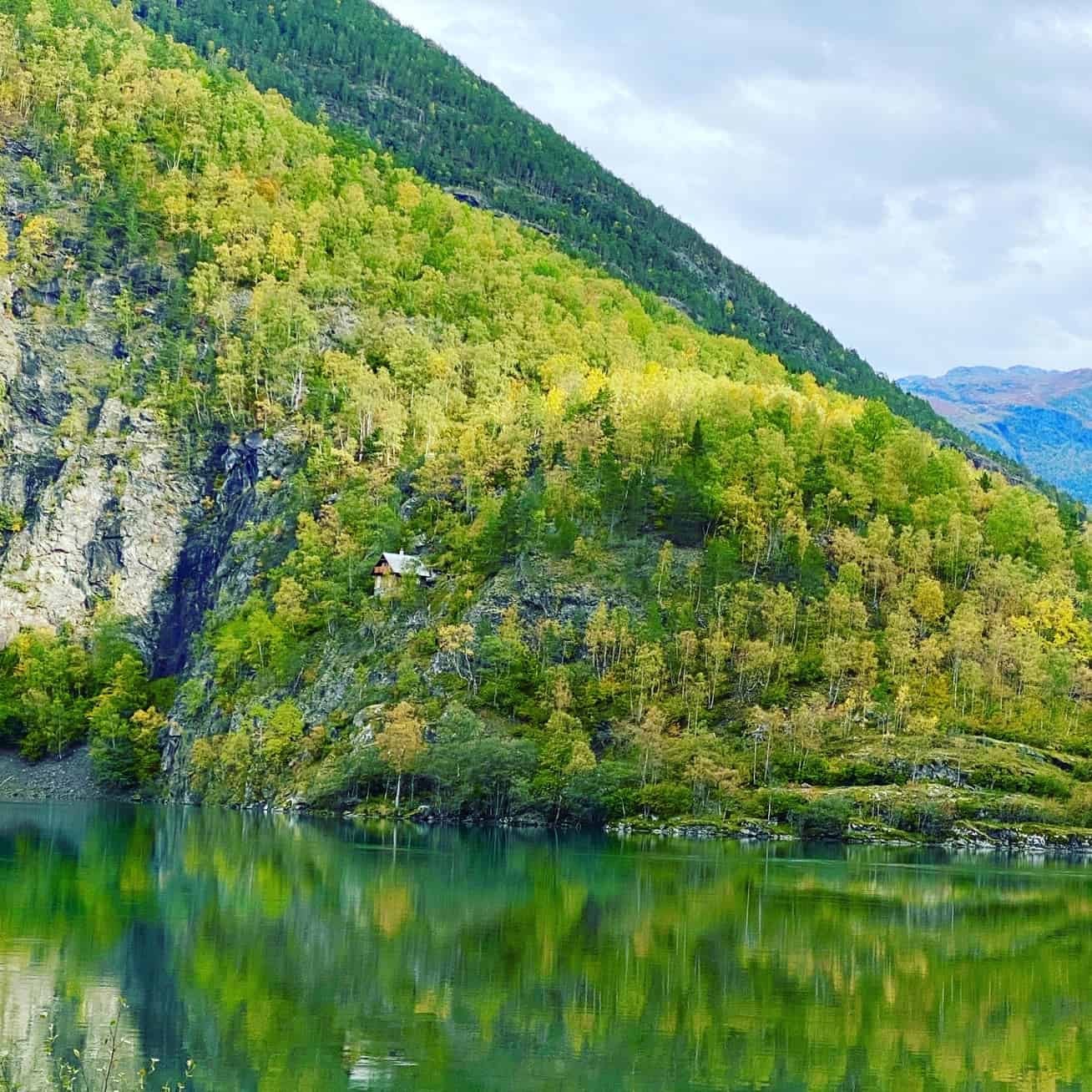
This is a closer look at the cabin:
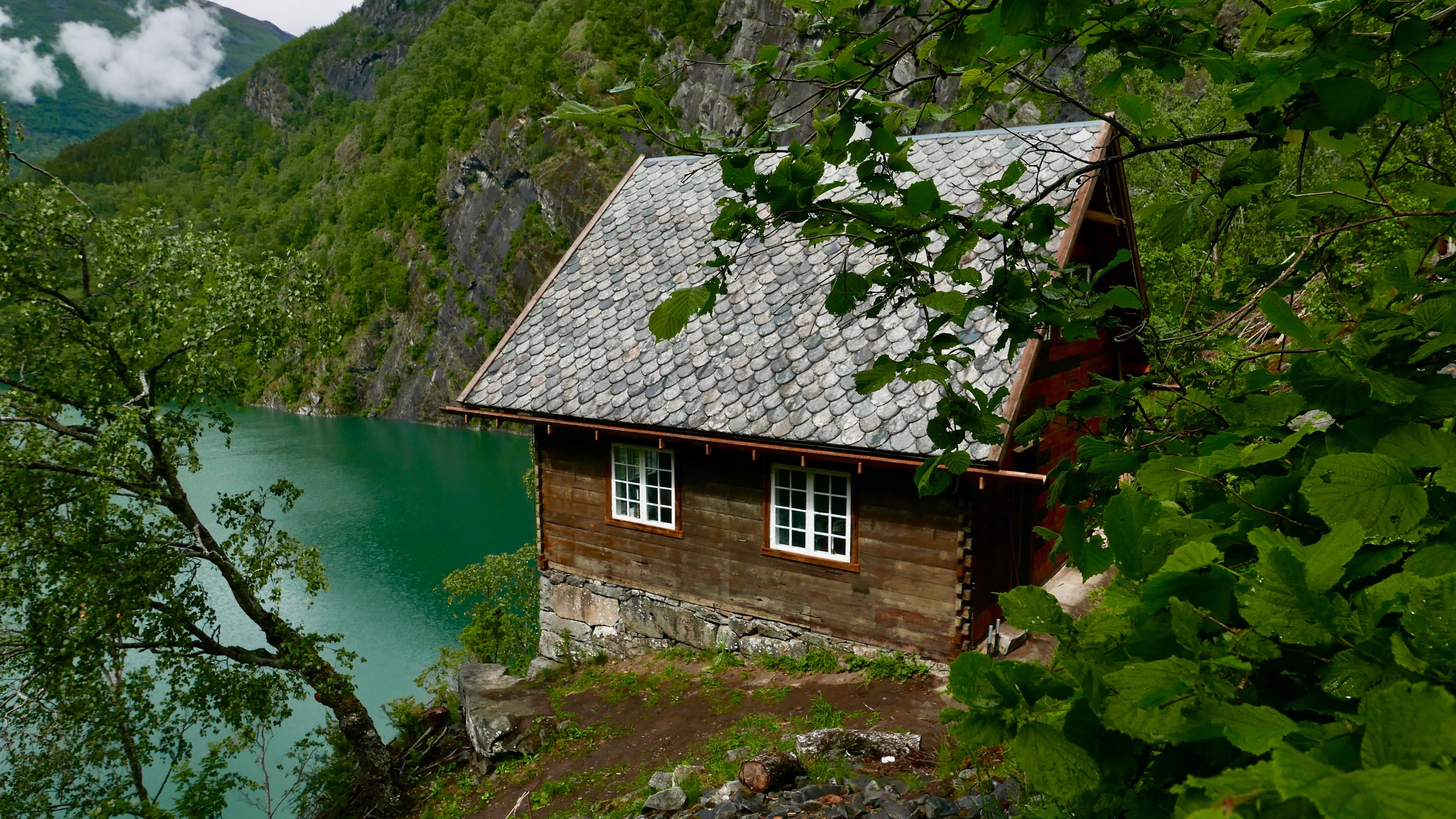
What Wittgenstein needed in 1913 was solitude, and he had finally found it. In his book, Monk writes:
His horror of the bourgeois life was based in part on the superficial nature of the relationships it imposed on people, but partly also on the fact that his own nature imposed upon him an almost insufferable conflict when faced with it - the conflict between needing to withstand it, and needing to conform to it.
In Skjolden he could be free from such conflicts; he could be himself without the strain of upsetting or offending people.
It was perhaps the only time in his life when he had no doubts that he was in the right place, doing the right thing, and the year he spent in Skjolden was possibly the most productive of his life.
Incidentally, the construction of his cabin was completed in early 1915, while Wittgenstein was serving in the army in Krakow. He would not return to the cabin until 1921. In June 2019, Wittgenstein’s cabin was reopened to the public after being dismantled for 60 years.
In Skjolden, the 24-year-old Wittgenstein was a philosopher in exile, on a voluntary “escape” both from one of Austria-Hungary’s greatest family fortunes, which he wanted to be independent from, as well as from England’s sharpest philosophers at Cambridge – a place where the genius apparently found it distracting.
As Monk described, it was in Skjolden that Wittgenstein could finally struggle for clarity:
Complete clarity, or death - there is no middle way. If he could not solve: “the question [that] is fundamental to the whole of logic”, he had no right - or, at any rate, no desire - to live. There was to be no compromise.
However, the war broke Wittgenstein’s exile. On August 7, 1914, a day after Austria declared war on Russia, Wittgenstein joined the Austrian army as a volunteer, which put him and his friend Pinsent on different sides of the war.
Wittgenstein’s enlistment in the army was more complicated than just a desire to defend his country. It was also linked to a desire for personal growth. Monk explains:
That he in some way welcomed the war seems indisputable, even though this was primarily for personal reasons rather than nationalistic reasons… Wittgenstein felt that the experience of facing death would, in some way or other, improve him. He went to war, one could say, not for the sake of his country, but for the sake of himself.
As it turned out, while assigned to an artillery regiment serving at Krakow on the Eastern Front, he completed the first part of Tractatus Logico-Philosophicus. In March 1916, while assigned to a fighting unit on the Russian Front, he completed the second part of the book, which addressed his thoughts on ethics, aesthetics, the soul, and the meaning of life. Monk writes:
It was as if the personal and the philosophical had become fused; ethics and logic - the two aspects of the duty to oneself - had finally come together, not merely as two aspects of the same personal task, but as two parts of the same philosophical work.
During his time on the front lines, Wittgenstein consistently put himself in harm’s way. He had faced death, been shot, highly decorated for bravery, and finally sent to prisoner-of-war camps in Como and Cassino, Italy. All of this had steeled his will. He had become a different person. He was released on August 21, 1919, and returned to Vienna, now the capital of a small, impoverished, and insignificant Alpine republic.
Due to his father’s financial astuteness in transferring the family’s wealth into American war bonds, Wittgenstein returned from the war one of the wealthiest men in Europe; however, within a month of his return, he had disposed of the entire estate. In September 1919, after getting rid of all his wealth, he enrolled in a teacher’s college and became a schoolteacher in the remote Austrian village of Trattenbach. From there, he dedicated himself to finding a publisher for his manuscript.
Wittgenstein’s Tractatus Logico-Philosophicus was finally published in German in 1921 as Logisch-Philosophische Abhandlung (Logical-Philosophical Treatise); however, Wittgenstein was not satisfied with this edition and called it a “pirated edition.”
The following year, with a new Latin title, Tractatus Logico-Philosophicus was published together with an English translation, which he considered a properly published edition. It would be his only philosophical work published during his lifetime. Interestingly, Searls’ latest translation claims to be a clearer and more accessible rendering.
Wittgenstein dedicated Tractatus Logico-Philosophicus to David Pinsent, “My first and my only friend.” Upon learning of her son’s death, Wittgenstein wrote to Mrs. Pinsent:
I have indeed known many young men of my own age and have been on good terms with some, but only in him did I feel a real friend, the hours I have spent with him have been the best of my life, he was to me a brother and a friend.
Ludwig Wittgenstein died on April 29, 1951. He was 62 years old. He was given a Catholic burial at Ascension Parish Burial Ground in Cambridge, England.
Bertrand Russell said about him, “He is perhaps the most perfect example I have ever known of genius as traditionally conceived; passionate, profound, intense, and dominating.”
Here’s one more for the road. It’s been in the news that Gustav Klimt’s painting Portrait of Serena Lederer just sold at Sotheby’s for a whopping $236.4 million, becoming the most expensive work of modern art ever sold at auction. Elisabeth Lederer was the daughter of Austrian industrialist and art collector August and his wife Serena Lederer.
Like Lederer, Karl Wittgenstein was one of Klimt’s patrons, having bought his Life is a Struggle, Water Snakes I (which is amazing), and The Sunflower, among others. In 1905, he commissioned Klimt to paint a portrait of his daughter Margaret on the occasion of her marriage to wealthy American art collector, Jerome Stonborough:

Margaret commissioned her brother Ludwig, along with architect Paul Engelmann, to build her a house, now known as Haus Wittgenstein, on the Kundmanngasse in Vienna:
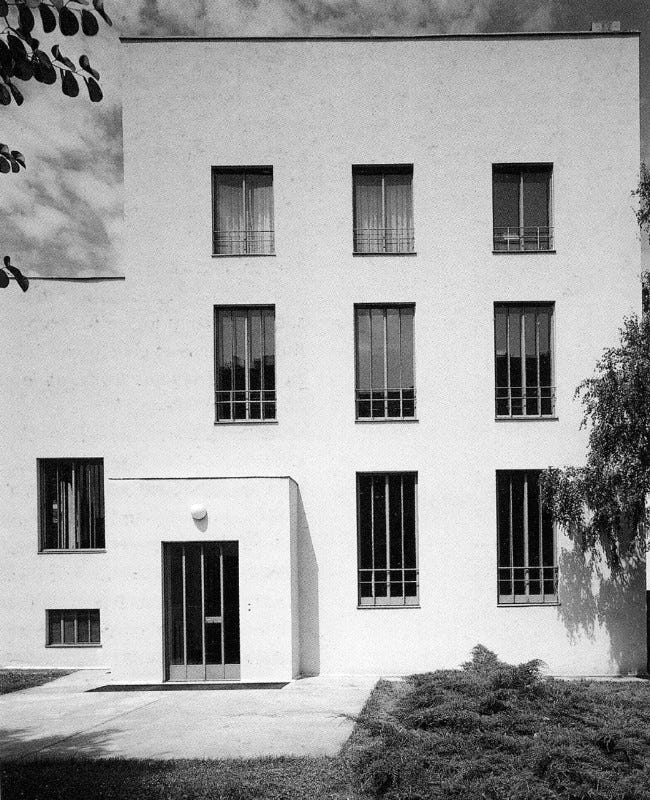
Describing the work, Ludwig and Margaret’s eldest sister, Hermine, wrote:
Even though I admired the house very much, I always knew that I neither wanted to, nor could, live in it myself. It seemed indeed to be much more a dwelling for the gods than for a small mortal like me, and at first I even had to overcome a faint inner opposition to this ‘house embodied logic’ as I called it, to this perfection and monumentality.
The project evolved into a two-year collaboration where Wittgenstein became the primary architect, pouring his philosophical and engineering principles into the modernist house’s strict attention to detail.
Although it is well documented that Wittgenstein was not a fan of modern music, I think if he were alive in the 1970s, he would have been a fan of Brian Eno’s renderings in ambient music. For example, I think he’d have listened to Eno’s landmark 1978 Ambient 1: Music for Airports:
And also liked an album Eno produced, Harold Budd’s 1978 collaboration with Marion Brown, The Pavilion of Dreams:
It seems to me that the music’s pace, ideal for relaxation and meditation, would create the perfect conditions for him to think about Logic.
In my mind, I picture Ludwig in his cabin in Norway, sitting at his desk, staring at the blank page. All the while, sinking deeper into thought, contemplating: Is it true that we can capture the physical world only through language, and, if the limit of language is the limit of our understanding of the world?
I don’t know about these things, but I do agree with the last sentence in his Tractatus: “About things we cannot speak of we must keep silent.”
When we have spoken our last word, we will hear the voice of silence, and it will be the truth.
I won’t say ‘See you tomorrow’ because that would be like predicting the future, and I’m pretty sure I can’t do that.
— Wittgenstein (1949)
Next week on that Big River called Jazz, we’ll dig our paddles into the waters of the Lighthouse All-Stars.
Please hit this link to buy me a cup of coffee, if you’d like to show your guide some appreciation for this and past journeys. Know in advance that I thank you for your kindness and support.
If you like what you’ve been reading and hearing so far on our journey and would like to share this with someone you think might be interested in learning more about our great American art form, Jazz, just hit the “Share” button.
From Astaire to Sun Ra: A Jazz Journey is a reader-supported publication. If you feel so inclined, subscribe to my journey by hitting the “Subscribe now” button.
Feel free to contact me at any time to talk shop. I welcome and encourage that.
Until then, keep on walking….
I have read Monk's bio of Russell. Based on your most excellent recommendation I am going to acquire his bio of Wittgenstein. For years I have bypassed Tractatus in bookstores. I will soon remedy that. Keep 'em coming. 🤘😎🤘