
Jean Cocteau
And all that jazz...

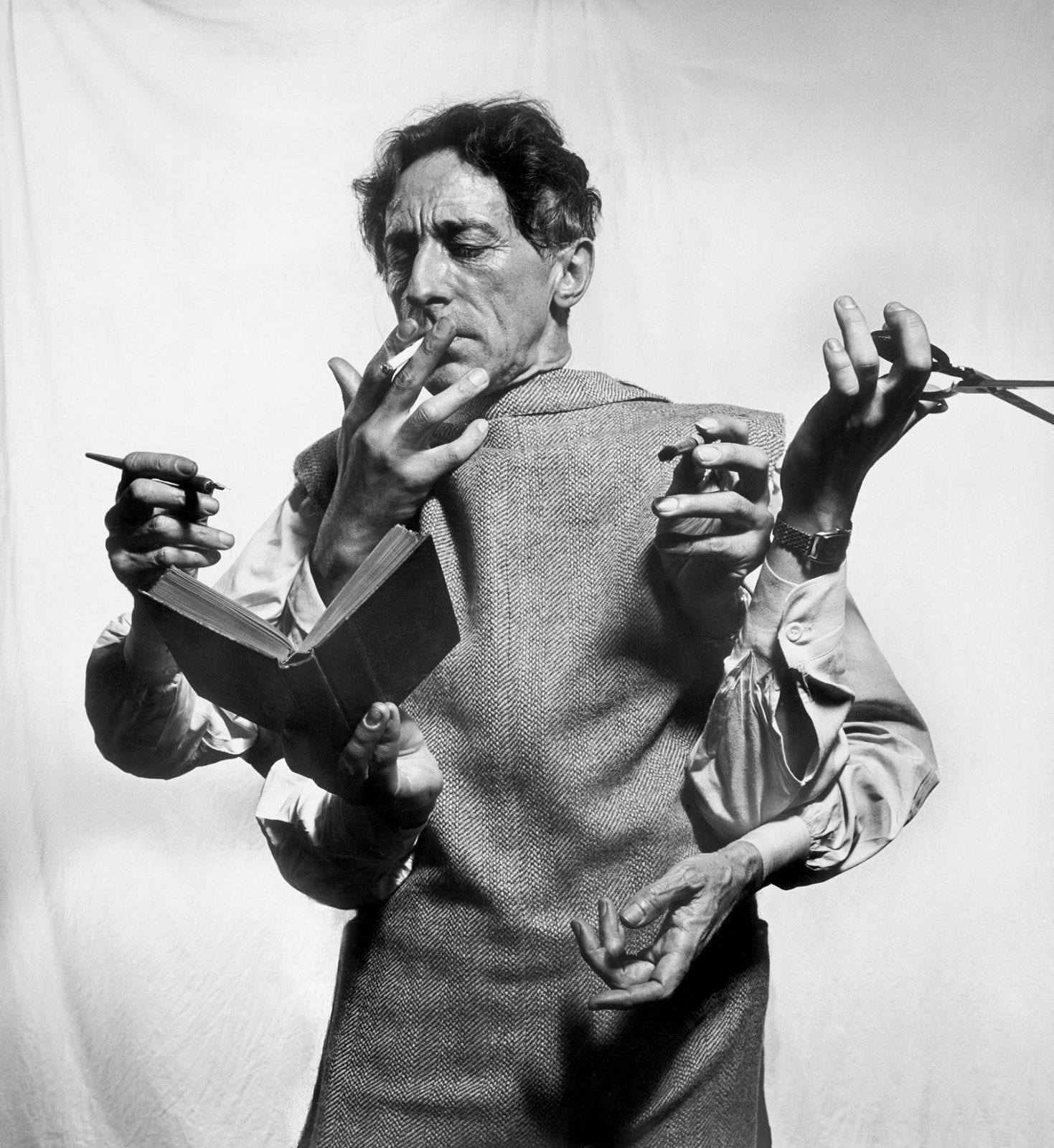
I found jazz more intoxicating than alcohol, which does not agree with me.
- Jean Cocteau
In memory of Bastille Day earlier this week, our journey this week takes on une ambiance française distinctive.
By 1917, the Great War had raged for nearly two and a half years, and the French people had suffered horribly.
That same year, in the dire atmosphere of war, Surrealism was conceived. It was seven years before André Breton would write its first manifesto.
French poet Guillaume Apollinaire coined the term “surrealism” in the program notes for the historic 1917 ballet Parade by the triumvirate Jean Cocteau, Erik Satie, and Pablo Picasso. Apollinaire described the performance as “une sorte de surréalisme” (a kind of Surrealism).
Parade’s roots go back to 1914, when French poet and playwright Jean Cocteau heard Satie’s Trois morceaux en forme de poire (Three Pieces in the Shape of a Pear) at a concert. He envisioned writing a ballet scenario to Satie’s music and shared the idea with the Russian impresario Sergei Diaghilev, who persuaded him to go for it.
Cocteau got to work and recruited Pablo Picasso for the costumes and sets, Apollinaire for the libretto, Diaghilev’s latest discovery, Leonide Massine, for the choreography, and, of course, Satie for the music. The result of all this effort was Parade, produced and performed by Diaghilev’s Ballets Russes, which premiered on Friday, May 18, 1917, at the legendary Théâtre du Châtelet in Paris:
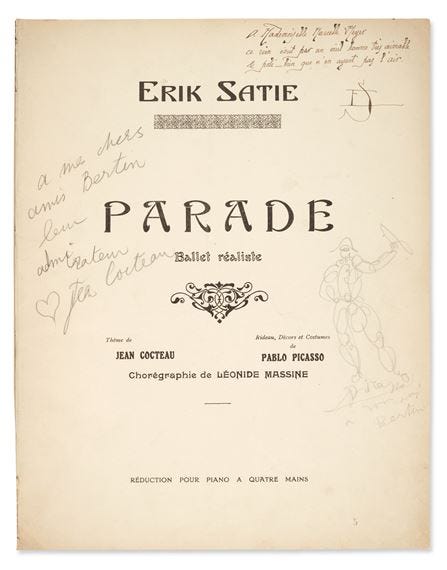
From Parade, here’s Satie’s Prélude du rideau rouge (Red Curtain Prelude), a nod to Picasso’s massive stage curtain, known as the “Red Curtain”:
This lovely prelude defies the nature of the surrealistic ballet, which featured wild costumes designed by Picasso, like this one:
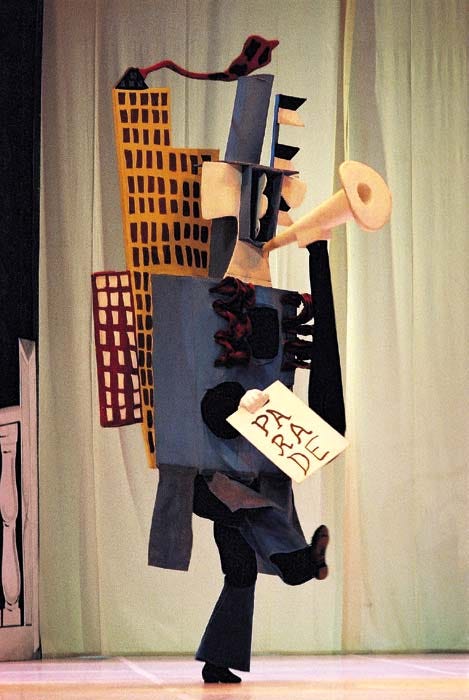
Apollinaire explained that he used the term surréalisme to describe Picasso’s artistic flair in Parade, envisioning it as a means of transforming how we look at life. Later in his life, Picasso shared, “I value a more profound resemblance, realer than real, attaining the surreal. That’s how I viewed Surrealism.”
Interestingly, I was in Seoul last week at the Centre Pompidou Hanwha Museum to see the exhibit The Cubists: Inventing Modern Vision. It was spectacular. They had on display Picasso’s stage curtain for Mercure, a ballet with music by Erik Satie. The Soirées de Paris stage company commissioned it, and it was first performed at the Théâtre de la Cigale in Montmartre, Paris, on June 15, 1924.
The “Mercure Curtain” was stunning and gave me a good feel for the scope of Picasso’s “Red Curtain” from Parade.
In 1917, Surrealism was not an art movement, but rather a way of life - a rebellion against the establishment that had given the world the hideous slaughter of the Great War. The Surrealists felt that if conventional human society could lead to something as disgusting as that, then it must itself be disgusting. They conceptualized an idea that the realism of copying nature should be replaced by the sur-realism of interpreting it. Two such artists were Cocteau and Picasso, who in July 1917 moved to a studio at 22 rue Victor-Hugo in Montrouge, in southern Paris.
By that point, Parisian avant-garde composers had not yet begun incorporating “jazz” techniques into their work, a practice that didn’t start in ernest until about the time French composer Darius Milhaud composed Le Bœuf sur le toit (literally “the ox on the roof”), Op. 58, a short piece for small orchestra written in 1919–20. Here is the program for the original ballet-farce Le Bœuf sur le toit, illustrated by Raoul Dufy.
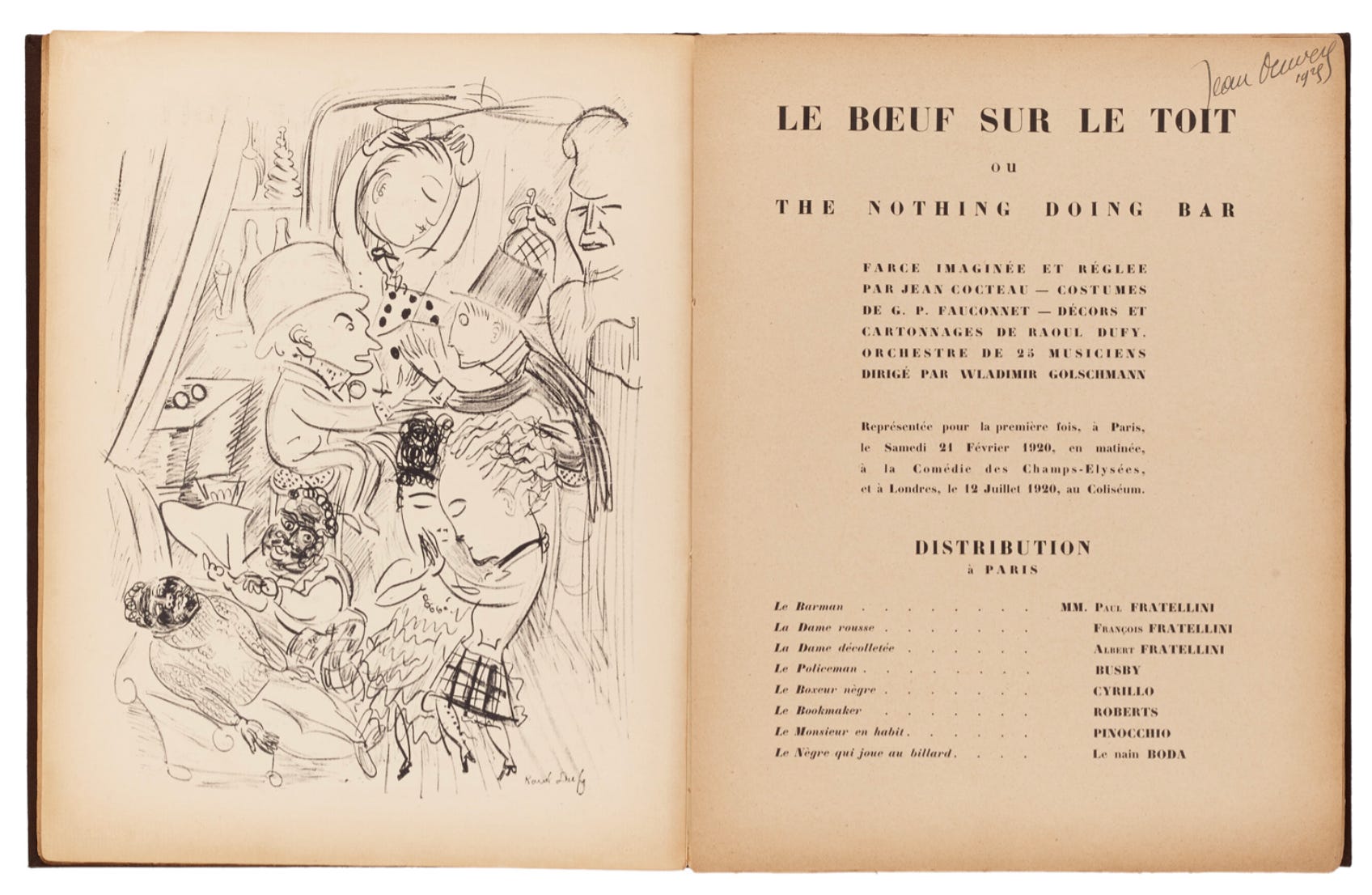
Milhaud conceived the piece as incidental music for any of Charlie Chaplin's comic silent films. Still, Le Bœuf sur le toit received its premiere as the music for a ballet staged by Jean Cocteau on February 21, 1920, at the Comédie des Champs-Élysées.
The seeds of this first significant connection between jazz music and French composers were sown by Milhaud and a group of composers who called themselves Les Six. They were the hottest ‘band’ in town. They all emerged from a group of admirers of Satie and his ragtime-inspired ballet Parade, and began incorporating jazz rhythms, melodies, and instrumentation into their works.
However, Les Six’s connection with jazz did not only involve composing, performing, and writing about it; in 1921, they collaborated with Cocteau to establish a nightspot called La Gaya to celebrate it. At La Gaya, Cocteau choreographed a ballet-farce, performed on the piano by three players, that parodied American ragtime and jazz compositions; soon, Le Gaya was “discovered” and became the playground of the Paris cultural elite. Realizing the potential to make some money, the owners moved the bar to a larger space and renamed it Le Boeuf sur le Toit, after Milhaud’s tango-inspired ballet. The cabaret remains in operation today.
They invited French pianist Jean Wiéner and American banjoist Vance Lowry, whom Cocteau discovered at a nearby bistro, to perform as regulars. Bit by bit, the writers and composers at Le Boeuf sur le Toit took to listening to jazz.
Vance Lowry was known as the “Banjo King” of Emporia, Kansas. He spent many years performing in Europe while living in France during the Jazz Age.
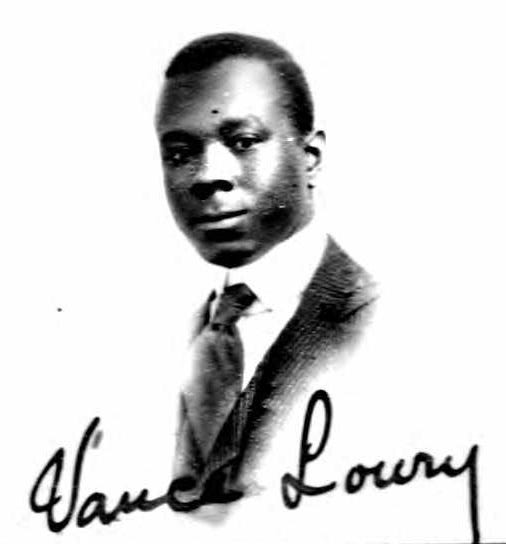
In 1914, Lowry traveled to London to play with Louis Mitchell’s Southern Symphony Quintette. Two years later, in 1916, Lowry joined pianist Dan Kildare and the Ciro’s Club Coon Orchestra, an all-black string band, which played at Ciro’s Club, the legendary nightclub that presaged the Jazz Age in Great War-era London. Kildare was born in Jamaica, but trained in the U.S. under James Reese Europe and, with Lowry, played for dance sensations Vernon and Irene Castle. I wrote about them here:

Ciro’s Club Coon Orchestra recorded several sides with Columbia Records in London. Here’s one of them, Poor Butterfly:
In 1917, Lowry amended his passport to travel from London to Paris to play an engagement with Louis Mitchell’s “Seven Spades” at the Alhambra Theater. By 1921, Lowry had returned to Paris and remained there, performing at the Bar Gaya with Wiéner.
Mitchell later formed Mitchell’s Jazz Kings, a renowned band that accompanied Mistinguett’s revue at the Casino de Paris and recorded exclusively for the Pathé label from January 1922 to July 1923. While playing in Paris with Mitchell’s Jazz Kings, Lowry caught the eye of Jean Cocteau and the Quintette du Hot Club de France violinist Stéphane Grappelli.
In March 1929, Cocteau invited Lowry to record music he composed based on the foxtrot Pourquoi j’ai regretté with the Dan Parrish Jazz Orchestra to accompany Cocteau’s poem Les Voleurs D'Enfants:
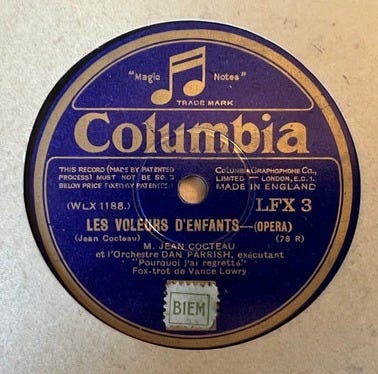
In a 1963 interview with DownBeat magazine, shortly before his death, Cocteau shared this when asked about the jazz scene at Le Boeuf sur le Toit:
Yes, which they were still calling the Gaya Bar. There you could hear Wiéner and an American named Vance, whom I had discovered and recorded my first album, The Robbers of Children, while directing with one hand and reciting my poem at the same time.
About this Vance. Up till then, he had been playing in a nearby bistro. Thanks to Vance, the people at the Gaya took on… the habit of listening to jazz. I even played drums there myself on occasion. It was, incidentally, at this future Boeuf sur le Toit that the first fox trot was introduced.
Here’s that recording of Cocteau reading his poem, accompanied by Lowry and the Dan Parrish Jazz Orchestra:
By the mid-1920s, much of the avant-garde had lost interest in jazz because it was becoming too well-known. After a few good years, Le Boeuf sur le Toit moved to a new location, but the famous people did not follow. Milhaud explained, “[Jazz] had now become official and won official recognition.” The music had lost its outsider status. However, when WWII broke out, the fortunes of jazz changed, at least for the time being, as neither the Nazi nor the Vichy government banned jazz. That was later challenged by those who envisioned a more restricted “France for the French.”
And so it goes on that Big River called Jazz…
Here’s one more for the road. In 1955, the La Voix De Son Maître (His Master’s Voice) label released Poèmes de Jean Cocteau Dits Par L’auteur, an album of Cocteau reading his poetry. I love this simple yet distinctive cover:
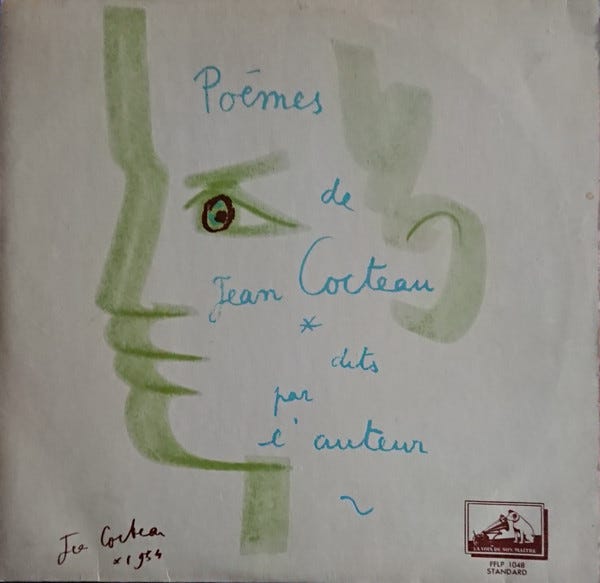
Notice the eye in the picture. In SACRED MONSTER, Chloë Cassens writes:
Eyes are a motif consistent throughout the work of Cocteau. They’re highlighted on pottery, in drawings, and in his films. While his friends Buñuel and Dalí were famously slicing through one in the Surrealist classic Un Chien Andalou (1929), Cocteau’s were frequently open wide – and when shut, done so with maximum effect, and with great artistic purpose.
Cocteau’s eyes, like Severin’s (Cassens’ grandfather and famous collector of Cocteau’s work), gave and received information in equal measure, as we all do. But what they were seeing was something unique and not of this world.
For Cocteau, eyes were not about a passive gaze but about an active, internal, and often painful vision that defined the artist’s unique, isolated path. In his 1946 film Beauty and the Beast, the Beast tells Belle not to look into his eyes, as this would reveal a truth that could harm her or break the “spell.” Clearly, Cocteau intended to put the world under his spell.
In 1957, in Villefranche-sur-Mer, as a mark of friendship towards the village fishermen who were refurbishing the Romanesque chapel of St Pierre, patron saint of fishermen, Cocteau agreed to decorate it. He used a simple, graphic style free from elaborate decorative techniques, blending figurative and abstract art, and the eyes were his focus:
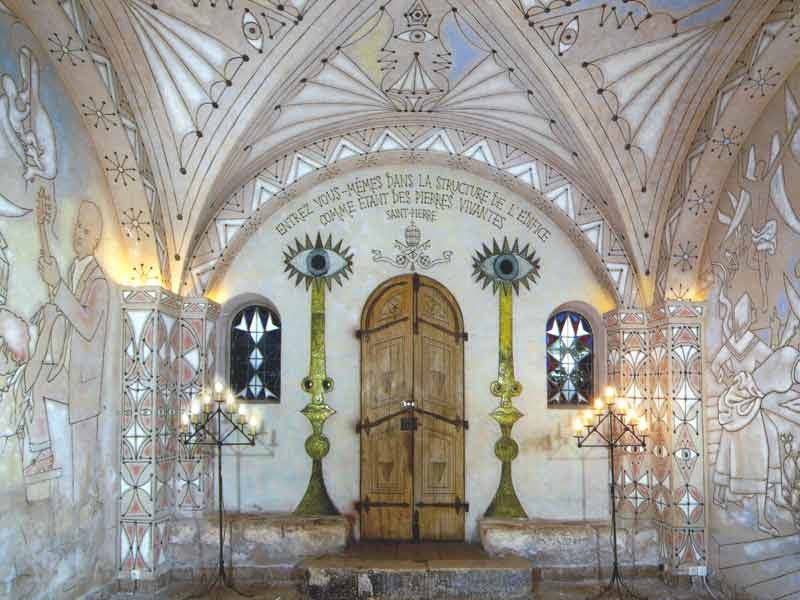
In his book Jean Cocteau: A Life, Claude Arnaud writes about Cocteau’s work on the chapel of St Pierre:
With the help of opium, which intended to embalm him alive, the chapel of Villefranche became a dream refuge against reality. The days he spent there had a stupefying power of anticipation; he imagined himself crossing the centuries just as frail, lively, and tenacious as the little red light that signaled a divine presence; it was almost his mausoleum he was building, while he waited to join the beyond, like the pharaohs within the pyramids.
In his work, like the Villefranche chapel, Cocteau used eyes primarily to symbolize the boundary between life and death - reality and myth.
This idea that eyes are the threshold between the conscious world and the surreal has always fascinated me, as if Cocteau had indirectly cast a spell on me…
“Beauty cannot be recognized with a cursory glance.”
—Jean Cocteau
After Cocteau suffered a severe heart attack on April 22, 1963, his health slowly deteriorated. Then, on the morning of October 11, 1963, when someone told him that his friend Edith Piaf had died, he said, “Today is my last day on earth.” Around noon, his heart gave out, and he passed to the Western Lands.
According to his wishes, he is buried beneath the floor of the Chapelle Saint-Blaise des Simples in Milly-la-Forêt, about 30 miles south of Paris. The epitaph on his gravestone set in the floor of the chapel reads: Je reste avec vous (“I stay with you.”)
Next week on that Big River called Jazz, we’ll dig our paddles into the world of another artist fascinated with the “threshold between the conscious world and the surreal,” American poet James Merrill.
Please hit this link to buy me a cup of coffee if you’d like to show your guide some appreciation for this and past journeys. Know in advance that I thank you for your kindness and support.
If you like what you’ve been reading and hearing so far on our journey and would like to share it with someone who might be interested in learning more about our great American art form, Jazz, just hit the “Share” button.
From Astaire to Sun Ra: A Jazz Journey is a reader-supported publication. To subscribe, please hit the “Subscribe now” button.
Feel free to contact me anytime to talk shop. I welcome and encourage that.
Until then, keep on walking….
Wonderful post. I'm a big fan of Satie, and have several recordings of Parade. I think Cocteau suggested the sound effects, gunfire, a typewriter, which Satie felt were superfluous but went along with it. I like the sound effects personally. Varese was inspired to use sirens and ship's bells in Amerique by Parade's use of them, and in turn inspired Antheil to use siren and airplane propeller in the score of Ballet Mecanique. I think the use of the typewriter as percussion in Parade likely inspired its use on China My China on Eno's Taking Tiger Mountain by Strategy, where I believe Robert Wyatt is playing it.
Some other tangents which come to mind. Cocteau later used a young singer to play the witch, Aglaonice, in the second part of his Orphic Trilogy, Juliette Greco. She was part of the post war Parisian Jazz scene centered in Saint-Germain-des-Pres, whose unofficial mayor was novelist, playwright, Jazz critic, trumpeter, singer, songwriter, etc., Boris Vian. Vian was a member of the Collége de !Pataphysique, an organization of writers formed to pay homage to Alfred Jarry's pseudo-science, which also included Jacques Prévert, Raymond Queneau, himself an early member of Breton's Surrealist Group, and various others. Jarry having been one of the pre-cursor surrealist saints named by Breton as inspirations.
Jean-Paul Sartre was not a member of the Collége, but did hang around the Saint-Germain-des-Pres scene along with Simone de Beauvoir. Much of the material on Greco's early recordings were composed by Josef Kosma with lyrics by Prévert, Robert Desnos, another former surrealist, and surprisingly, Queneau and Sartre, who each penned a lyric for her. I don't think she was the first to record the Kosma / Prévert Les Feuilles Mortes (Autumn Leaves), and Yves Montand's recording is better known, but she first recorded it the same year he did and I like hers better.
In 1949, I think, Vian brought Miles Davis to Paris. He'd previously organized sojourns by Charlie Parker, Duke Ellington, Erroll Garner and others. He introduced Davis to Greco and later to Louis Malle, thus the score to Elevator to the Gallows. Greco and Davis had a torrid affair, and she wanted to marry him, but he felt he couldn't subject her to Jim Crow America. The miscegenation laws had actually been repealed in California in 1949, I knew an elderly woman who was in one of the first inter-racial couples to marry that year, but were still on the books in many places even 17 years later when the Supreme Court rendered them moot with their ruling in Loving v. Virginia.
Boris Vian wrote and recorded Le Déserteur, an anti-Algerian War song banned in France in the '50s. In Thomas Pynchon's novel, V, the "whole sick crew" are taught a song by a young woman who learned it from a French Paratrooper on leave from the Algerian War in Malta. Pynchon doesn't name the song, but quotes one of the verses in French, and it's from Le Déserteur. Also in V, there's a character named McClintock Sphere, a thinly disguised Ornette Coleman. He's introduced playing at the V Note, blowing "a hand carved ivory alto saxophone with a 4½ reed".
And finally Robert Wyatt's song, Old Europe, on his 2003 album, Cuckooland, is about the romance of Greco and Davis.
Fascinating post. I am a huge Satie fan. I have all of his solo piano works & listen to them frequently. I guess I need to check out his larger works. Parade sounds intriguing. Emporia, KS to Paris. That's quite the journey.