
J. B Lenior
The Mississippi road...

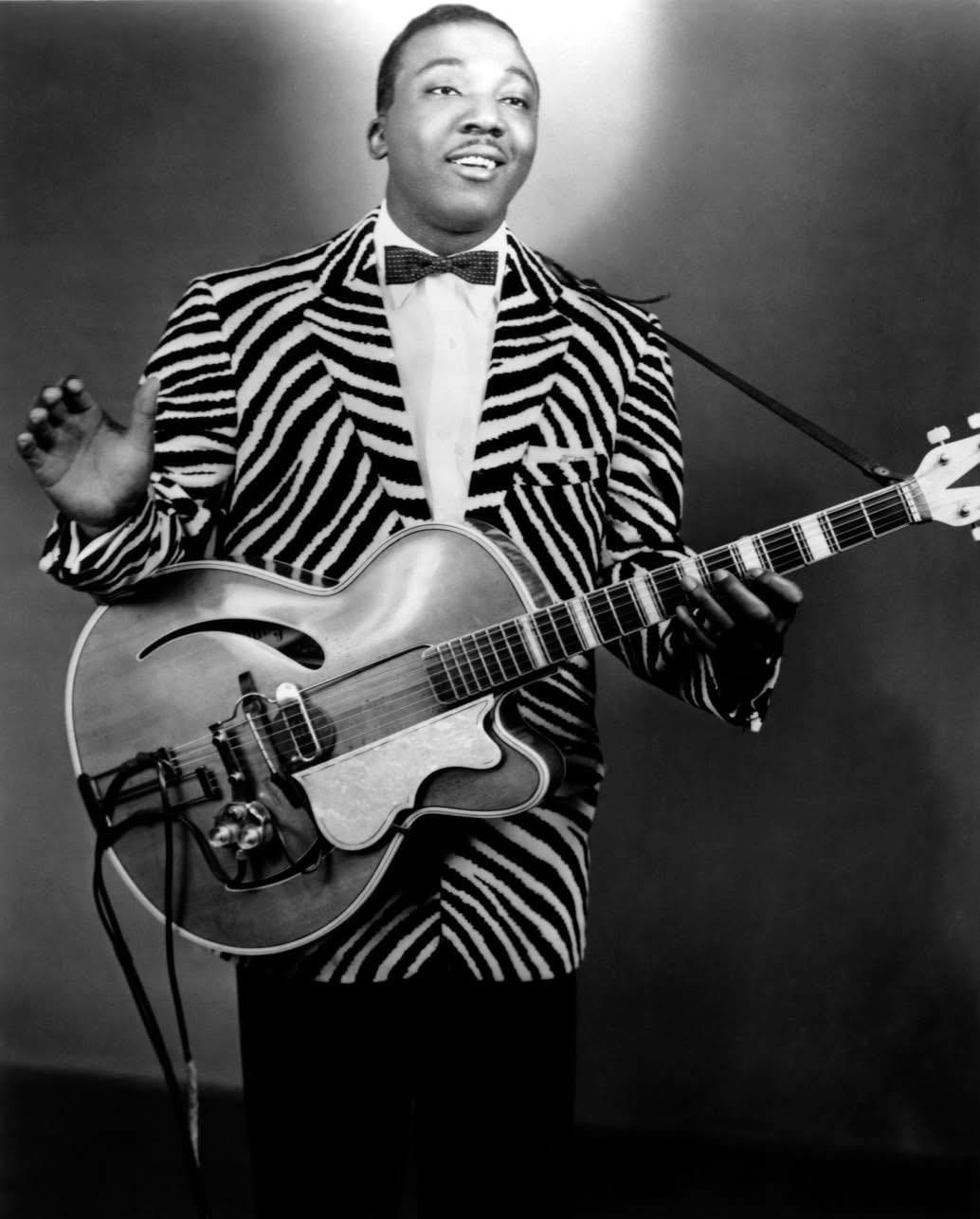
My name is J.B. Lenoir
And this the way my song go
-J.B. Lenior, I Want to Go
One of the first albums I remember playing was John Mayall’s 1969 The Turning Point. It was unlike anything I had heard before, and a foundational album in my jazz journey. It changed my life.
I found it in my oldest brother’s record collection. He had joined the Navy, leaving behind his record collection and his stereo system. I moved them all into my room. He also had some killer headphones with a mile-long, curly cord, so I could lie in bed across the room and listen to the album without waking the house, which back then was an amazing concept.
I still remember that day in 1977, when, for the first time and with absolutely no idea what to expect, I set the needle down on the album’s first track on Side 1, The Laws Must Change, a song about Mayall’s personal observations of police vs. youth and the drug situation. The song didn’t start with music, though. It started with Mayall saying, “Alright, mister. We’re ready,” and an argument ensued between him and the announcer. Then, Mayall introduces the band, and finally, the music abruptly kicks in with Steven Thompson’s thumping bass. Bam, it knocked me out; I was hooked.
The second song, Saw Mill Gulch Road, tells the story of an innocent encounter one night in Monterey, California. It starts with Mayall’s haunting slide and Johnny Almond’s flute. The trance-like feeling of this song would fortell my own trip to Monterey eight years later.
But the third song, I’m Gonna Fight for You J.B. was different, a dedication that starts with Mayall talking again, saying, “This next one is about J.B. Lenior. It’s called I’m Gonna Fight For You J.B.”
That was the first time I heard the name J.B. Lenior, and I had no idea who that was.
One day, a couple of years later, while I was in high school, I ran across this strange cover in a St. Paul used record store:
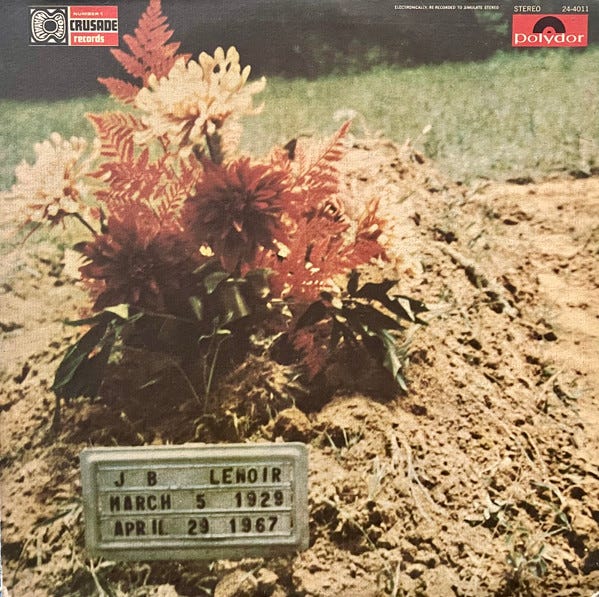
I can’t recall which section it was filed in, but it wasn't under John Mayall, and there’s never a J.B. Lenior section in a used record store. However, I noticed it because of the logo in the upper-left corner: John Mayall Crusade Records.
I remember thinking, "Is this a John Mayall album?” When I turned it over, that’s when the light bulb went on. “No. This is a J.B. Lenior album - the J.B. Lenior from that The Turning Point song.”
The songs on this album are, I feel, some of Lenior’s best, recorded on September 2, 1966, at Sound Studio in Chicago with Freddie Below on drums and under the supervision of Willie Dixon, who also sings backup vocals on some songs. In 1970, John Mayall's company leased these unpublished recordings and compiled the album. It includes, between tracks, recordings of Mayall interviewing J.B.’s widow, Ella Louise Lenoir. The whole album is a terrific document of J.B. Lenior’s life and music—a real treasure.
This week on that Big River called Jazz, we’ll dig in our paddles and discover the world of J.B. Lenior.
J.B. Lenoir was born in Monticello, Mississippi, on March 5, 1929. According to this song, he lived on a high hill, way on that Mississippi road:
His father introduced him to the music of Blind Lemon Jefferson, who became a major influence. When he was 15, he wandered the South, playing his guitar and meeting many of the great Southern bluesmen. However, he couldn’t wait to get out of the Mississippi of the 1930s, as he sings about in this absolutely chilling song:
So, in 1949, he moved to Chicago, where Big Bill Broonzy helped introduce him to the city’s blues community. He began performing at local nightclubs alongside musicians such as Memphis Minnie, Big Maceo Merriweather, and Muddy Waters, and soon became an important part of the Chicago blues scene.
Lenior’s first recording date was in December 1950. The session was recorded with his band, the Bayou Boys, which included Sunnyland Slim on piano, Leroy Foster on guitar, and Alfred Wallace on drums. They recorded four tracks: My Baby Told Me, Korea Blues, Deep In Dept Blues, and Carrie Lee. All were immediately sold to the Chess label, which released them in 1951.
In 1952, Lenoir began recording for J.O.B. Records, a small but important independent Chicago blues record label founded in 1949 by businessman Joe Brown and bluesman St. Louis Jimmy Oden. At J.O.B. Records, he recorded with the same group, but called themselves J. B. Lenior and His Combo. They recorded a number of sides for J.O.B. Records before moving in 1954 to the Parrot Records label, another label that catered to the growing demand for blues and R&B music.
Parrot Records was founded in July 1953 by Chicago DJ Al Benson, who arrived in Chicago in 1923 from Jackson, Mississippi, where he had been an entertainer, produced shows at a theater, worked as a probation officer, and preached.
In 1943, he began a career as a DJ with a new gospel show on Chicago radio station WGES. His skill at selling commercial time on his church program landed him a R&B show at WGES toward the end of 1945, and he quickly became one of the biggest forces in the R&B business, earning the nickname "The Godfather of Black Radio."
The song Bronzeville Swing was recorded at Chicago’s Pershing Ballroom in early 1948. The record was by “Skeetz Van and his Orchestra” and released on the Aristocrat label, the forerunner to Chess Records. You can notice on the label that the song is “Dedicated to the 1949 Mayor of Bronzeville”, in honor of Al Benson.
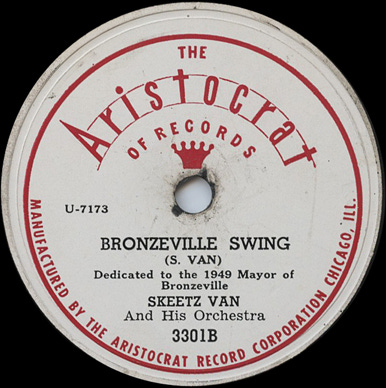
Incidentally, “Skeetz Van and his Orchestra” was really the great Tom Archia and his All Stars. Due to a recording ban, Aristocrat went to great lengths to hide musicians’ names and later issued tracks like this one under bogus bandleaders. Incidentally, Skeetz Van Orn was a real person. He just didn’t have a band. He hung out at the Macomba Lounge and did odd jobs for Benson.
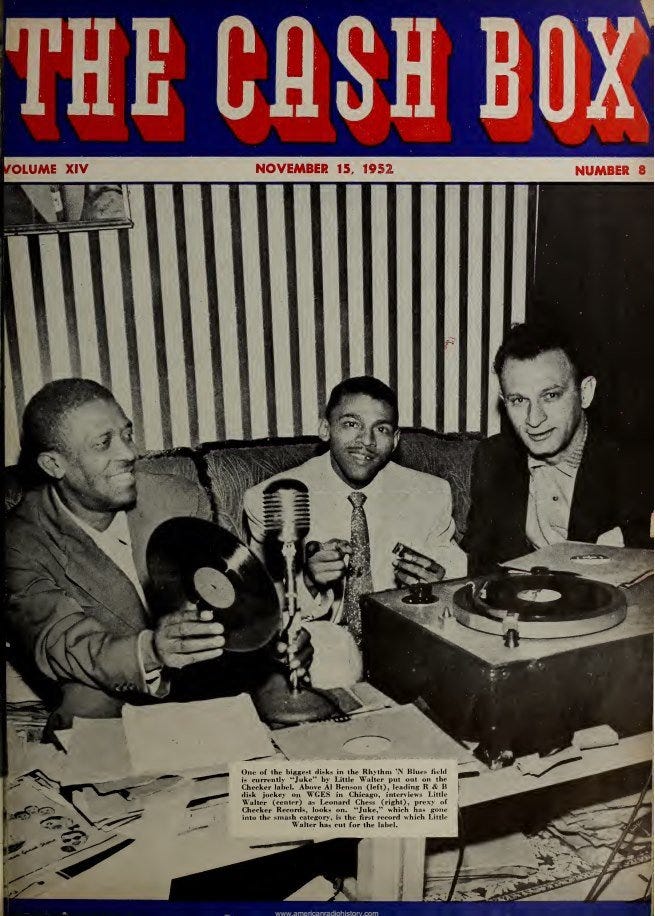
Al Benson was a force on the Chicago airwaves and helped build the careers of not only Lenior, but many great bluesmen, including Little Walter, Howlin' Wolf, Muddy Waters, and Jimmy Reed. Here’s Benson in 1952 with Little Walter in the middle and Leonard Chess on the right:
Benson’s last fling at the record business was in 1965-66, when he issued 45 rpm records by Jimmy Dobbins, Ray and Dave, The Steelers, Magic Sam, and Big Moose Walker on his Mica, Crash, and The Blues labels, like this one by Shakey “Joke” (harmonica player and singer Shakey Jake):
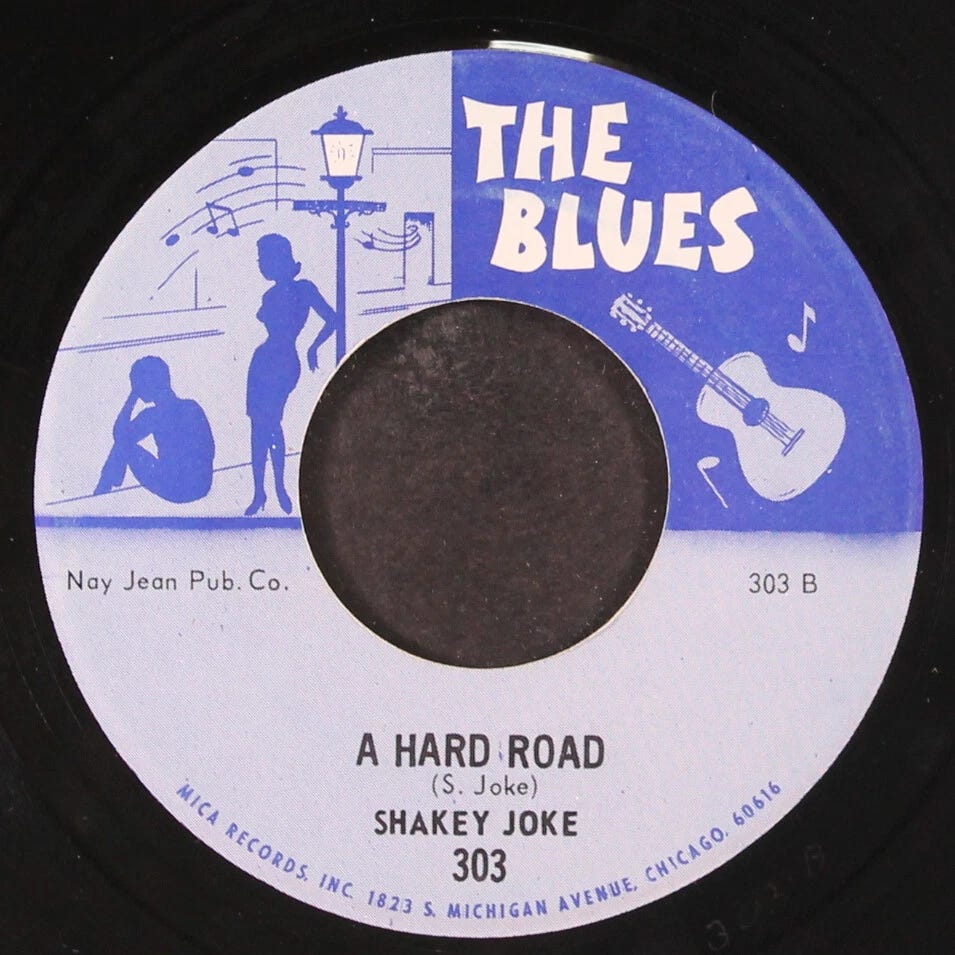
Benson left WGES in 1962 and retired from DJing in 1974 due to ill health. Having moved to Michigan some years earlier, he died there in 1978.
J.B. Lenior’s first recording with Benson’s Parrot Records was in March 1954 at Universal Studios in Chicago. He recorded two tracks I’m in Korea and Eisenhower Blues:
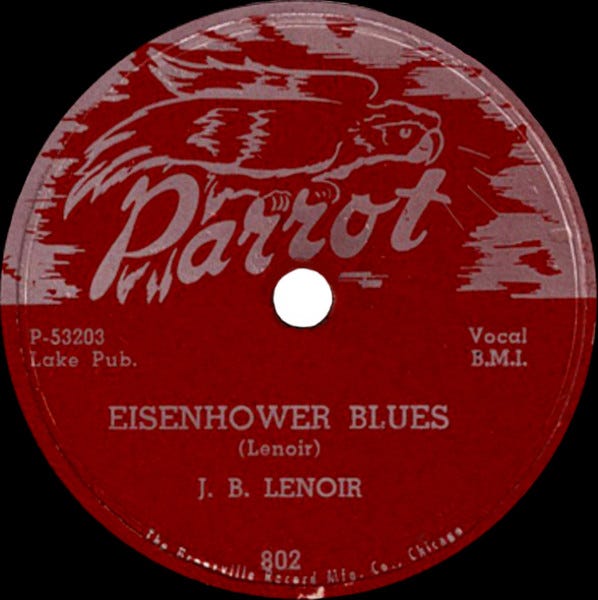
After the record’s initial release in May 1954, however, due to its controversial lyrics, Parrot Records withdrew it and replaced it with a second version bearing the same catalog number. In the remake, Lenior changes all three occurrences of “I got the Eisenhower blues” to “I got the tax-paying blues.”
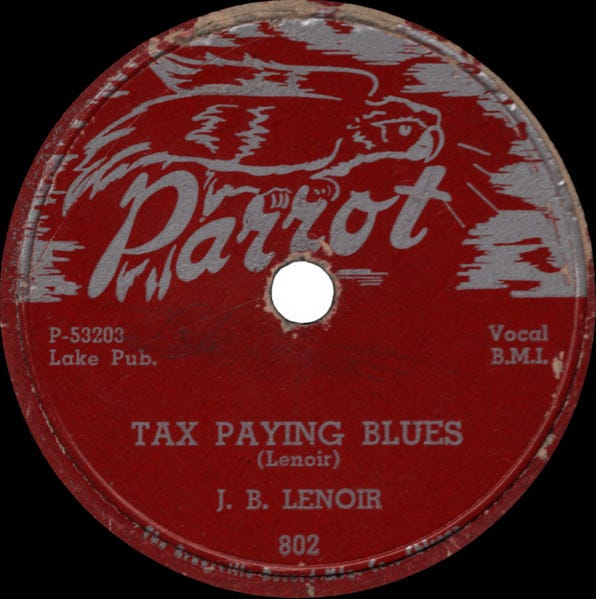
Here’s the original Eisenhower Blues:
Parrot released one last single by J. B. Lenoir in November 1955, after which he went through a slack period of recording; however, he continued to perform regularly in the Chicagoland area.
In the 1960s, the demand for blues picked up, as a major blues revival got underway. That was when Lenoir cut two very strong albums. The first Alabama Blues was recorded in Chicago on May 5, 1965, and released in Germany in 1966. The second Down in Mississippi was recorded on September 2nd, 1966, at Sound Studio, Chicago, under the supervision of Willie Dixon. I think these records contain some of Lenior’s best and most poignant material. From those two Chicago sessions, here are two awesome songs, If I Get Lucky:
…and Round and Round:
Lenior was perhaps the first blues artist to sing songs about social and political consciousness. As a result, he gained influence for boldly addressing important issues during the turbulent times in the late 1960s, writing songs like Alabama March:
About the song, Lenior said:
Well you know, Alabama is a case, where it hits everbody. When you look at it how the poor pwople down there are beaten and mistreated… well you know: these are my brothers and sister. You gettin’ worried anout things happening down there. To get a release it might cause different reactions, but with me, I just take my box and sing. I create.
Unfortunately, Lenoir was unable to benefit from this renewed interest in his music, as he tragically died in Urbana, Illinois, on April 29, 1967, from untreated complications after suffering apparently minor injuries in a car crash three weeks earlier. He was just 38 years old.
In 2003, however, he re-entered the limelight when he was featured, along with Skip James and Blind Willie Johnson, in the documentary film The Soul of a Man, directed by Wim Wenders and part of Martin Scorsese’s The Blues series.
In the film, Chicago’s Steve and Ronnog Seaberg discuss how, in 1964, they filmed Lenior in an attempt to introduce him and his music to people. Here they are during some publicity filming:
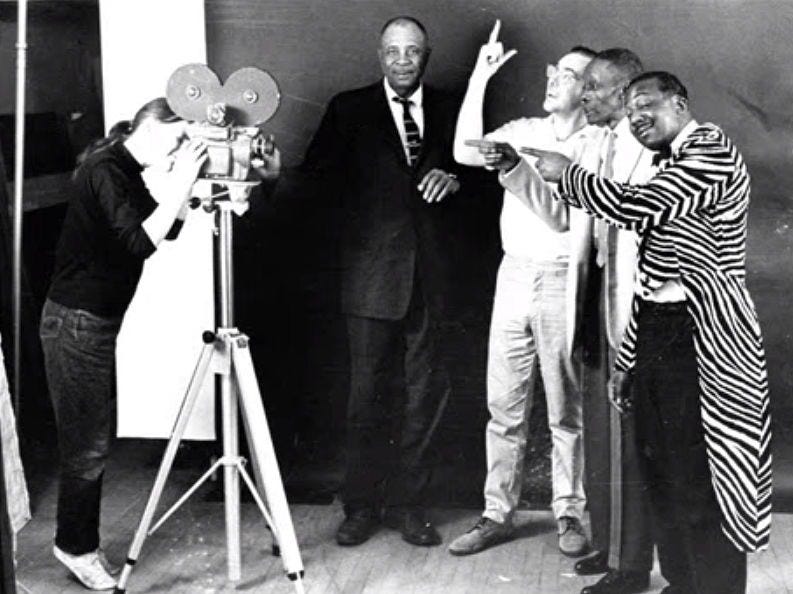
The Seabergs took the films to Sweden that year in an attempt to spur interest in a blues tour package, which was then dominating the European blues scene; however, the films were shown, not even in Sweden. This is one of their films:
Here’s one more for the road. Unfortunately, I think more people discovered J.B Lenoir because of John Mayall after Lenior’s death than from anything J.B. ever did himself. That was the case for me.
Crusade was John Mayall & the Bluesbreakers’ fourth album and third studio album, and Mick Taylor’s first recording. It was released in the UK in September 1967 on Decca Records. One of the tracks on the album is his tribute song The Death of J.B. Lenior:
That’s a killer baritone solo by Rip Kant, as far as I can tell, a journeyman musician who recorded mainly with the Bluesbreakers in the UK in the late 1960s.
In a 2015 Guardian interview with Ed Vulliamy, Mayall recalls:
You sing about your life, and your time. A lot of the critics thought that song was rather trite, but I thought: “I’ve got to have a song about this,” and what I write about in this song never changes. That’s the whole point.
It’s part of what the blues does, to write about these things. J.B. Lenoir was the main one in this regard – he wrote about Korea, too, in fact. Songs that reflect these current situations – in his case, racial issues for the most part: in my case, what has happened to me, and I was in Korea.
With Crusade, Mayall was already finding ways to bring jazz into his blues, a change that finally came about after his 1968 Blues from Laurel Canyon, with the 1969 release of the aptly named The Turning Point.
Anyone who remembers the blues scene of the late 1960s recalls the disbelief when Mayall ditched drums and lead guitar to release The Turning Point with mellifluous flute, sax, and finger-picking guitar. On the insert that came with the album, which you still can find from time to time inside used copies of the album, Mayall wrote:
So I have now got a new thing in operation whereby drums are not used on the theory that every instrument is capable of creating its own rhythm
Interstingly, in the Guardian interview, Mayall recalls how he came up with this new “operation”:
The promoters didn’t think it would work. They thought it would flop. But I was inspired by Jazz on a Summer’s Day by Jimmy Giuffre. He showed that you didn’t need drums to drive a rhythm, create that warm sound, play a jazz-blues fusion.
The song he’s talking about is, The Train and the River, which appeared in the film Jazz on a Summer’s Day about the 1958 Newport Jazz Festival. It was performed by the Jimmy Giuffre 3, which consisted of Giuffre on sax, Jim Hall on guitar, and Bob Brookmeyer on trombone:
J.B. Lenior was one of John Mayall’s biggest influences. Likewise, John Mayall was one of my biggest influences. When I returned to California after my time in the service, I had a band with a guy I had worked with, a tremendous guitar player and singer, Pat Weber - so it wasn’t really a band, because it was just the two of us. It was like Sonny Terry and Brownie McGhee. We played at coffee shops in the South Bay around Menlo Park and Palo Alto. We called ourselves The Blues Crusade. Wherever we played, I placed John Mayall’s Crusade album on a stand in front of us.
It was through John Mayall that I learned about many bluesmen and their music. He was also my gateway to jazz. While I was listening to Mayall’s Jazz Blues Fusion, Movin’ On, and Ten Years Are Gone, I was actually listening to jazz musicians like Blue Mitchell, Freddy Robinson, Ernie Watts, Clifford Solomon, Victor Gaskin, and Charles Owens, whom I would years later run across on jazz labels like Blue Note, Prestige, Discovery, Pacific Jazz, and Verve.
I find it interesting the way I discovered J.B. Lenior: from hearing his name in a song without any idea who he was to discovering him on Mayall’s Memorial album. It was very personal for me. All these years later, Lenior remains close to my heart. He was a courageous man, and his music made a difference. I wish he could have lived long enough to know just how much.
I’m gonna fight for you J.B.
Your Passing made so many cry.
But you’re resting now from struggle
Out in God’s land beyond the sky.
This ends a Blues Trilogy that highlighted my three favorite blues artists: Blind Lemon Jefferson, Skip James, and J.B.Lenior. Next week on that Big River called Jazz, we’ll dig our paddles into the waters of Miles Davis’ muse, Frances Taylor.
Please hit this link to buy me a cup of coffee if you’d like to show your guide some appreciation for this and past journeys. I thank you in advance for your kindness and support.
If you like what you’ve been reading and hearing so far on our journey and would like to share this with someone you think might be interested in learning more about our great American art form, Jazz, just hit the “Share” button.
From Astaire to Sun Ra: A Jazz Journey is a reader-supported publication. If you feel so inclined, subscribe to my journey by hitting the “Subscribe now” button.
Feel free to contact me anytime to talk shop. I welcome and encourage that.
Until then, keep on walking….
You've lived an interesting life, my friend!
Have you seen "Sinners" yet? J. B. Lenior resembles the guitar player....
My Uncle introduced me to Frank Zappa in 1973. They didn't play his music on the Tulsa radio station I listened to. My uncle had several albums. I listened to them over & over. Several years passed & I was studying Petroleum Engineering at the University of Oklahoma. I used my yard mowing money to buy a pretty nice stereo system (for a college student). I honed in on Zappa & bought every album I could find. The album Weasels Ripped My Flesh contained the song The Eric Dolphy Memorial Barbecue. If Frank had written a song about Eric, then he must have been important. I bought the album Out to Lunch. OMG! One of my favorite albums. It started me down the jazz rabbit hole. I'll never get out, but that's a good thing. Great post! 🤘😎🤘