
Feminist Improvising Group
Stand and be recognized...

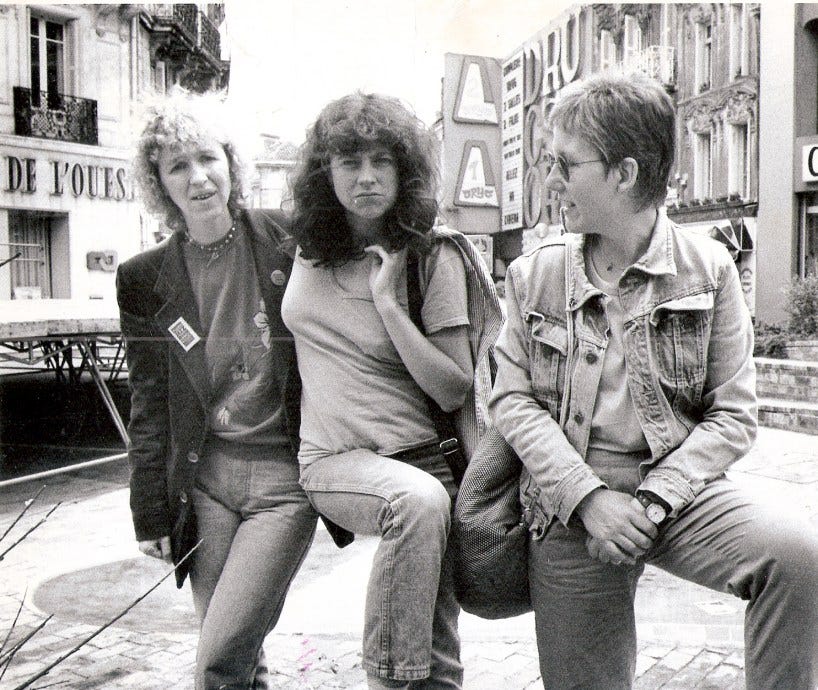
It's hard for people to let go of what we've been socialised to believe is “proper” music, but in letting go of preconceptions we discover the joy of music as a liberating and healing force.
-Maggie Nicols
A few months ago, Mats Gustafsson shared with me the story of his first encounter with the French trio, Nout. It happened a few years ago while he was in Stockholm checking in with the folks at Fasching, a concert venue, club, restaurant, and bar downtown. One of the club’s producers convinced him to check out a French flute, harp, and drums trio playing there. Gustafsson was thinking, “What is this, chamber jazz?” So he went anyway to hang out and have a drink. He recalled:
I was so wrong…. just out of control wrong. I have never been so surprised by live music I’d never heard before. I was sitting with my jaw down to my knees for a full set. I could not understand how great and in-your-face this music was. Totally radical and hardcore on every level.
The trio, an alliance of Delphine Joussein on flute, Rafaëlle Rinaudo on electric harp, and Blanche Lafuente on drums, is a rare blend that turns the format on its head. Bandcamp, I think, rightly proclaims them as the missing link between jazz and punk, somewhere between Nirvana and Sun Ra. I love their energy and grit. Keep your eyes and ears open for them. Also, check out Paris Blow, the new duo Flöjter with Delphine Joussein and Gustafsson, here. The session was recorded live at La Dynamo, Banlieues Bleues in Paris and released earlier this year.
Nout’s 2024 album, Live Album, is a collection of live recordings from their 2023 tour. The album also includes three tracks from a July 4, 2023, performance with Gustafsson at Jazzfestival Alto Adige in Bolzano, Italy. Check out Gustafsson with Nout on the final three tunes, starting with The Last Train:
Clever name of the last song: Noutsson.
Here is Nout in December 2024 performing The Last Train live at l’Antipode in Rennes, France, during Trans Musicales 2024:
You talk about the last chance Texaco - put on your safety belts, that song explodes with all possible FIRE. Solid! And how about drummer Blanche Lafuente sporting the killer Fire! T-shirt.
Gustafsson invited Joussein and Lafuente to join his latest version of Fire! Orchestra for performances at the 2024 North Sea Jazz Festival in the Netherlands and at the 2025 Skopje Jazz Festival in North Macedonia. Also, look for them on the latest Fire! Orchestra album, coming out soon.
The Fire! Orchestra is an amazing, gender-balanced, free improvisational ensemble formed to supplement Gustafsson’s Nordic experimental trio supergroup, Fire!, with Johan Berthling (bass guitar) and Andreas Werlin (drums). The Fire! Orchestra’s latest release, Echoes, is massive and outstanding, featuring wonderful vocalizing by Sofia Jernberg.
Gustafsson’s promotion of female musicians is commendable, and I hope his leadership opens doors for more female improvisational groups like the Feminist Improvising Group, which hit the stage in the summer of 1977, a time when women were not supported in the improvisational music community. As you can imagine, they were loved and hated. And despite considerable headwinds, the Feminist Improvising Group established itself as one of Europe's most important improvisational groups. However, to this day, they remain relatively unknown.
This week on that Big River called Jazz, we’ll dig in our paddles and discover the world of the Feminist Improvising Group.
In London in 1977, frustrated by the lack of representation of women in improvised music, Scottish vocalist Maggie Nichols and English bassoonist and composer Lindsay Cooper formed the Feminist Improvising Group (FIG). In a 1989 interview with Dale Smoak for Cadence magazine, Cooper shared:
It was a time when there were beginning to be quite a few women’s rock bands, this was the summer of 1977 or something. Yeah, in England there were quite a few women’s rock bands, that did benefits and things like that, and we were saying how frustrating it was that there were still hardly any women who did improvised music, and we decided there and then to get a group together, that was a group of women who did improvised music. So that was how the group was born.
FIG was a five-to eight-piece, somewhat fluid, international free-improvising avant-garde jazz and experimental music ensemble. Their debut performance was at a “Music for Socialism” festival at the Almost Free Theatre in London in October 1977, and they toured Europe several times in the late 1970s and early 1980s. Unfortunately, their music is not well documented.
FIG only released one session, their self-titled debut, released exclusively as a limited edition cassette tape in 1979:
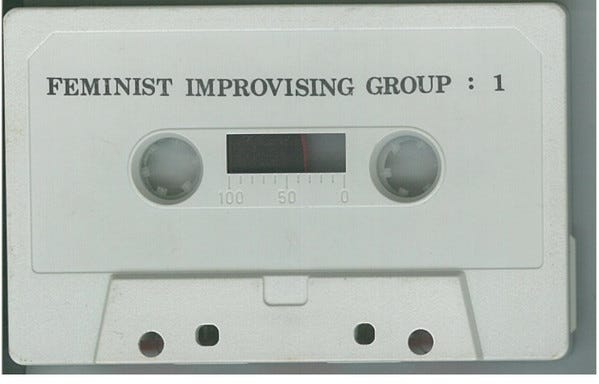
Here’s the opening track, recorded live on April 29, 1978, at the International Women’s Music Festival in Copenhagen:
The leader and vocalist of FIG was Maggie Nicols. In her mid-teens, she left school in Edinburgh, Scotland, and began working as a dancer at London’s Windmill Theatre. At 16, she took her first singing engagement at a strip club in Manchester. Around that time, she became obsessed with Jazz and began singing with the revolutionary English bebop pianist Dennis Rose.
In 1968, she returned to London, met John Stevens at the Little Theatre Club, and joined his Spontaneous Music Ensemble with Trevor Watts and Johnny Dyani. The group performed at the 1968 inaugural Total Music Meeting at the Quartier von Quasimodo in Berlin, an event initiated by Brötzmann and Jost Gebers after the Berliner Jazztage (today Jazzfest Berlin) withdrew its invitation to Brötzmann because he could not guarantee that his band would adhere to the dress code.
In 1969, she recorded the seminal John Stevens Spontaneous Music Ensemble, released on the Marmalade Records label. Shortly afterward, she joined Keith Tippett’s fifty-piece British progressive jazz-rock big band, Centipede. I wrote about Keith Tippett back in 2025:

I recently became aware of another terrific project led by German artist and composer Alfred Harth, who in May 1983 brought together Nicols, Paul Bley, Barrie Phillips, and Trilok Gurtu at ECM’s legendary Tonstudio Bauer in Ludwigsburg, Germany, to record the wonderful This Earth! It was released by ECM in 1984 and remains a forgotten classic in their catalog - please spread the word:
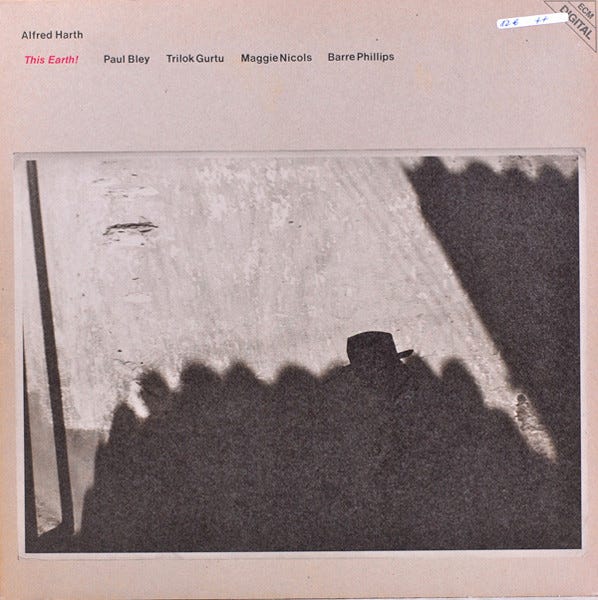
According to Harth, the album “was meant to be a contribution for more conscious ecology.” A noble cause. Although not listed on the cover, Nicols brought her friend Vicky Scrivener’s words into Harth’s project. All the tracks are strong. Perhaps none stronger than on the album’s finale, Transformate, Transcend Tones And Images:
This is a stunning song. The last stanza, “Woman in a violet tail-coat, blows her soul-blue sax on south bank,” fades into a string of transformative, transcendent sax-like tones, supported so tenderly by Harth’s tenor. I had thought it was a soprano, but when I wrote to him about the song, he respectfully corrected me.
When I listen to Nicols, I am reminded of another female vocal pioneer, Tina Marsh, who passed away tragically in 2009. She was 55 years old. I wrote about her in a three-part piece that also featured her close friend and Texas hero Alex Coke. These are some of my most difficult and heartfelt pieces, as I collaborated with Tina’s son, Zak, to present much of her work online for the first time in a three-part special back in 2025. Here’s Part 1:

Another FIG leader was Lindsay Cooper, who had been a member of the British experimental art rock group Henry Cow, founded in 1968 by multi-instrumentalists Fred Frith and Tim Hodgkinson. In the summer of 1977, as Henry Cow was beginning to disband, Cooper met Nicols at a musicians’ union branch meeting, and they decided to form a group that would become FIG.
Here is Cooper in November 1978 playing bassoon at a FIG concert in Reykjavik, Iceland:
Outside of their cassette, FIG appears on the compilation Another Evening At Logos 1974 79 81, released by the Logos label in 2015:
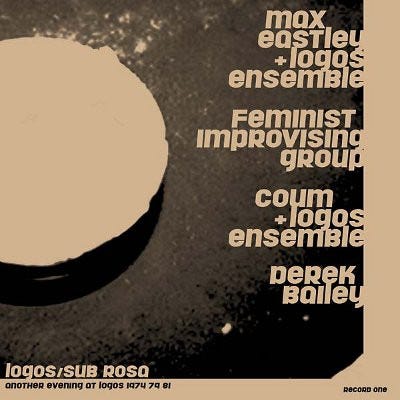
Here is an untitled track from the album recorded live on February 22, 1979, at the IXth International Multi Media Festival in Ghent, Belgium, with Cooper on bassoon, Maggie Nicols on piano and voice, Irene Schweiser on piano and drums, Sally Potter on alto sax and voice, and Georgie Born on cello and bass guitar:
Although these are FIG’s only two documented releases, the group was very active in the UK and Europe until 1982, when it evolved into the European Women's Improvising Group (EWIG), bowing to pressure to change its name. EWIG brought in many new women musicians, including bassist Joëlle Leandra and singer Annick Nozati.
FIG opened the door to a whole new world of creative empowerment and served as a direct catalyst for several ongoing women-only and feminist musical ensembles, such as Contradictions, which Nicols and Corine Liensol started with Irene Schweizer and dancer Roberta Garrison as an open women’s workshop performance group. Schweizer also organized the Canaille festivals, which staged the first International Women’s Jazz Festival for Improvised Music in 1986 in Frankfurt. For a deep dive into all of this, visit The Women’s Liberation Music Archive.
Here are two more for the road. Across the pond from the Feminist Improvising Group, the landscape for improvising women was similar, still a male-dominated scene. I don’t recall any similar women’s improvising groups active in the US during the 1970s and early 1980s. A few women performed as headliners in male-dominated bands. Carla Bley, Patty Waters, Barbara Donald, and Marilyn Crispell come to my mind. I also think of Annette Peacock, a pioneer in electronic music who combined her voice with one of the first Moog synthesizers in the late 1960s.
I first heard about Peacock as a composer on Paul Bley’s 1968 Turning Point, which featured Sun Ra’s tenorman, John Gilmore. She contributed two songs, Mr. Joy and Kid Dynamite. Here’s Kid Dynamite, played as a trio with Gilmore sitting out:
The first time I heard her was on Paul Bley’s Improvisie, an album released in 1971 on the French America label, which has a very Sun Ra-esque feel.
Improvisie, along with The Bley Synthesizer Show and Dual Unity, is part of a trilogy of Bley and Peacock's combined experimental work that pioneered electronic music and synthesized vocals after they received a prototype of the first Moog synthesizer from its inventor, Robert Moog.
Improvisie is a live trio performance at Club B14 in Rotterdam, the Netherlands, with Peacock on electric bass, electric piano, and piano; Bley on electric piano and synthesizer; and Han Bennink on drums. Peacock sings on the second track, Touching:
When I heard Maggie Nicols much later, I was reminded of Peacock’s vocalizing, like on Pony from Peacock’s 1972 debut album, I’m The One, when she evolves into vocalizing halfway through the song:
The Wire’s David Keenan called I’m The One “the missing link between Betty Davis and Ornette Coleman, between eroticised performance and radical harmolodic invention.”
Improvising women and groups like FIG are few and far between, a testament to the predominantly male-dominated world of improvised music. Look no further than the sentiment Peter Brötzmann shared with The Wire’s David Keenan in December 2012. In the interview, Brötzmann dismissed Nicols and her comrades in the first generation of free improvisers as “little English chickens”. Their music, he argued, was too often an intellectual exercise, lacking the Europeans' urgent expressionism. The Germans, he added, were in a more “serious situation” than the British. I see the point, but with all due respect, Mr. Brötzmann, that was FIG’s point: to bring women’s experiences into avant-garde music. However mundane their daily lives may be, that does not make them any less serious. These women were making music because it creates for them a world they want to inhabit, makes them feel alive, and lets that life flood over the edges of the recording and into us, the listeners.
In the Ecstatic Peace Library’s 2025 book Now Jazz Now, Thurston Moore eloquently writes:
Free jazz, Free Improvisation and Free Music have long been sobriquets to resistance, resilience and liberation, profoundly, and justifiably, focused on the glaring factor of ethnic discrimination. There has been less critical discourse, through the timeline of the culture, of any pronounced dialogue in regards to gender imbalance. With a discipline so attuned to intuition and emotional communication (complexes that are historically feared by men, yet stereotypically exalted through woman) it is rather ridiculous in how very few females were not only recognized, but encouraged in these scenes.
Hear, hear, Mr. Moore! Let them now stand and be recognized.
Despite their music being vastly underappreciated, their impact has been far-reaching. This is why, like John Stevens and the Spontaneous Music Ensemble before him, I admire Mats Gustafsson’s continued hard work to include and promote female jazz musicians. It is not only encouraging but refreshing. Most importantly, the success is self-evident.
I believe Gustafsson’s willingness to learn from and association with women enable him to discover new ways to express his creativity. And isn’t that the name of the game?
Next week on that Big River called Jazz, we’ll dig in our paddles and, in memory of Bastille Day, explore the world of Jean Cocteau.
Please hit this link to buy me a cup of coffee if you’d like to show your guide some appreciation for this and past journeys. I thank you in advance for your kindness and support.
If you like what you’ve been reading and hearing so far on our journey and would like to share it with someone who might be interested in learning more about our great American art form, Jazz, just hit the “Share” button.
From Astaire to Sun Ra: A Jazz Journey is a reader-supported publication. If you feel so inclined, subscribe to my journey by hitting the “Subscribe now” button.
Feel free to contact me anytime to talk shop. I welcome and encourage that.
Until then, keep on paddling….
Great post. I never heard anything from FIG prior to this. And that brief December ‘24 Nout live performance at l’Antipode in Rennes in France is off-the-rails good.
Good to see Lindsay Cooper getting some accolades. I've been a fan since the mid '70s, and I knew about F.I.G. but never came across the cassette. I finally found a digital copy of it some years back along, with two German performances from '80 and '81. One was recorded by Radio Hamburg and the other is from Kaserne. There were various offshoots of F.I.G. as well, Cooper, Nichols and the French double bassist, Joelle Leandre, recorded Live at the Bastille. Cooper, Nichols and Born performed as The Marx Brothers, though I know of no recordings. Later Cooper, Nichols and Schweizer recorded three albums as Les Diaboliques.
I attended the tribute to Cooper at Mills, which was organized by Frith and Zeena Parkins, with Jack O' the Clock as the core group, plus Larry Ochs and various others, performing many of Cooper's compositions from Henry Cow, News From Babel, Rags, The Golddiggers,etc. The program notes mentioned that on the same evening in Tokyo, Chris Cutler and Yumi Hara were leading a band of Japanese musicians also paying tribute to Cooper, and in a similar spirit of wabi sabi.
I see F.I.G.'s legacy in the Norwegian women who bonded at conservatory over a shared love of Astrid Lindgren's stories and founded the improvising quartet, Spunk, named for Pippi Longstockings favorite word. They released several albums on the Rune Grammofon Label with their titles taken from lines in Lindgren's books. Their widescreen use of electronic treatments of their instruments, mainly voice, cello, French horn, and trumpet, also points back to Peacock's work with Paul Bley in the early '70s. I've never seen Spunk, but I've seen their vocalist, Maja Ratjke, use her voice, a laptop, little bells and some toys to conjure a masterful, immersive four channel performance out of thin air.