
Bob James
Once upon a time...

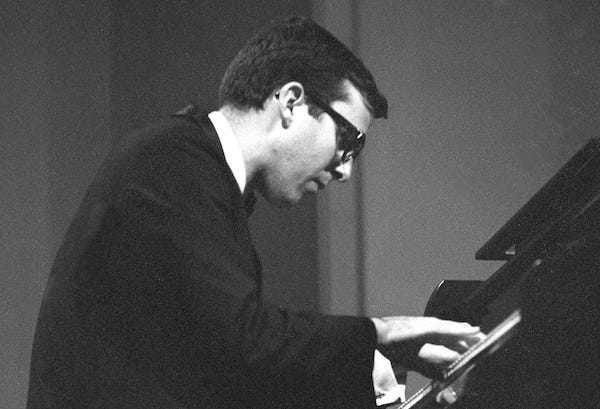
Ann Arbor, Michigan, was kind of a way station for working beatniks and avant-gardists between New York and the West Coast. I met Andy Warhol first in Ann Arbor. There was a female artist named Charlotte Moorman, and she never got her due during her life. She was a beautiful girl from Alabama who hung with the John Cage, Nam June Paik crowd, very avant-garde music people. I was, I think, 17, and I saw a picture of her playing the cello topless, bound. It made a big impression on me. It made a big, big impression. It wasn’t lascivious, but it was more like, in some way, she influenced me a lot. There was another man named Robert Ashley, who made screaming sounds through amplifiers. There were a lot of kinds of loose cannons around, and that’s a great thing, you know?
-Iggy Pop
The first time I heard Bob James was in high school in 1979. On Saturday nights, Public radio played what they called “smooth jazz.” A song that caught my attention was Winding River from his 1979 album, One on One, a collaboration with guitarist Earl Klugh. From that song, I became a big Bob James fan. Over the next few years, I bought all of his records, going back to his 1974 album One.
I had no idea he had released two albums ten years earlier than 1974: Bold Conceptions, his debut as a leader, released in 1963 on the Mercury Records label; and Explosions, released in 1965 on the ESP-Disk label. Needless to say, these albums sound nothing like his 1970s music - they weren’t “smooth jazz,” and I wasn’t ready for them back then.
In the spring of 1962, as a college student at the University of Michigan in Ann Arbor, Bob James and his trio entered the Notre Dame Collegiate Jazz Festival, where the judges included Henry Mancini and Quincy Jones. In a field of primarily straight-ahead music, the trio provided a more avant-garde approach. To their surprise, they won the competition, and not long afterwards, Quincy Jones signed James to an album deal with Mercury Records.
In August 1962, at Universal Recording studio in Chicago, the Bob James Trio recorded its debut album, Bold Conceptions, produced by Quincy Jones.
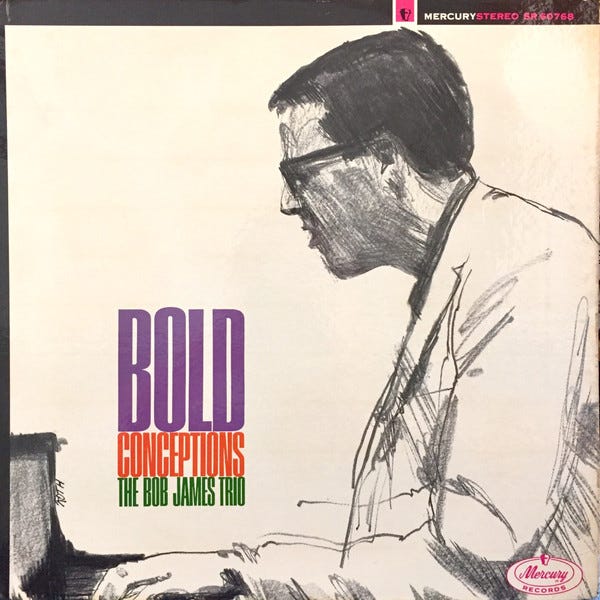
This is a solid debut featuring mostly standards; however, it also includes two James compositions, Trilogy and Quest. I find these original compositions the most compelling.
From that album, here is the fully avant-garde Trilogy:
From around that timeframe, here is the trio in a remarkable video performing The Internal Triangle. Drummer Bob Pozar is unbelievable:
Another amazing thing about James’s debut album is that it also included bassist Ron Brooks, who went to high school in Ann Arbor. After recording Bold Conceptions, Brooks recorded with the Contemporary Jazz Quintet (CJQ), a Detroit-based ensemble that released two fantastic albums on Blue Note Records. He then followed with one more on Strata Records, the independent jazz label founded by CJQ pianist, Detroit’s own Kenny Cox. I wrote about Starta Records and CJQ here:

As I think about it now, I can’t believe this is the same Bob James who recorded Winding River and went on to become such a contemporary jazz icon.
This week on Big River called jazz, we’ll dig our paddles into Bob James and his early voyages into the world of free jazz.
In the 1960s, Ann Arbor, Michigan, was known as a hotbed of radicalism — not only in student political and social activism, but also in new music. The University of Michigan’s School of Music was a center of change, where composers were in the vanguard of a cultural revolution that explored both electronic music and new dimensions of sound using conventional instruments.
Affiliations with the University of Michigan School of Music and influenced by mathematics, science, and emerging technologies of the time, a coterie of composers explored avant-garde techniques and styles of composition that included expressionism, serialism, and elements of chance. They also collaborated with theater and visual artists in multimedia presentations.
At the time, the composer in residence at the University of Michigan was Ross Lee Finney, known for his domineering manner and the somewhat condescending nature he showed towards the more experimental work of his many students; however, he also had a generous side. For example, in 1958, when Karlheinz Stockhausen visited the university to give lectures, Finney opened up his home to him for a gathering and invited his students, who found much to admire in the charismatic Stockhausen.
In his talks at the university, Stockhausen emphasized self-reliance to the young composers. He encouraged them to continue composing new music and then organize their own performance opportunities, without depending on institutional support. Robert Ashley, Gordon Mumma, and other students who attended the lectures took Stockhausen’s advice to heart.
Earlier that year, when Ashley collided with Mumma at the University of Michigan, alongside other figures in the arts and music scene there, it set into motion a series of events that resulted in the establishment of the fiercely independent Cooperative Studio for Electronic Music. It was split between available spaces at Mumma’s place, Ashley’s home, and Milton Cohen’s Space Theater, a loft converted into a multimedia performance space. The Cooperative Studio for Electronic Music was a real do-it-yourself affair.
In his 2021 article ONCE Upon a Time in Ann Arbor, Justin Patrick Moore wrote:
Ashley and Mumma used these homebrewed set ups to produce the swirling, electronic, mind-bending soundtrack for Cohen’s Space Theater light shows. Some of the visual elements of the Space Theater included slides and films made by George Manupelli. All of the material was presented in sixty to ninety minute long montaged and collaged, kaleidoscopic and hallucinatory performances held together around themes that included the four elements, seasons, the human body, different colors and more. A spellbound audience sat in the center of the twenty sided dome that was the canvas for Cohen’s imaginative show.
With their newfound success and experiences, they stood at the center of a burgeoning arts scene in Ann Arbor. They soon took things to another level by developing the ONCE Group and Festival.
When Ross Lee Finney took a sabbatical in 1960, the Spanish composer Roberto Gerhard was brought in for a year-long residency. Gerhard is pictured here with his students in Ann Arbor:
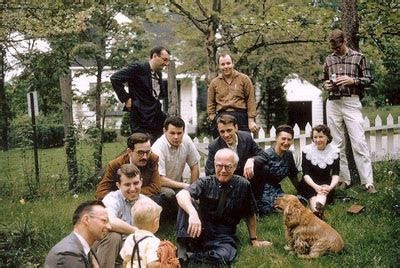
Gerhard represented a link to what was happening musically in Europe and was a breath of fresh air compared to what students felt were Finney’s more restrictive tendencies. Gerhard had an affable nature and insisted that his students develop their own distinctive style and voice. Although firmly embedded in serialism, Gerhard didn’t make his students toe a strict serialist line.
Gerhard was born in 1896 in Valls, near Tarragona, Spain. After Spanish composers dismissed him as a possible student, Gerhard shut himself away in a Catalan farmhouse to reflect on his professional future and concentrate on his work. He turned his gaze to German avant-garde music and decided to send a letter and one of his compositions to the composer Arnold Schoenberg, asking to be his student.
After Schoenberg agreed, Gerhard immediately left for Vienna. He was Schoenberg's only Spanish pupil. He studied with him in Vienna and Berlin between 1923 and 1928, and their relationship developed into a lifelong friendship.
Gerhard was one of the main drivers of the 1936 International Society for Contemporary Music Festival, the fourteenth edition of the festival, best remembered for the posthumous world premiere of Alban Berg's Violin Concerto on its inaugural day. It was held in Barcelona in April, just three months before the outbreak of the Spanish Civil War, and one of the last major cultural events of the Second Spanish Republic. Gerhard supported the Republican cause in the Spanish Civil War (as musical adviser to the Minister of Fine Arts in the Catalan Government and a member of the Republican government's Social Music Council). When Barcelona fell to Franco’s Nationalist forces at the end of January 1939, he fled with his wife first to Paris and later that year settled they in Cambridge, England, where he was offered a one-year fellowship at King’s College.
During the 1950s, his legacy with Schoenbergian serialism placed Gerhard firmly in the ranks of the avant-garde. Here is his 1960 Sinfonia n.3 “Collages:”
In May 1960, while at the University of Michigan, Gerhard gave a lecture entitled “Is New Music Growing Old?” In his talk, Gerhard refuted Theodor Adorno’s contention from his 1956 book Dissonanzen, which claimed that the new developments in twentieth-century music had been on a steady decline since a summit had been reached in the twenties when the Second Viennese School was in full swing.
Gerhard argued instead that the world of music, with the introduction of chance operations, the birth of electronic music, and other contemporary trends, was healthy. He thought it was “what one would expect from a social body deep in ferment and teeming with creative energy. It would seem a poor show if an epoch does not manage to develop its ‘contemporary’ ideas fully in all directions, to the utmost limits of contradiction.”
His lecture was received by the young composers with enthusiasm and filled them with excitement about all the possibilities around them. For example, Donald Scavarda recalled, “Gerhard was the catalyst,” and Mumma said Gerhard was “Wide open” and “enthusiastic about differences.”
With the seeds of a possible new music group and festival planted, Roger Reynolds visited New York at the invitation of his friend Sherman van Solkelma, who had encouraged him to check out the art museums. He attended a concert where La Monte Young performed his piece Poem for Chairs, Tables, Benches, Etc. John Cage was one of the performers of the piece, pushing a metal chair around the floor to create part of the musical texture for Young’s unorthodox tone poem.
After the show, Reynolds introduced himself to Cage and expressed his admiration and interest in the composer’s work and ideas. Cage, always the gracious and enthusiastic ambassador for new music, promptly invited Reynolds to his home in Stony Brook. The pair hit it off, and Reynolds arranged for Cage and his colleague David Tudor to come to Ann Arbor the following month, having managed to get them on the bill for the College of Architecture and Design’s third annual open house.
When Cage and Tudor arrived in Ann Arbor, they gave two concerts. The first featured Cage’s piece Indeterminacy, where he read one-minute-long stories accompanied by Tudor on electronics. The second concert was part of a program sponsored by the University’s Dramatic Arts Center (DAC), featuring on the evening’s musical menu works by Stockhausen, Christian Wolff, and Sylvano Bussotti.
That same month, Robert Ashley brought to Ann Arbor the composer Luciano Berio. Luciano played his piece Thema (Omaggio a Joyce) at a record store, followed by a talk and discussion on the work.
During his short time in Ann Arbor, Gerhard had managed to inspire his students, and the watershed events they sponsored that spring and through the end of the school year laid the groundwork for what was to come.
At the end of the summer of 1960, Ashley, Mumma, Reynolds, and Cacioppo crossed the border into Canada to attend an international composers conference in Stratford, Ontario, put on by the League of Canadian Composers. However, the event was a disappointment. When they returned to Ann Arbor, Ashley remarked, “We could do a better festival than that.”
Over the next few months, they mapped out their idea into a concrete blueprint they could present to DAC. A plot and a plan were born for a contemporary music festival with six concerts. Ashley and Reynolds pitched it to the board, who agreed to provide $750 if the organizers could raise an equal amount through ticket sales and donations. Working together, Robert Ashley, Gordon Mumma, George Cacioppo, Donald Scarvada, and Roger Reynolds decided to call it the ONCE Festival.
The first festival took place in February and March of 1961, and was held at the Unitarian Church in Ann Arbor. It featured acoustic, electroacoustic, and purely electronic music. It also featured a two-channel film called The Bottlemen by George Manupelli with an original soundtrack by Ashley. The tape and electronic piece, The Fourth of July, was also shown and received, perhaps understandably, mixed reactions from critics. Here is that performance:
ONCE acted as a creative stimulus for these composers. Scavarda described the adventure as an explosion of pent-up energy: "Suddenly we could write anything we wanted and have it heard." And they did.
The first year set the stage for what was to come. Subsequent festivals included theatrical works, and ONCE quickly became an early multimedia festival. The events were also taped and, over the coming months, broadcast on the university radio station WUOM, giving the festival much wider coverage.
They had not originally intended for the festival to become a recurring event, hence the name “ONCE.” But the artistic success garnered enough support to ensure the festival could be continued the following year.
The ONCE Festival ran from 1961 to 1966 and jolted the New Music scene in the United States.
All of this whirlwind of activity was happening around Bob James in 1962, while he was a music student at the University of Michigan. James’s first appearance at ONCE was with this splendid duet with Karen Hill on piccolo playing Roger Reynolds’s composition Mosaic:
James also played on Robert Ashley’s Fives, which included Robert Pozar on drums:
As part of the 1964 ONCE festival, Pozar also played drums on the Bob James song Personal Statement, recorded at WUOM studios at the University of Michigan on March 2, 1964. When Blue Note released Dolphy’s album Other Aspects in 1987, the title was changed to Jim Crow:
Pozar was a real innovator in the jazz world and kind of a lost figure.
Born in Eveleth, Minnesota, on August 8, 1941, Pozar picked up drums early and, as most drummers from Duluth did back then, cut his teeth in polka bands. In an interview with Hank Shteamer in April 2008, Pozar shared:
I tell everybody I was born of steel because [Eveleth is] where the iron mines were, and they were a big deal in World War II. My father was an electrical mechanical field engineer for P&H, and they did stuff with cranes, electric shovels and so on. So before that, he worked in the mines. All my people were either miners, farmers or lumberjacks.
During his teenage years, he moved to Phoenix and played in country bands, learned rudimental marching percussion, before falling hard for jazz. He studied at the University of Michigan and quickly became an in-demand contemporary-classical percussionist at the university. He also met fellow Michigan student Bob James and joined his jazz trio at the local Falcon Bar. About those gigs, Pozar recalled:
[With a standard like] "Nardis," instead of playing it with brushes, I developed all this stuff like using knitting needles on cymbals. Working with the Once cats, I did things like [that and] bowing the cymbals, so I really had command over those techniques. So college people started coming [to the Falcon Bar] and then the local jazzers would come and they were all jealous of us having the gig, so James used to wait until all of them got there and then we'd play "Giant Steps" and "Moment's Notice" as fast as possible, just to drive them crazy. And James was noted for driving people crazy. So more and more college people started coming.
Pozar eventually left school and headed for New York, where he worked with prominent jazz vanguardists Bill Dixon. In the Shteamer interview, Pozar recalls:
So Bill was looking for a drummer, and [saxist] Ed [Curran] and everybody knew that I would never go and audition for Bill because it would scare the shit of me. So we were rehearsing for a gig...and Ed calls Bill and says, "He's gonna be there at this time-- he can't get out of it because he's rehearsing with me." [Laughs] So here we are in the middle of a tune and Bill Dixon walks in, and I'm like, Oh shit, what am I gonna do now? I can't stop in the middle of a rehearsal. So I had to do it. So Bill said to me, "We're starting the October Revolution tomorrow, I want you to play drums with me in Central Park."
And that was that. Pozar appeared on Dixon's classic 1967 Intents and Purposes. Also in 1967, Dixon produced Pozar's debut recording as a leader, the Savoy LP Good Golly Miss Nancy. Pozar eventually left New York and moved with his wife Nancy and son Mingus to a remote cabin in New Hampshire, where he woodshedded techniques with drum guru Alan Dawson. The family then relocated to Boston in the late 1960s, where Pozar collaborated with the pianist Gene Ashton (now known as Cooper-Moore)and performed at trade shows for the Arp synthesizer company.
He also developed a complex solo percussion setup, which he presented in concert and documented on his self-released LP Solo Percussion, recorded in 1974 at Intermedia Studio in Boston, Massachusetts:
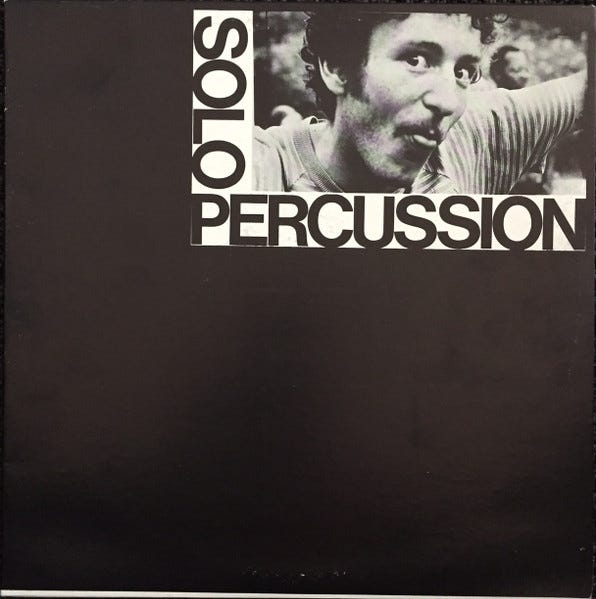
From the album, here is Cosmic Piece:
You can also watch him perform this piece live in 2011 in this video:
Or I encourage you to listen to the entire Solo Percussion album here - it is a masterpiece. Sometime before the release of the album, he legally changed his name to Cleve Pozar. About the album, Pozar recalled:
If I ever reissue Solo Percussion, it's going to be called Before Synth, because it was before [synthesizers] and everything that I did, I had to do the hard way, man. I had a 14-foot van that when I did it live in concert, my roadie was in the van, my son was in the van and the marimba bars were rolled up between the driver's seat and the other seat and my son sat on the marimba bars. The rest of the van was totally packed: It took us a half a day to set up and mix.
Pozar eventually returned to New York in the mid-1980s. As far as I can tell, Pozar passed away in April 2019, as documented here.
Here’s one more for the road. After he graduated from college, Bob James brought ESP-Disk a master of a session he had produced with Pozar and bassist Barre Phillips, and also included tape collages by composers Gordon Mumma and Robert Ashley. It was recorded at Bell Sound Studios in New York City during May 1965. ESP-Disk released it later that year as Explosions. James chose for the front cover a torn poster he had photographed on a visit to Australia.
In 1974, after recording several gold records, James returned to visit ESP-Disk on the ground floor at 290 West End Avenue in New York City. Lounging in a swing-back leather chair, he commented that he thought Explosions, the second album by the Bob James Trio, was the best one he had ever made.
The album features two Ashley songs, Untitled Mixes, and the wonderfully unhinged piece Wolfman, which had a liberating effect on the young Pop musicians. It premiered at the 1964 ONCE festival and was something of a reputation maker for Ashley. It also could be considered a precursor and battle cry of punk, an essential source code for the genres of noise and power electronics:
That Big River called Jazz is deep and wide, with many back channels. Sometimes it’s good to get out of the current of the main channel and explore some of the hidden, more secluded waters that flow through the side chutes and sloughs. Bob James worked these waters first, before he hit it big on the main river…
Next week on that Big River called Jazz, we’ll dig our paddles into the waters of the second of three parts on Tina Marsh and the Creative Opportunity Orchestra.
Please hit this link to buy me a cup of coffee if you’d like to show your guide some appreciation for this and past journeys. Know in advance that I thank you for your kindness and support.
If you like what you’ve been reading and hearing so far on our journey and would like to share this with someone you think might be interested in learning more about our great American art form, Jazz, just hit the “Share” button.
From Astaire to Sun Ra: A Jazz Journey is a reader-supported publication. To subscribe, please hit the “Subscribe now” button.
Feel free to contact me at any time to talk shop. I welcome and encourage that.
Until then, keep on walking….
A lot to unpack here. I was not a Bob James fan at all until I heard one of the earlier albums; then I thought of something George Benson said after he started making hit records: “You want me to make another jazz album? Give me a million dollars.”
I love Ann Arbor. I worked there mid-00s, during which time I saw Alice Coltrane with her son Ravi, Charlie Hayden and Roy Haynes. I also saw the Royal Shakespeare production of The Tempest with Patrick Stewart. Neither show cost more than five bucks. Go Blue.